The International Space Station (ISS), humanity’s orbiting outpost, is about to receive a much-needed boost. NASA and SpaceX are on the cusp of launching the SpaceX Crew-12 Mission, an urgent endeavor designed to restore the station’s full operational capacity after an unexpected period of understaffing. This critical mission underscores the resilience of international space partnerships and the vital role of commercial spaceflight in maintaining a continuous human presence in low-Earth orbit.
The Urgent Call to Orbit: Why Crew-12 Matters
For weeks, the International Space Station has been operating with a skeletal crew of just three individuals: NASA astronaut Chris Williams and Roscosmos cosmonauts Sergey Mikaev and Sergey Kud-Sverchkov. This uncharacteristically lean team has been shouldering the workload since mid-January, following the unforeseen early return of the Crew-11 astronauts. Their premature departure was prompted by an undisclosed medical issue affecting an unidentified crew member.
NASA Administrator Jared Isaacman commended the rapid response of the teams involved in the safe return of Crew-11, highlighting the importance of rigorous training for such contingencies. The returning Crew-11 — which included NASA’s Zena Cardman and Mike Fincke, JAXA’s Kimiya Yui, and Roscosmos’s Oleg Platonov — splashed down off the coast of California. All four were medically evaluated before appearing at a news conference, where Fincke emphasized that their handling of the “unforeseen operation” bodes well for future exploration.
The understaffed situation created an urgent need for the SpaceX Crew-12 Mission. While the ISS has historically operated with smaller crews, NASA now aims for a robust seven-person staff. This ensures maximum productivity and the continuation of crucial scientific research. The agency, which contracts SpaceX for astronaut transport, had sought to expedite the Crew-12 launch. However, initial launch windows on Wednesday and Thursday were forfeited due to unfavorable weather conditions along the rocket’s flight path.
Meet the Elite Crew of Crew-12
The SpaceX Crew-12 Mission will carry an international quartet of seasoned and new astronauts, ready to embark on an eight-month tenure aboard the orbiting laboratory. This diverse crew embodies the spirit of global collaboration in space exploration.
Jessica Meir: Commander with a Rich History
Leading the mission as spacecraft commander is NASA astronaut Jessica Meir, making her second journey to space. A marine biologist by training, Meir is celebrated for her participation in the groundbreaking first all-woman spacewalk in 2019 during her initial space mission, Expedition 61/62. Originally from Caribou, Maine, Meir brings a wealth of scientific expertise to the ISS. This mission holds a new personal dimension for Meir, who now has a husband and a 3-year-old daughter. She reflected that while she was reluctant to return home after her first seven-month stint, this time her feelings might be “a little bit different.” She hopes her work will be “exciting enough, important enough, noteworthy enough” for her daughter to appreciate one day.
Jack Hathaway: Pilot with a Distinguished Naval Career
Serving as pilot for his inaugural spaceflight is NASA astronaut Jack Hathaway. A decorated Navy pilot, Hathaway boasts an impressive career, accumulating 2,500 flight hours across 30 aircraft and undertaking 39 combat missions. His extensive background in naval aviation and two master’s degrees provide a strong foundation for the complexities of spaceflight. Hathaway was selected as an astronaut candidate in December 2021, marking his ascent to space exploration.
Sophie Adenot: Europe’s Pioneering Mission Specialist
Representing the European Space Agency (ESA) on her first spaceflight is Sophie Adenot. An engineer with a master’s degree in human factors engineering from MIT, Adenot previously worked at Airbus Helicopters. She later joined the French Air Force, serving as a helicopter pilot for search-and-rescue and government transport missions, and graduated as a helicopter test pilot. Selected as an ESA astronaut candidate in 2022, Adenot is the first from her class to be assigned to a long-duration ISS mission, with her ESA mission named “εpsilon.”
Andrey Fedyaev: Roscosmos Veteran of Crew Dragon
The final crew member is Roscosmos cosmonaut Andrey Fedyaev, who is undertaking his second spaceflight. A former Russian Air Force pilot, Fedyaev was selected as a cosmonaut in 2012. He previously flew to the ISS aboard Crew-6 in March 2023, making him the second Russian cosmonaut to travel on a SpaceX Crew Dragon spacecraft. Fedyaev’s assignment to Crew-12 came after a notable change in December 2025, when he replaced Oleg Artemyev, reportedly due to Artemyev’s “transition to another job,” amid unconfirmed reports of an ITAR violation involving photographs of SpaceX technologies. Fedyaev’s prior experience with the Crew Dragon facilitated a smoother training integration for the expedited mission.
Launch Details: Falcon 9 and Crew Dragon Freedom
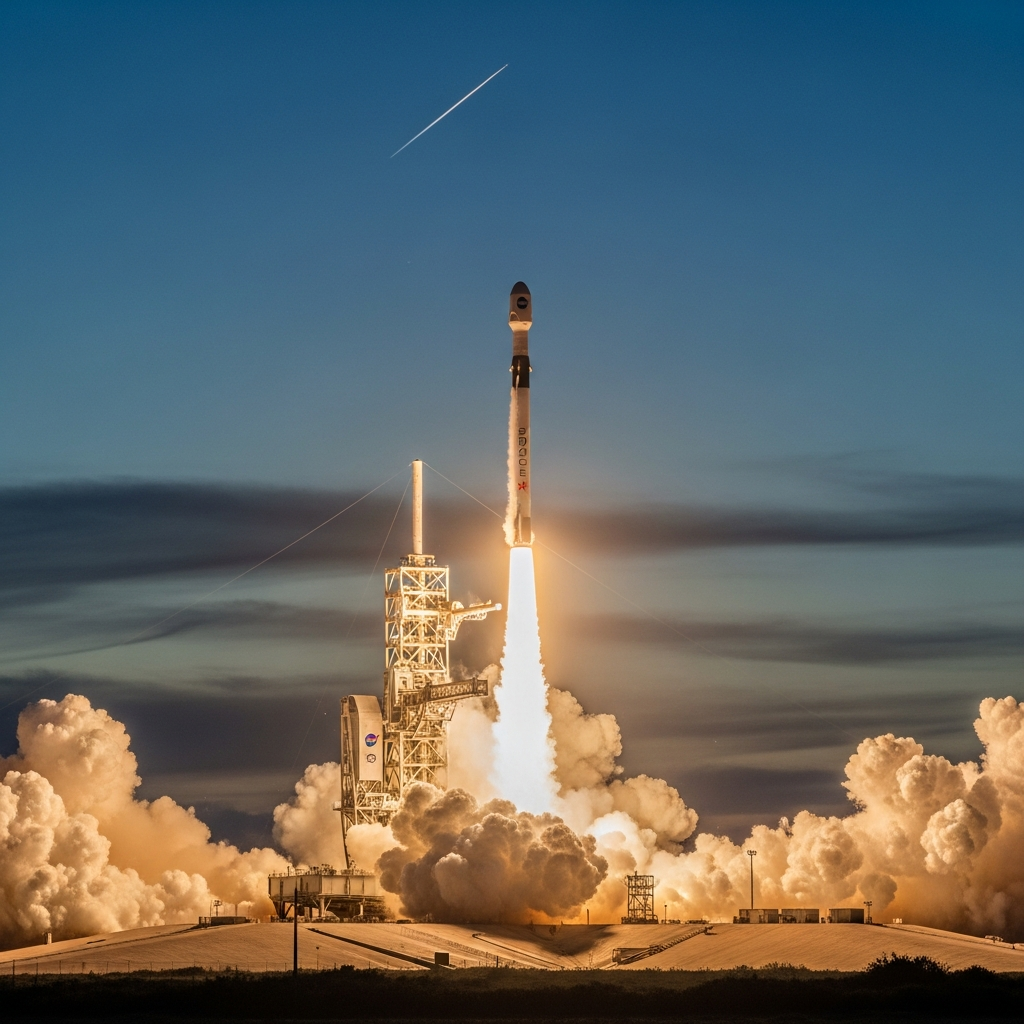
The SpaceX Crew-12 Mission is targeted for liftoff no earlier than 5:15 a.m. ET on Friday, February 13, 2026. This early morning launch will originate from Space Launch Complex 40 (SLC-40) at Cape Canaveral Space Force Station in Florida. The launch was initially scheduled for earlier in the week but was delayed due to elevated winds. NASA currently reports an 85% favorable weather forecast for the Friday launch, with cumulus clouds being the primary concern.
A SpaceX Falcon 9 rocket will propel the Crew Dragon Freedom into orbit. This mission marks a significant milestone for SpaceX, as the Falcon 9 in its Block 5 configuration will be undertaking its 600th mission overall and its 17th of 2026. Following stage separation, the Falcon 9’s first stage booster (B1101) is slated to perform a return-to-launch-site landing at the brand-new Landing Zone 40 (LZ-40), located adjacent to the launch pad, which promises faster recovery operations.
The Crew Dragon C212 Freedom itself is a veteran, embarking on its fifth flight to space after a 503-day turnaround from its last mission, Crew-9. The capsule was aptly named by the Crew-4 astronauts to celebrate human freedom and honor the historic Freedom 7 mission. Prior to launch, the Crew-12 astronauts completed a dress rehearsal on February 9, donning their SpaceX spacesuits and departing from the Neil A. Armstrong Operations and Checkout Building. All four astronauts are currently in quarantine at NASA’s Kennedy Space Center as part of their essential pre-launch health protocols.
After approximately a 10-hour journey, the Dragon spacecraft is expected to dock with the International Space Station at 3:15 p.m. ET on Saturday, February 14. Hatches between the Dragon capsule and the ISS are anticipated to open shortly after 5 p.m. ET on the same day, marking the official welcome of the new crew.
A Crucial Boost for Science and Maintenance
The arrival of the Crew-12 astronauts is eagerly anticipated, especially given the lack of a direct handover period with the departing Crew-11. Normally, incoming and outgoing crews overlap for several days, allowing for in-orbit orientation. Due to Crew-11’s emergency departure, this wasn’t possible. However, Jessica Meir confirmed that the Crew-12 team was able to exchange critical information with their Crew-11 counterparts on the ground, ensuring a smoother transition.
Maximizing the value and productivity of the football field-sized ISS, which costs approximately $3 billion annually to operate, is a key priority for NASA. An understaffed station inevitably limits the amount of novel research that can be conducted. NASA Administrator Jared Isaacman has repeatedly emphasized the importance of pioneering research on the orbiting laboratory as a pathway to future commercial space stations.
During their roughly eight-month stay, the Crew-12 astronauts are slated to undertake an array of vital research projects. These include:
Physiological Studies: Ultrasound scans of their blood vessels to investigate changes in circulation in microgravity.
Pharmaceutical Research: Investigations into bacteria that cause pneumonia, aiding in the development of new treatments.
Life Support Systems: Experiments on on-demand intravenous fluid generation and automated plant health monitoring.
Future Exploration: A simulated lunar landing effort designed to assess how abrupt changes in gravity affect the human body and cognitive functions.
- Biological Interactions: Studies on the interactions between plants and nitrogen-fixing microbes.
- www.floridatoday.com
- www.foxweather.com
- www.nasaspaceflight.com
- www.wabi.tv
- www.nasa.gov
Beyond scientific endeavors, the crew will perform essential maintenance on the 27-year-old orbiting laboratory, including potential spacewalks. The mission will also see the arrival and departure of several other spacecraft, including Soyuz missions (MS-29 incoming, MS-28 departing) and uncrewed cargo missions like SpaceX Cargo Dragon, Northrop Grumman Cygnus XL, and Roscosmos Progress.
The Broader Vision: NASA’s Commercial Crew Program & Future Exploration
The SpaceX Crew-12 Mission is the 12th human science expedition to the ISS under NASA’s Commercial Crew Program. This innovative partnership, which contracts American private companies like SpaceX for astronaut and cargo transport, is a cornerstone of NASA’s strategy. By leveraging private sector capabilities for routine access to low-Earth orbit, NASA can concentrate its resources and efforts on more ambitious endeavors, such as the Artemis lunar program and future crewed voyages to Mars. This mission further underscores the program’s success and reliability, marking the 13th human spaceflight mission to the ISS supported by a Dragon spacecraft since 2020.
NASA’s long-term vision includes the development of multiple commercial space stations in low-Earth orbit to eventually replace the aging ISS. As Isaacman stated, “in order for that to be a financially viable model, we have to absolutely maximize the remaining life of the International Space Station — get the highest potential science and research to the space.” The ongoing scientific work conducted by missions like Crew-12 is therefore directly paving the way for a sustainable commercial space economy.
In related news, while the Crew-12 mission proceeds, NASA recently announced a delay for the Artemis II moon rocket mission, pushing its launch from February to March. This delay followed issues with a critical fuel test, including a liquid hydrogen leak and unexpectedly cold temperatures caused by an Arctic outbreak in Florida. These separate challenges highlight the multifaceted complexities of space exploration, from maintaining orbital outposts to venturing back to the Moon.
Frequently Asked Questions
Why was the SpaceX Crew-12 mission expedited?
The SpaceX Crew-12 Mission was expedited due to an unforeseen medical issue that forced the early return of the Crew-11 astronauts in mid-January. This left the International Space Station (ISS) with a reduced crew of only three individuals. NASA typically prefers a robust seven-person staff to maximize scientific research and operational efficiency. The urgent launch of Crew-12 aims to restore the ISS to its full staffing levels and ensure continuous productivity.
Where can I watch live coverage of the SpaceX Crew-12 launch and docking?
Live coverage of the SpaceX Crew-12 Mission launch and docking will be extensively provided by both NASA and SpaceX. NASA’s coverage will be available on its streaming app (NASA+), YouTube channel, X account, and Amazon Prime. SpaceX will also offer a livestream on its website, X, and the X TV mobile app. Launch coverage begins at 3:15 a.m. ET on Friday, February 13, leading up to the 5:15 a.m. ET liftoff. Docking coverage for the ISS arrival begins at 1:15 p.m. ET on Saturday, February 14.
What kind of scientific research will the Crew-12 astronauts conduct on the ISS?
During their eight-month stay on the International Space Station, the Crew-12 astronauts are slated to perform a wide array of scientific research projects. These include ultrasound scans of their blood vessels to study changes in circulation in microgravity, and pharmaceutical research related to pneumonia-causing bacteria. They will also investigate automated plant health monitoring, and interactions between plants and nitrogen-fixing microbes. Furthermore, the crew will conduct a simulated lunar landing experiment to assess how abrupt changes in gravity impact the human body and cognition, contributing to future deep space exploration.
Conclusion: Charting a Course for Continuous Discovery
The SpaceX Crew-12 Mission represents a pivotal moment in the ongoing saga of human space exploration. It is a testament to the agility and dedication of NASA, SpaceX, and their international partners to overcome unforeseen challenges and ensure the continuous operation and scientific output of the International Space Station. With a highly skilled and diverse crew poised for launch, this mission will not only restore critical staffing levels but also drive forward groundbreaking research essential for our understanding of space and for paving the way to future commercial space stations and deep-space missions. As humanity reaches further into the cosmos, the collaborative efforts embodied by Crew-12 underscore our collective commitment to discovery and innovation.