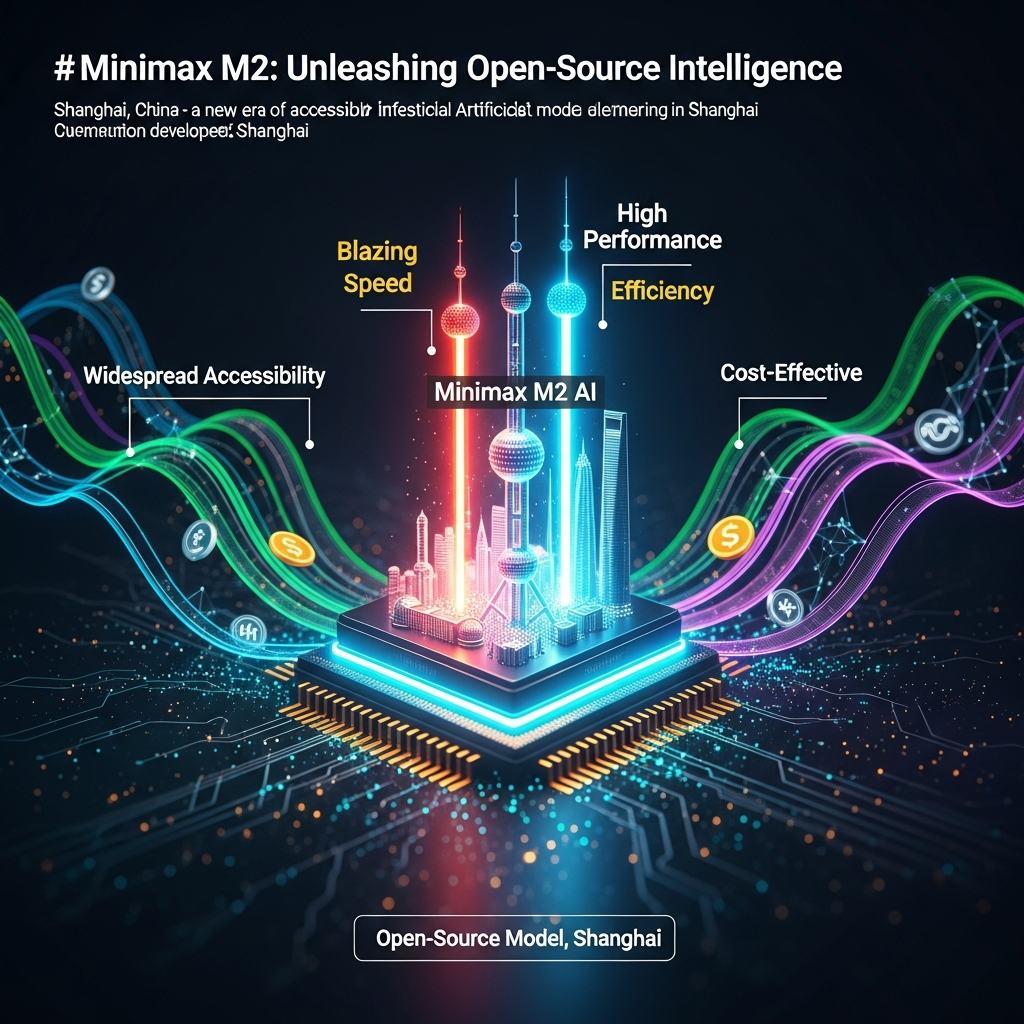
The landscape of artificial intelligence is constantly evolving, with new innovations regularly challenging established norms. Today, a new contender from Shanghai, Minimax M2 AI, is redefining what’s possible in the open-source large model arena. This groundbreaking model isn’t just turning heads; it’s delivering state-of-the-art performance, blazing-fast inference speeds, and unprecedented cost-effectiveness. Minimax M2 is poised to democratize access to advanced AI, offering capabilities that rival top proprietary models at a mere fraction of their cost. This isn’t just an upgrade; it’s a game-changer for developers, businesses, and the entire AI community.
Unveiling the Minimax M2: A Paradigm Shift in Open-Source AI
For years, the AI industry grappled with an “impossible triangle”: the challenge of simultaneously achieving high intelligence, rapid speed, and low cost. Traditional models often forced a compromise, sacrificing one for the sake of the others. The Minimax M2 AI model has now shattered this long-standing barrier. It emerges as a new leader, effectively ending the previous dominance held by other Hangzhou-based models like DeepSeek and Qwen. Upon its release, Minimax M2 garnered immediate attention and orders, primarily due to its unique combination of high performance and exceptionally low cost, offering one million tokens for an astonishing 8 RMB (approximately $1.1 USD).
This breakthrough is a significant stride towards making sophisticated AI more accessible. For developers and researchers, it means powerful tools are now within reach without prohibitive expenses. For businesses, it translates to enhanced capabilities and efficiency gains at a scale previously unimaginable.
The Engine Beneath the Hood: M2’s Innovative MoE Architecture
At the heart of Minimax M2 AI‘s efficiency lies its sophisticated Mixture of Experts (MoE) architecture. This technical marvel sets it apart from many conventional large language models. While the M2 boasts a substantial 230 billion total parameters, its intelligent design ensures that only about 10 billion parameters are actively engaged during any given inference.
This “sparse activation” design is critical. It dramatically reduces computational demands, significantly lowers memory pressure, and improves “tail latency” during complex operations. Such efficiency is paramount for demanding agentic workflows, enabling more concurrent runs in critical tasks like continuous integration (CI), browser interactions, and retrieval chains. This clever engineering allows M2 to deliver high-performance solutions that are both practical and remarkably affordable.
Performance Benchmarks: Rivaling the Best, Affording the Rest
The Minimax M2 AI model is not just cost-effective; it’s a top-tier performer. In rigorous tests conducted by Artificial Analysis, a respected third-party evaluation institution, M2 scored an impressive 61 points. This achievement positions it as the first among open-source models, closely trailing advanced proprietary models like Claude 4.5 Sonnet.
The model’s competitive edge is further highlighted by its operational metrics:
Cost-Efficiency: M2’s API price is only 8% of Claude 3.5 Sonnet’s, making advanced AI dramatically more affordable.
Blazing Speed: Its inference speed is reportedly twice that of Claude 3.5 Sonnet, accelerating development and deployment.
Detailed Benchmarks: M2 achieved strong scores in developer-centric evaluations, including 46.3 on Terminal Bench, 36.2 on Multi SWE Bench, 44.0 on BrowseComp, and 69.4 on SWE Bench Verified.
These figures underscore Minimax M2’s superior cost-effectiveness and speed-based performance against competitors. Comparative analyses by Minimax illustrate a high “Win + Tie” ratio against models such as Claude Sonnet 4.5, GLM 4.6, Kimi – K2, and DeepSeek V3.2, all at a significantly lower operational cost.
Designed for Action: Agents, Coding, and Interleaved Thinking
Minimax M2 AI is explicitly engineered for practical applications, particularly excelling in agents and programming. It leverages an “interleaved thinking format,” a crucial element for complex Agent reasoning. This unique design allows the model to plan and verify steps across multiple conversations, mimicking a more human-like problem-solving approach. The model’s internal reasoning is structured within specific
Built for end-to-end development workflows, M2 showcases exceptional planning and stable execution for complex, long-chain tool invocation tasks. It supports a wide array of tools, including Shell, browsers, Python code interpreters, and various MCP tools. In key Agent capabilities—programming, tool usage, and deep search—M2 is comparable to top overseas models in tool usage and deep search, while its programming ability ranks among the best in China. This focus makes M2 an invaluable asset for developers building sophisticated AI applications.
Open-Source Commitment and Developer Accessibility
Minimax has demonstrated a strong commitment to the open-source community by making the complete weights of the Minimax M2 AI model publicly available under the MIT license on Hugging Face. This move fosters transparency, encourages innovation, and invites global collaboration. The online Agent platform and API are currently available for free for a limited time, providing an excellent opportunity for developers to explore its capabilities firsthand.
Deployment guidance for platforms like vLLM and SGLang, alongside an Anthropic-compatible API, further underscores its readiness for practical application within the developer community. This open approach differentiates Minimax M2, positioning it as a robust foundation for future AI projects. Compared to its predecessor, Minimax M1, M2 features a more compact design, a Sparse MoE, and a primary focus on agent and code-native workflows, marking a significant evolution in its capabilities and accessibility.
Beyond Text: Minimax M2’s Multimodal Vision and Ecosystem
Minimax’s vision extends beyond traditional text-based AI. The company is explicitly committed to advancing Artificial General Intelligence (AGI)—AI systems capable of performing a broad spectrum of tasks autonomously. To achieve this, the Minimax M2 AI model incorporates multimodal capabilities. This allows it to process and interpret diverse data types, including text, audio, images, video, and even music. This versatility positions M2 for a wide range of applications, from creative content generation to complex data analysis.
M2 is an integral part of a comprehensive Minimax ecosystem that includes tools such as Miniax Agent, Helio AI, Talki, and Miniax Audio. This extensive ecosystem serves a substantial global user base, encompassing over 157 million users across more than 200 countries and over 50,000 companies. Its multimodal capabilities make it highly adaptable across various industries:
Software Engineering: Automates coding tasks, debugging, and optimizes development workflows.
Customer Service: Enhances interactions through advanced AI-driven chatbots and virtual assistants.
Creative Industries: Enables the generation of high-precision content, including music, videos, and written materials.
- Data Analysis: Processes and interprets complex datasets to derive actionable insights.
- eu.36kr.com
- www.marktechpost.com
- www.geeky-gadgets.com
A unique and innovative aspect of M2 is its capacity for self-testing and iterative improvement. The model can independently create, test, and refine its own outputs over time. An illustrative example of this is its successful development and optimization of a fully functional Tetris game without any external human input. This feature not only enhances its practical utility but also ensures its adaptability and reliability in dynamic environments, setting a new benchmark for AI development.
A Deeper Dive: Minimax M2’s Attention Mechanism Choice
Interestingly, the Minimax NLP team chose a full attention mechanism for M2, diverging from some contemporary trends. While initial observations suggested a mixed attention approach, they found that introducing sliding window attention (SWA) during pre-training led to a performance loss. This finding was echoed by the Falcon team during their model training, contradicting some research suggesting SWA improves efficiency without performance degradation (e.g., Mistral, Google Gemma). Minimax’s tests indicated SWA’s limitations in long-range dependency tasks. Similarly, M2 did not adopt Lightning Attention due to performance loss, despite some papers advocating for linear attention in long-sequence tasks. This demonstrates Minimax’s practical, performance-driven approach, prioritizing tested results over academic trends to ensure M2 meets its high standards.
Frequently Asked Questions
What is the “impossible triangle” that Minimax M2 has reportedly broken?
The “impossible triangle” refers to the long-standing challenge in AI development where achieving high intelligence, rapid inference speed, and low operational cost simultaneously was deemed unattainable. Traditionally, AI models had to compromise on one or more of these aspects. The Minimax M2 AI model has reportedly overcome this by combining its innovative Sparse Mixture of Experts (MoE) architecture with optimized design choices, delivering Claude-level performance at 8% of the cost and twice the speed. This breakthrough makes advanced AI both powerful and economically viable.
Where can developers access Minimax M2 and its associated tools?
Developers can access the Minimax M2 AI model primarily through its open-source release on Hugging Face, where its complete weights are available under the MIT license. Minimax also provides an online Agent platform and API, which are currently offered for free for a limited evaluation period. The platform supports deployment guidance for popular frameworks like vLLM and SGLang, and features an Anthropic-compatible API, making integration into existing workflows straightforward for the developer community.
How does Minimax M2’s cost-effectiveness and speed benefit developers and businesses?
Minimax M2 AI‘s exceptional cost-effectiveness and speed offer significant benefits to developers and businesses. Its low API price (8% of Claude Sonnet) and double inference speed mean that complex AI tasks can be performed more frequently, efficiently, and at a much lower operational cost. For developers, this democratizes access to state-of-the-art AI, fostering innovation without budget constraints. Businesses can leverage M2 to automate more processes, enhance customer service, accelerate creative content generation, and gain deeper insights from data, all while achieving a higher return on investment for their AI initiatives.
Conclusion: The Future is Open, Fast, and Affordable
The emergence of Minimax M2 AI marks a pivotal moment in the evolution of artificial intelligence. By successfully breaking the “impossible triangle” of intelligence, speed, and cost, Minimax has set a new benchmark for open-source models. Its innovative MoE architecture, agent-centric design, and unwavering commitment to openness promise to empower developers and businesses worldwide.
From its top-tier performance in critical benchmarks to its multimodal capabilities and comprehensive ecosystem, Minimax M2 is more than just a new model; it’s a testament to the future of AI—a future that is accessible, efficient, and transformative. As we move closer to Artificial General Intelligence, tools like Minimax M2 will undoubtedly play a crucial role in shaping the next generation of intelligent systems. Explore Minimax M2 today and experience the dawn of truly democratized AI.