China’s artificial intelligence ecosystem is rapidly accelerating, routinely pushing the boundaries of what’s possible in AI development. The recent launch of Minimax M2.5, a powerful new large language model (LLM), highlights this dynamic shift. Minimax M2.5 has already captured global attention for surpassing leading US models like OpenAI’s GPT-5.2 and Google’s Gemini 3 Pro on critical industry benchmarks, particularly in software engineering and complex reasoning tasks. This breakthrough signals a profound evolution in the global AI landscape, showcasing China’s formidable capabilities and setting new standards for efficiency and performance in advanced AI systems.
Minimax M2.5: Setting New Performance Standards
Minimax, a prominent Chinese AI innovator, has truly made headlines with its latest LLM, the M2.5. This model delivers state-of-the-art (SOTA) performance across several competitive AI evaluations. Key areas where M2.5 excels include software engineering, intricate reasoning, and complex agentic tasks. Importantly, it achieves these high performance levels while maintaining remarkable operational efficiency and impressive scalability.
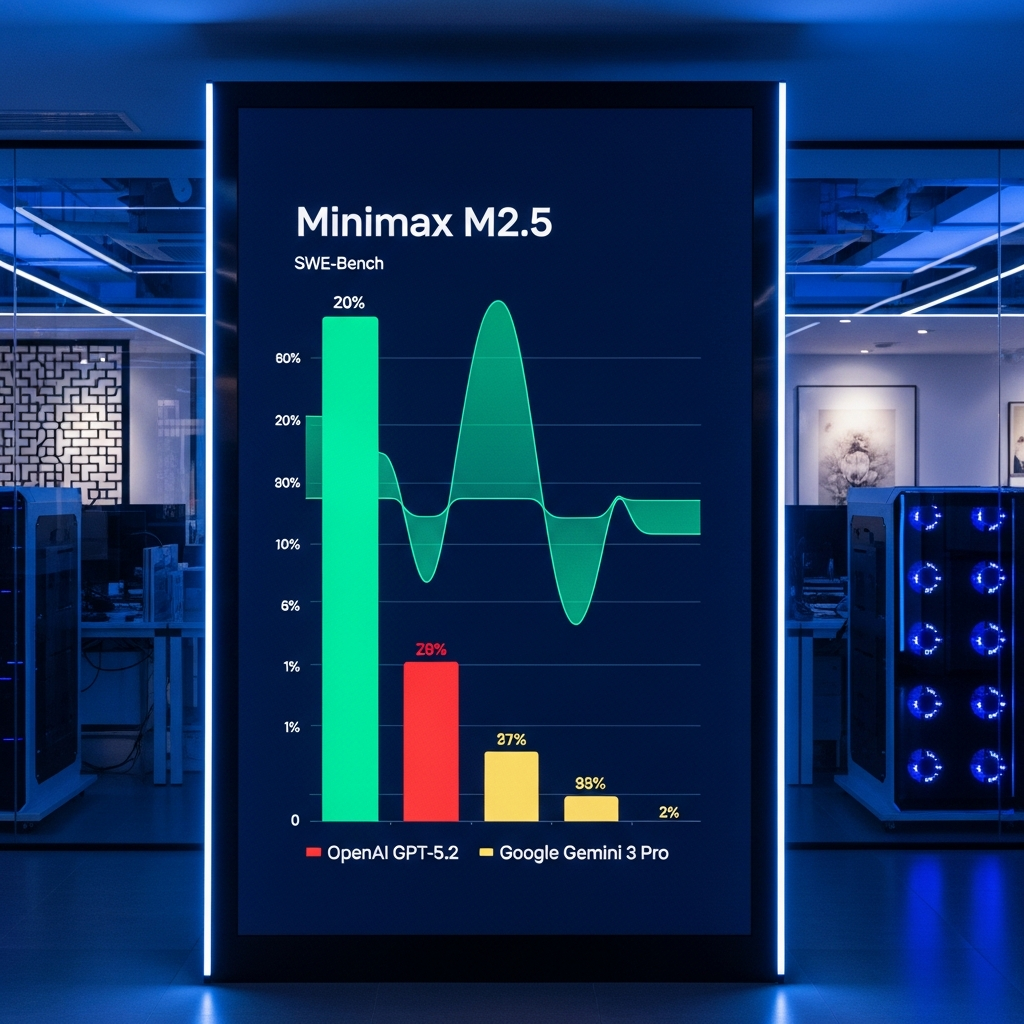
The most compelling evidence of M2.5’s prowess comes from the SWE-Bench Verified coding benchmark. This benchmark is a crucial industry measure for evaluating code generation and software reasoning abilities. On SWE-Bench, Minimax M2.5 achieved an impressive 80.2%. This score notably edged out OpenAI’s GPT-5.2 (80.0%) and Google’s Gemini 3 Pro (78%). It even came exceptionally close to Anthropic’s Claude Opus 4.6, which scored 80.8%. Beyond pure coding, M2.5 also demonstrated leading performance in other practical productivity and agentic evaluation suites. It scored 76.3% on BrowseComp (web search and context), 76.8% on BFCL Multi-Turn (tool-use reasoning), 74.4% on MEWC (multi-expert workflow coordination), and 54.2% on VIBE-Pro (office productivity).
Unmatched Efficiency and Scalability
A standout feature of Minimax M2.5 is its remarkable efficiency. Minimax claims that M2.5 executes complex tasks 37% faster than its predecessor. This speed enhancement combines with an enterprise-ready throughput. The model reportedly operates at a cost of just $1 per hour, handling 100 transactions per second (TPS). This cost-efficiency represents a significant breakthrough for scalable, long-horizon AI agents. It enables continuous, low-cost execution for highly complex workflows. Examples include advanced research assistants, sophisticated customer service automation, and even comprehensive software maintenance.
The Rapid Ascent of Chinese AI Innovation
The release of Minimax M2.5 is not an isolated event but rather part of a broader, rapid ascent of Chinese AI. A longitudinal comparison vividly illustrates Minimax’s accelerated progress. Over the past year, its M-series models dramatically climbed from 56% on SWE-Bench Verified (M1) to 80.2% with M2.5. This rate of improvement has notably outpaced the steady advancements seen from leading US labs like OpenAI, Anthropic, and Google.
This fierce competition is becoming the new norm. Just prior to M2.5’s unveiling, Chinese company Z.ai released GLM-5. That model had already outperformed Google’s flagship Gemini 3 Pro on the Artificial Analysis Intelligence Index. Minimax’s M2.5 now further cements this trend by outperforming both Google and OpenAI’s top models on a popular coding benchmark. This consistent high performance from multiple Chinese entities underscores a significant shift in the global AI power balance.
Mastering “Interleaved Thinking” for Agentic AI
A key driver behind these advancements, particularly in agentic tasks, is the sophisticated capability known as “interleaved thinking.” This innovative approach allows models to reflect on results between tool calls, closely mimicking human problem-solving processes. This deep reflective ability is crucial for handling complex, multi-step challenges. It empowers AI agents to reason coherently across hundreds of steps.
For instance, Moonshot AI’s Kimi K2 Thinking model, another prominent Chinese LLM, also showcases impressive interleaved thinking. It can execute 200-300 sequential tool calls autonomously. This capability makes models highly effective for deep research, multi-step coding projects, and combined web browsing and analysis. Such advancements significantly extend both “thinking tokens” and tool-calling steps, pushing the boundaries of test-time scaling for LLMs. The development of these advanced agentic capabilities in China’s AI models is fundamentally changing how AI can tackle real-world problems.
Challenging the Status Quo: Cost, Openness, and Global Impact
The rise of models like Minimax M2.5 and Kimi K2 Thinking directly challenges several established narratives in the AI world. One critical area is the cost of developing frontier LLMs. While some US companies advocate for trillion-dollar infrastructure deals, Chinese labs are demonstrating powerful innovation with significantly lower reported training costs. Kimi K2 Thinking, for example, was reportedly trained for less than $5 million. This challenges the notion that only deep-pocketed labs can develop cutting-edge LLMs.
Furthermore, Chinese models are integrating efficiency at a foundational level. Kimi K2 Thinking, for instance, ships natively in INT4 precision. It achieves this through quantization-native training, which significantly reduces model size and doubles generation speed. This approach supports non-Blackwell architecture hardware while maintaining state-of-the-art performance. Engineers emphasize that proper INT4 integration enhances latency, minimizes precision loss, and improves long-context reasoning stability. These innovations enable robust performance with greater cost-effectiveness and accessibility.
A Shifting Global AI Power Dynamic
The rapid progress from Chinese AI firms signals a profound shift in the global AI power dynamic. Previously, US companies often dominated mindshare in advanced LLM development. Now, Chinese labs like DeepSeek, Qwen, Minimax, and Moonshot AI are becoming household names. Many of these labs launched their foundation model efforts relatively recently. Yet, some have caught up to the open frontier in performance within just six months. This fast pace offers a considerable advantage in maintaining momentum and public perception of progress.
This proliferation of advanced, often more cost-effective models creates significant pricing pressure on established closed-source labs in the US. While US AI companies maintain strong distribution channels, Chinese models are poised to capture larger slices of the growing international AI market. They are increasingly dominating mindshare, even if not immediately revenue. The combined strengths of rapid innovation, efficiency, and strong benchmark performance from China’s AI sector mean an “interesting 2026” and beyond are certainly on the horizon for the entire artificial intelligence industry.
Frequently Asked Questions
What is the significance of Minimax M2.5’s SWE-Bench performance?
Minimax M2.5 achieved an impressive 80.2% on the SWE-Bench Verified coding benchmark. This is significant because it surpassed OpenAI’s GPT-5.2 (80.0%) and Google’s Gemini 3 Pro (78%), and came very close to Anthropic’s Claude Opus 4.6 (80.8%). This performance highlights Minimax M2.5’s state-of-the-art capabilities in software engineering and complex code generation, positioning it as a leading model globally and demonstrating China’s advanced standing in AI development.
How are Chinese AI models, like Minimax M2.5 and Kimi K2 Thinking, achieving advanced agentic capabilities?
Many leading Chinese AI models leverage “interleaved thinking,” a sophisticated technique allowing the model to pause and reflect on intermediate results between tool calls. This mirrors human problem-solving. This capability enables models like Minimax M2.5 and Kimi K2 Thinking to execute numerous sequential tool calls autonomously, reasoning coherently over hundreds of steps. This makes them exceptionally effective for complex, multi-step tasks such as deep research, multi-step coding, and dynamic web interaction.
What are the broader implications of China’s rapid advancements in AI for the global landscape?
China’s rapid AI advancements, exemplified by Minimax M2.5 and Kimi K2 Thinking, signify a major shift in the global AI power dynamic. These models demonstrate that high-performance, state-of-the-art AI can be developed with impressive efficiency and potentially lower training costs, challenging traditional narratives about exclusive access to advanced AI development. This intense competition fosters faster innovation, puts pricing pressure on established models, and increasingly positions Chinese AI companies to capture significant international market share and mindshare, fundamentally reshaping the future of artificial intelligence worldwide.
The Future of AI: A Global Race
The introduction of Minimax M2.5 serves as a powerful testament to the accelerating pace of AI innovation emanating from China. This model, alongside others like Kimi K2 Thinking, redefines expectations for performance, efficiency, and scalability in large language models. The rapid advancements and benchmark victories highlight a thriving, competitive AI ecosystem that is consistently pushing the boundaries. As Chinese AI continues its formidable ascent, the global artificial intelligence landscape is undoubtedly entering a new era of intense competition and collaborative innovation. This dynamic environment promises unprecedented breakthroughs and transformative applications for users worldwide.