The relentless “grading mountain” has long been a top driver of teacher burnout, pushing passionate educators to the brink. If you’re an educator, you know the feeling: staring at a towering stack of papers on a Sunday night, knowing it all needs to be done by morning. But a quiet revolution is underway in education, offering a powerful lifeline: AI grading. This innovative technology isn’t just a futuristic concept; it’s rapidly becoming an essential partner for teachers looking to reclaim their precious time and rekindle their love for teaching.
Research paints a stark picture of the challenges educators face. An alarming 80% of American educators report feeling burnt out, with one in three young teachers considering leaving the profession entirely. A significant portion of this burnout stems from the sheer administrative load. Teachers dedicate nearly 10 hours weekly to tasks like lesson planning and grading, not to mention paperwork, resource searching, and parent communication. This isn’t just about efficiency; it’s about the sustainability of the teaching profession itself. AI grading tools are emerging as a game-changer, promising to alleviate this burden and empower teachers to focus on what truly matters: their students.
The Unseen Crisis: How Grading Fuels Teacher Burnout
The “grading mountain” isn’t merely a metaphor; it’s a tangible barrier to effective teaching and teacher well-being. Imagine spending hours manually scoring 100 exams, only to find yourself exhausted and with less energy for lesson planning or student engagement. This cycle is unsustainable.
Traditional grading methods are not only time-consuming but also prone to human inconsistencies. Fatigue can lead to oversight, and unconscious biases can subtly influence scores. Moreover, evolving grading policies, such as “No Zero” policies designed to prevent students from giving up, often inadvertently increase teacher workload by requiring endless retakes and re-evaluations. While well-intentioned, these policies, if not carefully implemented, can shift the burden onto teachers, creating more paperwork and less time for meaningful instruction. This is where the power of AI grading for teachers steps in, offering a consistent, unbiased, and incredibly efficient alternative.
AI Grading: More Than Just a Scorekeeper
The integration of artificial intelligence into the classroom marks a significant shift, redefining the roles of both technology and educators. While some might fear AI replacing teachers, experts like Ingrid Guerra-López, Dean of the College of Education and Human Development at George Mason University, argue the opposite: AI won’t replace teachers, but teachers who use AI will transform teaching. Just as calculators didn’t eliminate math teachers, AI is poised to enhance the profession by becoming a powerful classroom assistant.
AI’s potential extends far beyond simple score calculation. It streamlines workflows, provides granular insights into student performance, and frees up valuable time. A recent national survey found that 6 in 10 K-12 teachers are already using AI tools, with weekly users reporting an average saving of approximately six hours per week. This saved time isn’t just about reducing workload; it’s about enabling teachers to invest more in personalized student support, innovative lesson design, and their own professional development.
Your Top Questions on Embracing AI Grading Answered
Making the switch to AI grading can bring up many questions. Here are the most common concerns educators have as they explore this transformative technology:
1. Can AI Tools Accurately Read Messy Handwriting?
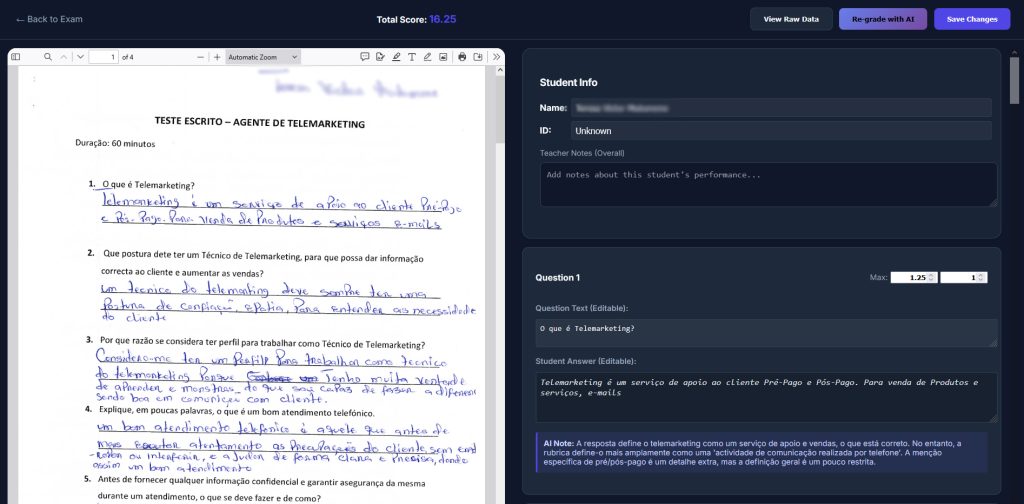
Absolutely. Modern AI leverage advanced Optical Character Recognition (OCR) technology, trained on millions of handwriting samples. This sophisticated AI can accurately interpret scanned paper exams—even those notoriously scribbled ones—and grade them precisely against your customized rubrics. For instance, platforms like QuantoSei Learn are specifically designed to excel at reading scanned PDFs and images, ensuring no student’s effort is overlooked due to illegible penmanship.
2. Is AI Grading as Accurate and Unbiased as a Human?
Yes, often more so in specific contexts. Research indicates that AI systems can achieve a correlation of 0.95 or higher when compared to human scores. Unlike a human working late into the night, AI doesn’t experience fatigue, personal bias, or mood fluctuations. It applies your custom rubrics with unwavering consistency, ensuring every student receives an objective evaluation. While AI excels at “low-level” tasks like grading multiple-choice questions or structured short answers, it’s crucial to remember that human oversight remains indispensable for nuanced evaluations and complex open-ended responses. The goal is to augment, not replace, a teacher’s professional judgment.
3. Does AI Grading Integrate with My Current LMS (e.g., Canvas, Google Classroom)?
Seamless integration is a non-negotiable feature for modern education technology. Leading AI grading platforms are built to work within your existing ecosystem. They allow you to easily import student rosters via CSV files and export grades directly back into your Learning Management System’s gradebook. This eliminates hours of tedious manual data entry, streamlining your administrative tasks significantly.
4. How Secure is Student Data with AI Grading Platforms?
This is arguably the most critical concern, and leading platforms prioritize it. Top-tier AI grading tools are developed with strict compliance to data privacy regulations like FERPA (Family Educational Rights and Privacy Act) and COPPA (Children’s Online Privacy Protection Act). This ensures that student data is rigorously protected, encrypted, and never stored on external servers without explicit consent. Some innovative solutions, like BrightBook, even go a step further by avoiding the collection of student data altogether, relying solely on a teacher’s professional observations and inputs for lesson planning, thereby enhancing privacy.
QuantoSei Learn: Your Intelligent Classroom Partner
While pioneering platforms like Gradescope and ExamAI have set the stage, QuantoSei Learn distinguishes itself by offering a comprehensive suite of tools designed to be a true partner in the classroom. It moves beyond simple scoring, providing educators with deeper insights and expanded functionalities.
| Feature | QuantoSei Learn | Gradescope | ExamAI |
| Handwritten OCR | Advanced; handles scanned PDFs/Images | Strong focus on paper-based | Up to 12,000 pages per upload |
| Quiz Generation | From YouTube, URLs, and PDFs | Limited (mostly template-based) | Focused on exam grading |
| Feedback Style | Detailed, rubric-aligned | AI-assisted grouping | Consistent, unbiased |
| Pricing | Free tier available | Institutional/Basic plans | Free tier + $19/mo Premium |
Beyond Grading: Reclaiming Your Time and Transforming Teaching
AI tools like QuantoSei Learn don’t just grade; they empower. By automating repetitive tasks, they free up crucial hours, allowing you to focus on the human aspects of education.
Bulk Grading in Seconds: Instead of slogging through papers one by one, upload an entire folder of student PDFs. The AI grades them sequentially, providing a full class report while you focus on strategic planning or individualized student support.
Flip Your Classroom with Instant Quizzes: Found a fantastic educational video on YouTube? Paste the link into QuantoSei Learn to instantly generate an interactive quiz that tests student comprehension. This feature streamlines the creation of engaging formative assessments.
Identify Learning Gaps Instantly: Utilize robust performance analytics to pinpoint exactly which questions or concepts the majority of your class struggled with. This data-driven insight eliminates guesswork, allowing you to tailor your re-teaching efforts precisely where they’re needed most.
Streamlined Lesson Planning: Platforms like BrightBook demonstrate AI’s potential to generate fully formed lesson plans, complete with teacher notes, procedural guidance, adaptation strategies for diverse learners, and assessments mapped to state standards—all in less than 60 seconds. This significantly reduces the 10 hours teachers typically spend on planning each week.
Enhanced Parent Communication: AI can even assist with administrative tasks like drafting templates for parent communications, ensuring clear and consistent messaging.
Navigating AI’s Impact on Students and Critical Thinking
While AI offers immense benefits for educators, responsible implementation is key, especially concerning student learning. A significant concern among educators is the potential for students to overuse AI, which could diminish their critical thinking and problem-solving abilities. Nearly half of teachers worry that students’ reliance on AI will decrease their ability to think independently.
However, this isn’t an indictment of AI itself, but a call for mindful integration. Teachers have a vital role in modeling responsible AI use, guiding students to use it as a tool for scaffolding their thinking, not outsourcing it. Students must learn discernment—knowing when and when not to use AI, how to evaluate its accuracy and potential biases, and how to ask the right questions rather than merely generating answers. By integrating AI thoughtfully, educators can prepare students for a future where such tools are commonplace, fostering both digital literacy and critical engagement.
Frequently Asked Questions
What specific teacher tasks can AI grading truly automate to reduce burnout?
AI grading tools can significantly automate repetitive, time-consuming tasks such as scoring multiple-choice questions, evaluating rubric-based short answers, providing consistent feedback, and even generating quizzes from existing content. By taking over these “low-level” grading and administrative tasks, AI frees up educators from hours of manual work, allowing them to focus on lesson planning, individualized student support, and deeper classroom engagement. The ability to instantly identify learning gaps and generate performance reports further streamlines a teacher’s workload.
How does AI grading ensure student data privacy and comply with educational regulations?
Leading AI grading platforms prioritize student data privacy by building their systems with strict adherence to regulations like FERPA and COPPA. This involves implementing robust encryption, secure data storage practices, and clear policies that prevent student data from being shared or stored without consent. Some innovative solutions even avoid collecting student data directly, instead relying on teacher inputs and observations, thereby enhancing privacy and trust within the educational ecosystem.
What are the main advantages of using a platform like QuantoSei Learn compared to traditional grading methods?
QuantoSei Learn offers several key advantages over traditional grading methods, primarily by drastically reducing the time spent on administrative tasks. It provides advanced OCR for grading handwritten exams, generates quizzes instantly from various sources, and offers detailed, rubric-aligned feedback consistently. Unlike manual grading, it eliminates human bias and fatigue, ensuring every student is evaluated fairly. This efficiency allows teachers to reclaim valuable hours (potentially 10+ hours a week), which can then be redirected towards personalized instruction, professional development, and meaningful student interaction.
The Future of Learning is Here
The ultimate goal of incorporating AI into education is not to replace the irreplaceable human element of teaching, but to replace the overwhelming paperwork. By taking on the repetitive, often soul-crushing administrative tasks, AI grading for teachers empowers educators to spend more time doing what they love: inspiring, mentoring, and directly engaging with their students.
The era of grading burnout can end. It’s time to stop grading and start teaching.
Create Your First AI-Powered Quiz for Free at QuantoSei Learn