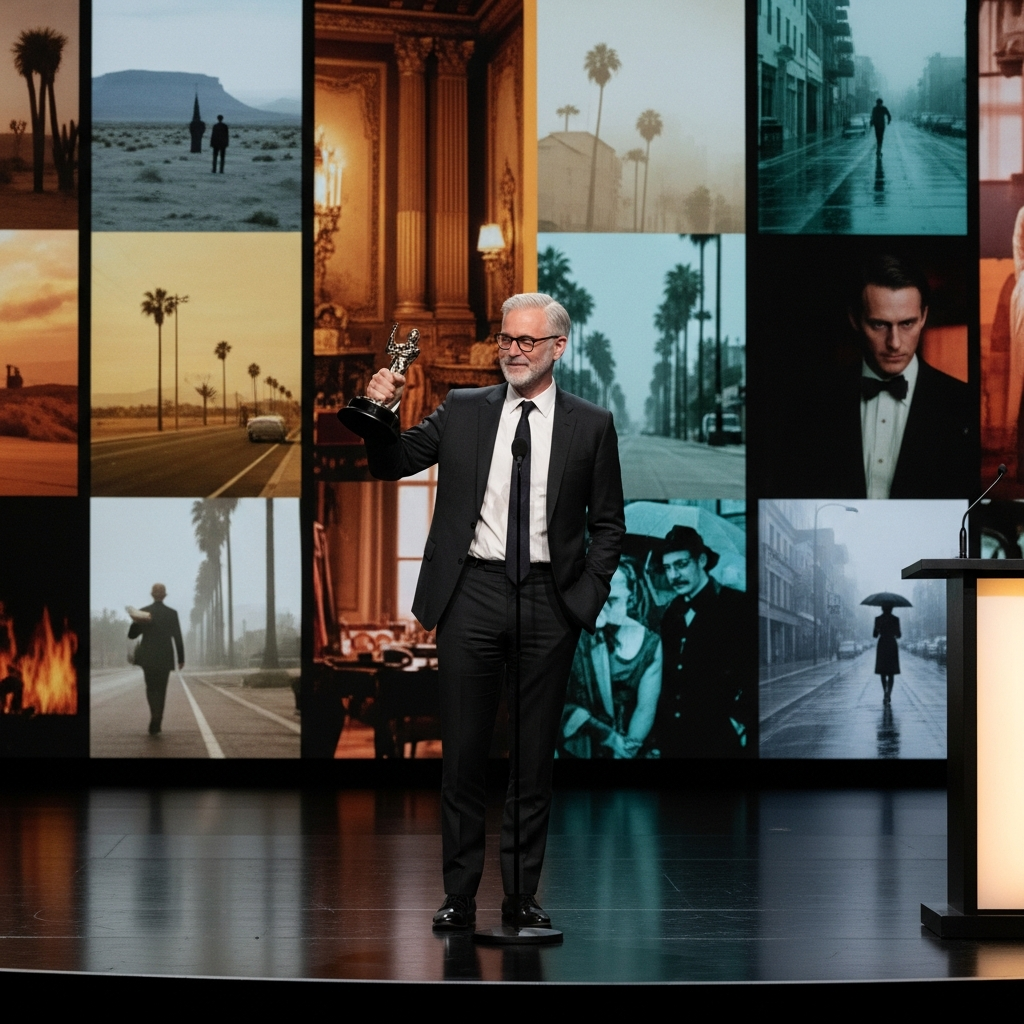
The 2026 awards season just saw a seismic shift. Esteemed filmmaker Paul Thomas Anderson clinched the Directors Guild of America’s (DGA) top honor for his latest cinematic triumph, “One Battle After Another.” This monumental victory, announced at the DGA Awards on Saturday, February 7, 2026, positions Anderson as a formidable frontrunner for the highly coveted Best Director Oscar. The DGA Award is a crucial bellwether, boasting an almost uncanny ability to predict Academy Award success, setting the stage for an electrifying conclusion to the cinematic year.
Paul Thomas Anderson’s Historic DGA Victory
Paul Thomas Anderson’s win for Outstanding Directorial Achievement in Theatrical Feature Film marks a significant milestone in his illustrious career. This is Anderson’s first DGA Award win, following previous nominations for acclaimed films like “Licorice Pizza” in 2021 and “There Will Be Blood” in 2007. His acclaimed work on “One Battle After Another” resonated deeply with the Guild’s members, showcasing his mastery of storytelling and directorial vision. The ceremony, held at the opulent Beverly Hilton, became a testament to his profound impact on contemporary cinema.
The DGA Award is widely considered one of the most reliable predictors of the Best Director Oscar. Historically, it has foreshadowed the Academy Award winner in all but eight instances since its inception in 1948. More strikingly, the DGA Theatrical Feature win and the Best Director Oscar have aligned perfectly for the past five consecutive years. This robust predictive power makes Anderson’s victory for “One Battle After Another” a powerful indicator of his likely success at the upcoming Academy Awards. Industry experts and fans alike are now watching the Oscar race with renewed intensity.
A Poignant Acceptance Speech Reflecting Art and Loss
Paul Thomas Anderson’s acceptance speech was a memorable highlight of the evening. He began with a humorous nod to DGA President Christopher Nolan. Then, Anderson offered profound insights into the art of filmmaking. He described it as a “cosmic thing” and an “addiction,” likening the creative compulsion to themes explored in Steven Spielberg’s “Close Encounters of the Third Kind.” His words resonated with the assembled directors, celebrating the shared passion for cinema.
A particularly moving segment of Anderson’s speech was his heartfelt dedication to his late friend and longtime first assistant director, Adam Somner. Somner tragically passed away in 2024 from thyroid cancer. Anderson spoke with deep emotion about Somner’s unwavering dedication to the craft and his exceptional ability to foster a safe and positive environment on set. “He took this work so seriously, and did not take himself seriously at all… He made us feel safe,” Anderson shared. He urged everyone to cherish their loved ones, emphasizing the importance of profound, loving relationships. This powerful tribute underscored the personal bonds formed within the collaborative world of filmmaking.
The Contenders: A Field of Directorial Excellence
Paul Thomas Anderson emerged victorious from a highly competitive pool of nominees. This year’s DGA nominations showcased a diverse array of directorial talent. The stellar lineup included Ryan Coogler for “Sinners,” Chloé Zhao for “Hamnet,” Guillermo del Toro for “Frankenstein,” and Josh Safdie for “Marty Supreme.” Each filmmaker presented a unique vision, making the DGA selection all the more impactful.
Several nominees brought significant past achievements to the table. Chloé Zhao, for instance, earned her second DGA nomination. She previously won in 2021 for “Nomadland,” a film that also garnered Best Picture and Best Director at the Oscars. Guillermo del Toro, a previous DGA winner in 2018 for “The Shape of Water,” demonstrated his continued directorial prowess. Josh Safdie received his first DGA nomination in this prestigious category, signaling his rising prominence. Ryan Coogler’s nomination was also noteworthy, as he became only the fifth Black director ever nominated for the DGA’s top prize. However, the award has yet to go to a Black filmmaker. The DGA’s recognition of these varied voices underscores its commitment to celebrating directorial excellence across the industry.
Oscar Implications: “One Battle After Another” Dominates Predictions
Paul Thomas Anderson’s DGA win for “One Battle After Another” firmly solidifies its status as a major contender for the 98th Academy Awards. This victory places the film and its director at the forefront of the Oscar race, particularly for Best Director and Best Picture. Early predictions, often influenced by key guild awards like the DGA, suggest “One Battle After Another” is a strong favorite.
Beyond directing, the film is also garnering attention in other Oscar categories. Teyana Taylor, for example, is widely predicted as a leading contender for Best Supporting Actress for her role in “One Battle After Another.” The film also holds strong prospects for Best Adapted Screenplay. The DGA win effectively sets the narrative for the final stages of Academy Award voting, building crucial momentum for Anderson and his team. This recent success suggests a highly anticipated outcome in the coming months, with “One Battle After Another” poised to make a significant impact across multiple categories.
DGA Versus Oscar: Not Always a Perfect Match
While the DGA is an exceptional predictor, a slight divergence between its nominees and the Academy’s list sometimes occurs. This year, for instance, the DGA nominated Guillermo del Toro for “Frankenstein.” However, the Academy opted to recognize Joachim Trier for “Sentimental Value” in its Best Director category. Such differences highlight the distinct perspectives of guild members versus the broader Academy. Despite these occasional discrepancies, Anderson’s win is widely considered a “consensus choice” among the DGA. His strong showing indicates broad industry support for his work.
The ceremony itself provided a glimpse into the camaraderie and respect within the directing community. Hosted by Kumail Nanjiani, the evening saw Christopher Nolan, in his first tenure as DGA president, address the challenges faced by filmmakers today. Esteemed presenters lauded each nominee, sharing personal anecdotes and praises. Leonardo DiCaprio presented Anderson’s award, crediting him with giving Los Angeles a “cinematic identity that feels almost forensic.” Steven Spielberg praised Chloé Zhao’s ability to bring Hamnet to life. These moments celebrated the individual artistry and collective spirit of the directing profession.
Beyond Feature Films: Celebrating Diverse Directorial Achievements
The Directors Guild of America Awards honor excellence across a wide spectrum of visual media, not just theatrical features. The 2026 ceremony recognized outstanding work in television, documentaries, commercials, and first-time features. This comprehensive celebration underscores the DGA’s commitment to supporting directorial talent across all platforms. The breadth of categories acknowledged the immense skill and dedication required in various production environments.
Key DGA Winners Across Categories
Numerous other directors were celebrated for their exceptional work. Charlie Polinger took home the Michael Apted First-Time Theatrical Feature Film award for “The Plague,” a notable achievement for an emerging talent. In documentaries, Mstyslav Chernov was honored for “2000 Meters to Andriivka,” an impactful piece of non-fiction filmmaking. Television directing saw strong recognition: Amanda Marsalis won for Dramatic Series for “The Pitt” (“6:00 P.M.”), while Seth Rogen and Evan Goldberg received the Comedy Series award for “The Studio” (“The Oner”). Shannon Murphy’s direction of “Dying for Sex” (“It’s Not That Serious”) earned her the Limited Series award.
Further accolades went to Stephen Chbosky for Movies for Television with “Nonnas,” Liz Patrick for Variety with “SNL50: The Anniversary Special,” and Mike Sweeney for Reality/Quiz and Game for “Conan O’Brien Must Go” (“Austria”). In the sports arena, Matthew Gangl won for his direction of the “2025 World Series – Game 7.” Kim Gehrig was recognized for her commercial work, including campaigns for Nike and Apple, showcasing the artistry in short-form storytelling. These wins highlight the depth of talent within the DGA membership and the diverse range of projects they bring to life.
Frequently Asked Questions
What is the significance of the DGA Award win for Paul Thomas Anderson’s Oscar chances?
Paul Thomas Anderson’s DGA Award for “One Battle After Another” is hugely significant for his Oscar prospects. Historically, the DGA Award for Outstanding Directorial Achievement in Theatrical Feature Film is a powerful predictor for the Best Director Oscar. It has correctly foreshadowed the Academy Award winner in nearly every instance since 1948, including a perfect five-year streak recently. This win positions Anderson as the clear frontrunner for the upcoming Best Director Oscar, dramatically increasing his and “One Battle After Another’s” chances for Academy recognition.
Who were the other key winners at the 2026 Directors Guild of America Awards?
Beyond Paul Thomas Anderson’s top honor, the 2026 DGA Awards celebrated directorial excellence across many categories. Notable winners included Charlie Polinger for Best First-Time Feature Film for “The Plague,” Mstyslav Chernov for Best Documentary Director for “2000 Meters to Andriivka,” Amanda Marsalis for Best Drama Series Directing (“The Pitt”), and Seth Rogen & Evan Goldberg for Best Comedy Series Directing (“The Studio”). Shannon Murphy won Best Limited Series Directing for “Dying for Sex,” and Liz Patrick received an award for “SNL50: The Anniversary Special.”
How did Paul Thomas Anderson’s acceptance speech reflect on his filmmaking philosophy?
Paul Thomas Anderson’s DGA acceptance speech offered deep insights into his filmmaking philosophy. He described filmmaking as a “cosmic thing” and an “addiction” that profoundly compels creators, illustrating his passion with a reference to Steven Spielberg’s “Close Encounters of the Third Kind.” More poignantly, he dedicated a significant portion of his speech to his late first assistant director, Adam Somner, praising Somner’s dedication to the craft and his ability to create a “safe” and positive set environment. This showed Anderson’s appreciation for the collaborative nature of filmmaking and the human connections essential to the artistic process.
The Road to the Oscars
Paul Thomas Anderson’s win at the Directors Guild of America Awards is far more than a single trophy; it’s a major pronouncement in the lead-up to the Academy Awards. His masterful direction of “One Battle After Another” has resonated strongly with his peers, signaling a compelling narrative for the remainder of awards season. As the industry anticipates the final Oscar nominations and the grand ceremony itself, all eyes will be on Anderson and his potentially historic sweep. This DGA victory firmly places “One Battle After Another” in contention for cinema’s highest honors, shaping the conversation around directorial excellence for 2026.