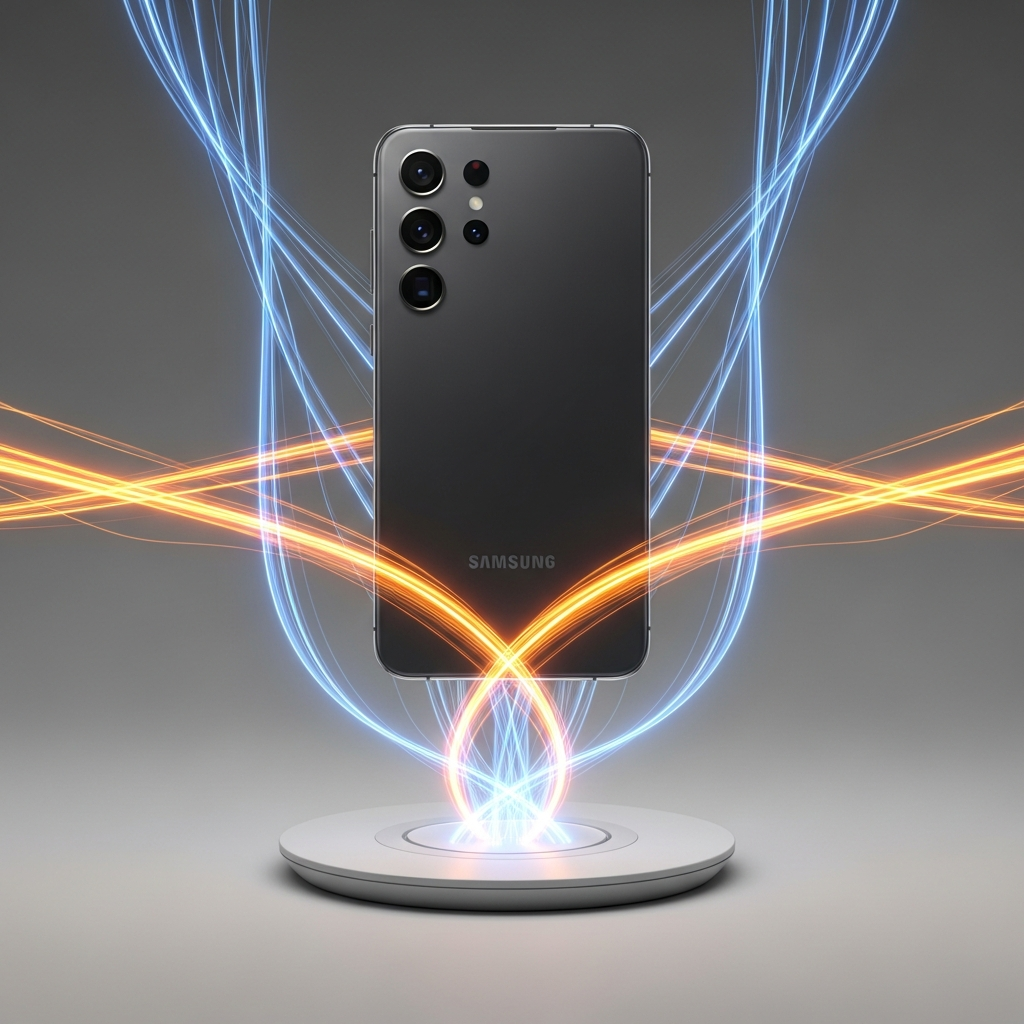
The upcoming Samsung Galaxy S26 series is already generating significant buzz. While the official launch is still weeks away, leaks are painting a clear picture of its wireless charging capabilities. Get ready for a surprising mix of innovation and a notable omission. Samsung’s next flagship phones will bring a crucial speed upgrade to Galaxy S26 wireless charging, powered by a new industry standard. However, they will likely miss out on built-in magnetic Qi2 support, a feature many eagerly anticipated. This deep dive uncovers what these decisions mean for future users and how the S26 stacks up.
Galaxy S26 Wireless Charging: Faster Speeds Confirmed
Exciting news for power users: the Samsung Galaxy S26 series appears set for a substantial upgrade in wireless charging speed. Recent listings at the Wireless Power Consortium (WPC), the body governing the Qi standard, reveal support for the advanced Qi 2.2.1 spec. This is a significant leap from the Qi 2.1.0 standard found in the previous Galaxy S25 lineup.
The Qi 2.2.1 specification is the first version capable of delivering wireless charging power beyond the standard 15W. This aligns perfectly with persistent rumors hinting at faster 20-25W wireless charging speeds for the S26 devices. For context, the Qi 2.2.1 spec is already in use by leading competitors, including the Pixel 10 Pro XL and the latest iPhone models. This move positions the Galaxy S26 to compete directly with rival flagships in charging efficiency. Though initial WPC listings show a placeholder 5W, this is not indicative of final commercial speeds. Instead, it confirms the underlying technology.
The Mystery of the Missing Qi2 Magnets
Despite the welcome speed upgrade, a significant feature appears to be absent from the Galaxy S26 series: built-in Qi2 magnets. This comes as a disappointment to many who expected Samsung to fully embrace the latest Qi2 standard. Initial reports and a “change in plans” suggest that native magnetic alignment, crucial for optimal charging and accessory integration, will once again rely on external cases.
This decision has raised eyebrows, especially since some of Samsung’s own first-party accessories already leverage magnet support. Leaks from multiple sources have consistently stated that the Galaxy S26 is “100%” skipping built-in Qi2 magnets. Further evidence for this omission comes from the WPC listings themselves. The power profiles for the likely Galaxy S26 models (identified by masked numbers like SM-K772, SM-K777, and SM-K778) conspicuously lack an “MPP” (Magnetic Power Profile) indicator. This absence strongly suggests that magnetic charging will not be a native capability. While some earlier broad leaks mentioned “magnetic Qi2 wireless charging” for the S26, the specific WPC technical data heavily favors the “no magnets” conclusion for integrated functionality.
Beyond Charging: What Else to Expect from the Galaxy S26 Series
The Galaxy S26 series is shaping up to be more than just a charging story. Early leaks provide a comprehensive look at potential design changes, battery enhancements, and performance upgrades. Samsung appears focused on refining the user experience across its flagship lineup.
Design Evolution and Battery Boosts
The vanilla Galaxy S26 model is set to undergo notable physical changes. It is projected to be significantly lighter, shedding around 25 grams to weigh just 137g, compared to the Galaxy S25’s 162g. This weight reduction comes with a slight increase in screen size, growing from 6.2 inches to 6.3 inches. The device will also be marginally taller and wider. In contrast, the Galaxy S26+ is expected to largely maintain the same dimensions and weight as its predecessor, keeping its 6.7-inch display.
Battery life is another area of focus. The standard Galaxy S26 is slated to receive a larger 4,300mAh battery, an increase from the S25’s 4,000mAh. Rumors also suggest an upgrade to 45W wired charging for the S26 and S26+, potentially bringing them in line with current fast-charging trends. The S26 Ultra is even rumored to reach 60W charging. For the Galaxy S26 Edge, leaks point to a practical, albeit modest, battery boost to 4,200 mAh from an assumed 3,900 mAh. However, earlier hopes for a revolutionary silicon-carbon battery (rumored at 7,000 mAh) are being tempered, with that advanced technology reserved for future devices.
Performance and Software Innovations
Under the hood, the Galaxy S26+ and S26 Ultra have reportedly been spotted with a Snapdragon 8 Elite Gen 5 chipset, promising next-generation performance. Regional variations might see an Exynos 2600 chipset in some markets. The vanilla S26 is also expected to finally gain Ultra-Wideband (UWB) technology, a crucial feature for tracking tags that has been missing from the standard model. Base storage for the vanilla S26 is rumored to increase to 256GB, offering more room for apps and media.
On the software front, the Galaxy S26 series will natively run One UI 8.5. This updated operating system is already undergoing internal testing. A public beta program for One UI 8.5 on the Galaxy S25 series is anticipated soon, likely starting in South Korea before expanding to regions like the United States, Germany, India, and the United Kingdom. This early rollout allows Samsung to gather feedback and refine the user experience before the S26 series launch.
The Elusive Galaxy S26 Edge: A Thin Future?
Among the numerous leaks, the potential existence of a Galaxy S26 Edge model has surfaced, shrouded in uncertainty. If it launches, it could redefine smartphone thinness. Leaked images of a dummy unit suggest an astonishingly slender profile, potentially measuring a mere 5.50 mm. This would make it thinner than an iPhone 16 Pro and even the rumored iPhone Air, positioning it as possibly the slimmest Android phone ever.
However, its launch status remains fluid. Reports conflict, with some suggesting the project might have been temporarily sidelined, while others claim it’s actively “in the works” under the codename “More Slim.” Even if confirmed, it might not launch alongside the main Galaxy S26 series. This super-thin design, if it materializes, would certainly be a design highlight for Samsung.
Implications for Consumers: Weighing the Choices
Samsung’s strategic decisions for the Galaxy S26 series present a compelling narrative. The upgrade to Qi 2.2.1 for faster wireless charging speeds is a practical and highly desirable enhancement, bringing the S26 in line with industry leaders. Users can expect quicker top-ups and greater convenience. However, the deliberate omission of built-in Qi2 magnets means consumers will need to rely on compatible cases or accessories to leverage magnetic alignment. This could be a cost-saving measure for Samsung or a design constraint, but it undoubtedly impacts the native user experience.
Ultimately, the Galaxy S26 series appears to be a mixed bag of innovation and careful evolution. With significant improvements to core performance, battery life, and charging speeds, alongside thoughtful design refinements and software updates, the S26 models are poised to be strong contenders. The official launch, expected on February 25, will reveal all the definitive details.
Frequently Asked Questions
What improvements are coming to Galaxy S26 wireless charging?
The Samsung Galaxy S26 series is expected to feature a significant upgrade in wireless charging technology. It will adopt the Qi 2.2.1 specification, which is the first version of the Qi standard capable of supporting speeds beyond 15W. This suggests that the Galaxy S26 could offer faster wireless charging, potentially in the 20-25W range. This advanced spec is already used by other flagship phones like the Pixel 10 Pro XL and the latest iPhones, indicating Samsung’s move to keep pace with industry leaders in charging efficiency.
Will the Galaxy S26 series support magnetic wireless accessories?
While the Galaxy S26 series will receive a speed upgrade for wireless charging, it is highly likely that it will not feature built-in Qi2 magnets for magnetic alignment. This means users hoping for native MagSafe-like functionality will probably need to rely on external cases or third-party accessories that incorporate magnets. Wireless Power Consortium (WPC) listings for the S26 models lack an “MPP” (Magnetic Power Profile) indicator, reinforcing the expectation that magnetic support will not be integrated directly into the phones.
How does the Galaxy S26’s wireless charging compare to other flagship phones?
With the adoption of the Qi 2.2.1 spec, the Galaxy S26 series’ wireless charging capabilities will align closely with other top-tier flagship smartphones. The Qi 2.2.1 standard is the first to allow speeds exceeding 15W, mirroring the technology found in devices like the Pixel 10 Pro XL and the latest iPhones. While specific maximum charging wattage for the S26 is still rumored at 20-25W, this upgrade ensures Samsung’s new phones remain competitive in wireless charging speed, offering comparable convenience to current market leaders despite the likely absence of built-in Qi2 magnets.
References
- 9to5google.com
- <a href="https://www.gsmarena.com/specsleaksuggeststhatthegalaxys26willbeabittallerandmuchlighters26detailsalsoleak-news-71339.php”>www.gsmarena.com
- www.techtimes.com
- www.notebookcheck.net
- www.androidauthority.com