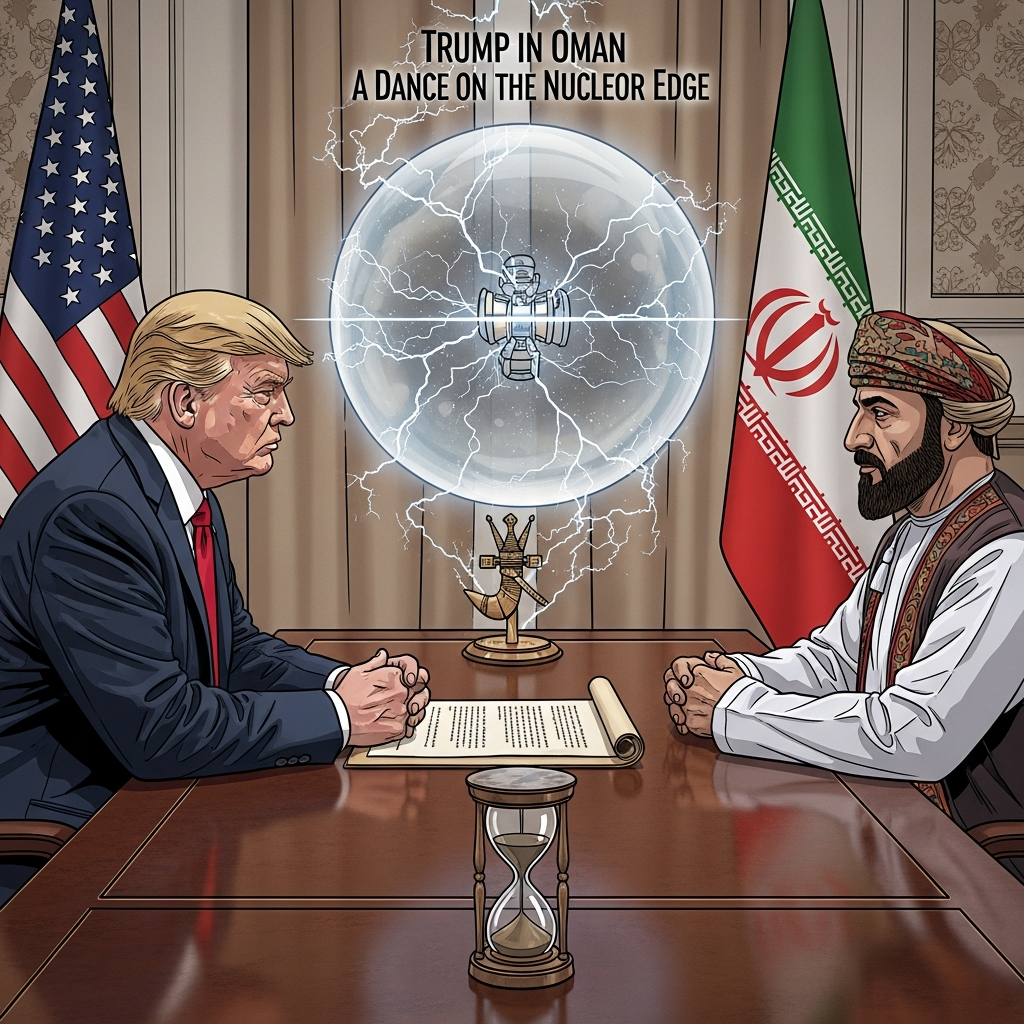
Amid escalating tensions in the Middle East, President Donald Trump announced on Friday, February 7, 2026, that the United States and Iran had conducted “very good talks” in Oman. These high-stakes, Omani-mediated discussions in Muscat represent the first direct diplomatic engagement between the two nations since a 12-day conflict last June, sparking cautious optimism but also highlighting deep-seated mistrust and significant hurdles toward a comprehensive nuclear deal. Observers are closely watching to see if this diplomatic overture can truly de-escalate regional instability or if it’s merely a brief pause in a protracted standoff.
Setting the Stage: Diplomatic Breakthrough or Delicate Dance?
The crucial dialogue took place on February 6, 2026, in Muscat, Oman, a neutral ground traditionally fostering regional diplomacy. Omani Foreign Minister Sayyid Badr Hamad Al Busaidi played a pivotal mediating role, meeting separately with delegations from both sides. The American team included President Trump’s Middle East envoy Steve Witkoff and advisor Jared Kushner. Notably, Navy Adm. Brad Cooper, head of U.S. Central Command, was also present, his uniform serving as a clear signal of potential military options. Iran’s delegation was led by its Foreign Minister Abbas Araghchi.
Following nearly eight hours of intensive discussions, President Trump characterized the talks as highly productive. Speaking on Air Force One, he claimed Iran’s position on a nuclear agreement appeared “more favorable” than before last June’s conflict. This positive framing, however, contrasts with the nuanced realities emerging from the region. While some saw this as a potential breakthrough, others cautioned that it represented a delicate dance, with each side holding firm on core demands. The sheer fact of face-to-face negotiations after a period of intense hostility underscored the gravity of the situation and the urgent need for de-escalation.
Key Players and Their Positions
The recent US-Iran nuclear talks revealed starkly contrasting demands and expectations from Washington and Tehran, underscoring the formidable challenge of finding common ground.
The US Stance: Pressure and Prerequisites
President Trump’s public statements consistently blend diplomatic overtures with strong warnings. He indicated that Iran “wants to make a deal very badly” but reiterated a non-negotiable condition: “no nuclear weapons.” He suggested Iran was now “willing to do much more than they would have a year and a half ago” regarding nuclear restrictions. However, this optimism was coupled with an aggressive stance, warning of “very steep consequences” if an agreement isn’t swiftly reached.
The Trump administration’s pressure campaign extends beyond rhetoric. Just before and after the talks, the US announced new sanctions targeting 15 entities, two individuals, and 14 vessels involved in illicit Iranian petroleum trade. This dual-track approach of engagement alongside heightened economic pressure is designed to compel Iran towards concessions. Furthermore, the significant US military buildup in the Gulf, including the deployment of the USS Abraham Lincoln supercarrier and reinforced air defenses, serves as a tangible threat. A recent incident where a fighter jet from the Abraham Lincoln shot down an Iranian drone illustrated the volatile environment. US demands include Iran completely abandoning uranium enrichment, even for civilian use, limiting its ballistic missile program, and ceasing support for regional proxy groups.
Iran’s Red Lines and Cautious Engagement
Iran’s Foreign Minister Abbas Araghchi described the talks as a “good start” but highlighted a prevailing “atmosphere of mistrust.” He emphasized that discussions focused “exclusively nuclear” issues, with the goal of securing sanctions relief and de-escalation. Crucially, Iran firmly maintains “red lines” regarding its ballistic missile program and its regional influence, asserting that these are non-negotiable matters of national sovereignty.
Immediately after Trump’s positive remarks, Iranian official Ebrahim Rezaei publicly refuted the US President’s claims, calling him “a liar.” Rezaei, spokesperson for the Iranian Parliament National Security and Foreign Policy Commission, stated that “The Islamic Republic has not backed down from its red lines and will not do so.” Concurrently, the Islamic Revolutionary Guard Corps (IRGC) test-launched a new Khorramshahr-4 ballistic missile capable of reaching Israel and US bases, signaling that Iran “will not give up our military power.” Iran’s primary demand in any potential agreement remains the lifting of international sanctions that have crippled its economy.
Oman’s Pivotal Mediation Role
Oman’s role as a neutral mediator in the Middle East diplomacy has been indispensable. Foreign Minister Sayyid Badr bin Hamad Al Busaidi confirmed that the discussions were “very serious” and “useful to clarify both Iranian and American thinking and identify areas for possible progress.” He noted that the outcomes would be “considered carefully in Tehran and Washington.”
The Omani Foreign Ministry clarified that these consultations aimed at “preparing the appropriate conditions for resuming diplomatic and technical negotiations.” This suggests that the recent talks were foundational, designed to establish a framework for future dialogue rather than immediately brokering a comprehensive deal. Oman’s consistent efforts to bridge the communication gap between these adversaries are crucial for fostering any hope of sustainable security and stability in the volatile Persian Gulf region.
The Shadow of Conflict: Escalating Tensions and Domestic Unrest
These US-Iran nuclear talks unfolded against a grim backdrop of recent conflict and severe internal challenges within Iran, intensifying the stakes for both sides.
Post-War Landscape and Military Jitters
The talks were the first direct engagement following the “12-day war” last June. During that period, the United States reportedly joined Israel’s actions, bombing three of Iran’s main nuclear facilities. This direct military involvement created a deep sense of mistrust and heightened the possibility of wider conflict. Trump himself had explicitly warned of pivoting to military action if a deal isn’t reached quickly. The continued deployment of US military assets, including the USS Abraham Lincoln supercarrier and supporting warships near Iranian waters, underscores the constant threat of escalation. Iran’s Supreme Leader Ayatollah Ali Khamenei has already issued stern warnings, stating that any US attack would ignite a regional war, a sentiment echoed by IRGC commanders.
Iran’s Internal Challenges
Domestically, Iran faces immense pressure. Nationwide anti-government protests erupted in late December, sparked by severe economic grievances like a crashing rial currency and soaring inflation. These demonstrations rapidly evolved into one of the most significant challenges to the ruling clergy in decades. The subsequent crackdown was brutal; human rights organizations, including the US-based Human Rights Activists News Agency (HRANA), reported confirmed deaths of thousands (at least 6,955 by some accounts) and over 50,000 arrests. The widespread use of lethal force by state forces and alleged forced confessions have drawn international condemnation. This internal turmoil significantly impacts the Iranian populace’s optimism for negotiations, with many hoping for an end to the “shadow of war” and economic relief, while others anticipate failure or even welcome military escalation, feeling current conditions are “more severe than war itself.”
Global Reactions and the Path Forward
International reactions to the Tehran-Washington dialogue were mixed, reflecting the global uncertainty surrounding the situation. Qatar’s foreign ministry expressed optimism for a “comprehensive agreement” beneficial to all parties and regional security. In contrast, French Foreign Minister Jean-Noel Barrot criticized Iran as a “destabilizing power” due to its nuclear program and support for “terrorist” groups, urging restraint.
Despite Trump’s claims of “very good talks,” significant gaps persist between the US and Iranian positions. The US seeks broad concessions beyond nuclear issues, while Iran firmly rejects any discussion of its missile program or regional influence. Although Trump indicated that special envoy Steve Witkoff and Jared Kushner would meet Iran’s foreign minister again “early next week,” a clear roadmap for a comprehensive agreement remains elusive. These negotiations offer a potential “off-ramp” for President Trump from his military threats, alleviating concerns among regional countries about a wider conflict. However, until Iran’s domestic stability improves and both sides demonstrate a genuine willingness for broader compromise, the future of US-Iran relations remains precariously balanced.
Frequently Asked Questions
What was the primary outcome of the recent US-Iran talks in Oman?
The talks on February 6, 2026, in Muscat, Oman, were described by both sides as a “good start” but did not produce a clear roadmap for de-escalation or a comprehensive nuclear deal. They were crucial as the first direct engagement since a 12-day conflict in June. President Trump characterized them as “very good talks,” citing a more favorable Iranian position, while Iranian officials acknowledged an “atmosphere of mistrust” and emphasized that discussions were exclusively nuclear-focused, not touching on missiles or regional influence. The primary outcome was a consensus for talks to continue, with another meeting scheduled for “early next week,” following consultations with respective capitals.
What significant events preceded these diplomatic engagements between the US and Iran?
These talks followed a highly volatile period, including a 12-day conflict in June, where the US reportedly joined Israel in bombing three of Iran’s main nuclear facilities. This direct military involvement significantly heightened regional tensions and mistrust. Additionally, the diplomatic efforts occurred amidst a massive US military buildup in the Gulf, including the deployment of the USS Abraham Lincoln supercarrier, and new US sanctions targeting Iran’s oil exports. Domestically, Iran had just experienced widespread anti-government protests in late December, stemming from severe economic grievances, which were met with a brutal crackdown resulting in thousands of deaths and arrests.
What are the main obstacles to a comprehensive nuclear deal between the U.S. and Iran?
The main obstacles revolve around fundamental disagreements on the scope of any deal and a deep-seated lack of trust. The U.S. insists on Iran completely abandoning uranium enrichment, even for civilian use, limiting its ballistic missile program, and ceasing support for regional proxy groups. In contrast, Iran considers its missile program and regional influence “red lines” and will only negotiate on nuclear issues to secure sanctions relief and an end to US threats of war. The atmosphere of mistrust, exacerbated by past conflicts, US sanctions, and Iran’s internal repression, further complicates diplomatic progress.