Artificial intelligence is rapidly reshaping our world, influencing everything from creative industries to global financial markets. The year 2026 serves as a powerful testament to this profound shift. We saw AI not only dominate the highly anticipated Super Bowl advertising landscape but also emerge as a significant catalyst behind the Dow Jones Industrial Average (DJIA) achieving an unprecedented milestone. This dual impact underscores AI’s pervasive and accelerating influence, signaling a new era of technological integration and economic transformation.
AI Takes Center Stage: Super Bowl 2026 Advertising Revolution
The Super Bowl, long a showcase for cutting-edge marketing, experienced a revolutionary shift in 2026. Brands moved beyond simply featuring AI in their commercials; they actively leveraged it for creation and product promotion. This marked AI’s emergence as a major “star” of the advertising world, sparking both fascination and debate.
Pioneering AI-Generated Commercials
Several companies made bold, often controversial, plays with AI in their Super Bowl spots. Svedka claimed the spotlight with “Shake Your Bots Off,” what it called the first “primarily” AI-generated national Super Bowl ad. This 30-second commercial depicted Svedka’s Fembot and Brobot characters dancing at a human party. Sazerac, Svedka’s parent company, reported a meticulous four-month process. This included reconstructing Fembot and training AI specifically for facial expressions and body movements. While human input remained crucial for narrative development, Svedka’s partnership with Silverside AI, known for its controversial Coca-Cola ads, ignited discussions about AI’s potential impact on creative jobs.
Other brands integrated AI into their messaging with unique twists. Rippling, a cloud-based workforce management platform, humorously addressed HR challenges, like onboarding an alien monster. Their Super Bowl debut positioned AI automation as the definitive solution. Similarly, Ramp featured Brian Baumgartner from “The Office” to promote its AI-powered spend management platform. The ad cleverly showed Baumgartner multiplying himself to handle a massive workload, emphasizing the platform’s automation for focused, critical tasks. Wix also introduced its new “Wix Harmony” platform. This promises an intuitive, AI-powered website creation experience, designed to mimic a natural conversation with a friend. Google showcased its “Nano Banana Pro” image-generation model. Their commercial depicted a mother and son using AI to visualize and design their new home. They transformed bare rooms into personalized spaces with simple prompts, highlighting AI’s role in creative design.
AI as a Product Feature: Smart Devices & Software
Beyond ad creation, AI became a central product feature promoted during the Super Bowl. Meta highlighted its Oakley-branded AI glasses, tailored for sports and extreme adventures. The ad featured thrill-seekers and celebrities like IShowSpeed and Spike Lee. They demonstrated hands-free recording, slow-motion capabilities, and direct Instagram posting. This built upon Meta’s previous smart glasses campaigns, emphasizing evolving AI integration in wearables.
Amazon presented a darkly comedic ad starring Chris Hemsworth, playfully satirizing common fears about AI. Hemsworth humorously accused Alexa+ of conspiring against him through exaggerated mishaps. Beneath the humor, the commercial introduced the enhanced capabilities of Alexa+. This advanced version, officially launched to all U.S. users, demonstrated superior intelligence for smart home management and vacation planning. Ring spotlighted its “Search Party” feature, an AI-powered community network. This network aims to reunite lost pets with their owners. The ad illustrated how users can upload a pet’s photo. AI then identifies matches, leveraging nearby Ring cameras and the community to track missing animals. This feature is now available even to non-Ring camera owners. Hims & Hers, a health company, used its ad to highlight healthcare access disparities. It subtly poked fun at expensive anti-aging routines. This tied into the company’s “MedMatch” tool, an AI-powered system designed to deliver personalized treatment recommendations, particularly for mental health and wellness.
The Battle for AI’s Soul: Ethics and Competition
The 2026 Super Bowl ads also brought underlying tensions in the AI industry to the forefront. Anthropic took a unique and bold approach. Instead of merely promoting its Claude chatbot, it directly criticized OpenAI’s plans to introduce ads to ChatGPT. Their tagline, “Ads are coming to AI. But not to Claude,” satirized the concept of an AI assistant becoming a product endorser. This generated an online feud, with OpenAI’s Sam Altman publicly calling the ad “clearly dishonest.” These campaigns collectively demonstrated a significant shift. Brands integrated AI not just as a thematic element but as a core tool and a central product feature to be promoted. These efforts often involved bold, attention-grabbing, and sometimes controversial campaigns.
The Financial Frontier: Dow 50,000 and AI’s Market Influence
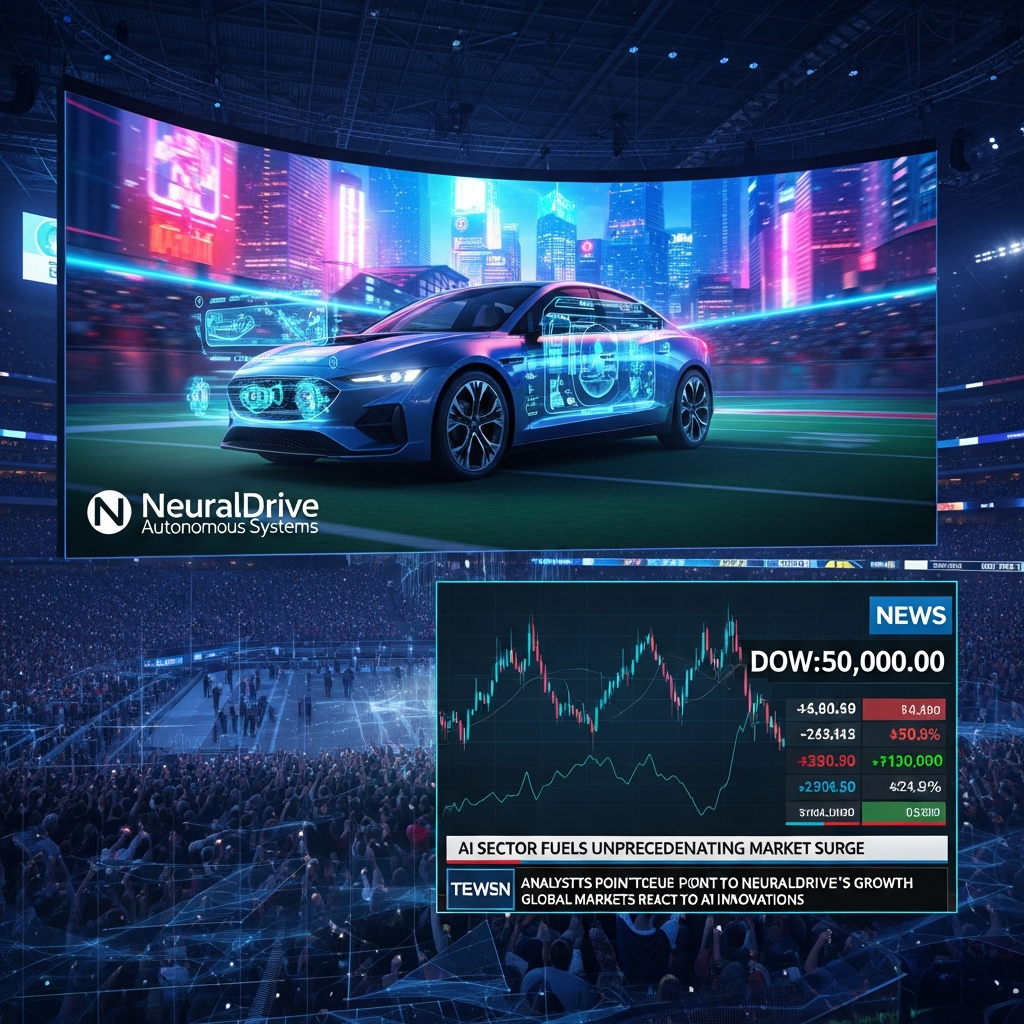
While AI reshaped advertising, it simultaneously exerted powerful influence over global financial markets. On a historic Friday, the Dow Jones Industrial Average (DJIA) closed above 50,000 points for the first time ever. The index posted a substantial gain of 1,206.95 points, or 2.47%, reaching 50,115.67. This unprecedented rally occurred after a week marked by a rout in tech shares. Both the S&P 500 and Nasdaq Composite also ended the day in positive territory, rising 1.97% and 2.18%, respectively.
Chip Stocks Surge: Powering the AI Infrastructure Boom
A key driver of this market strength was a significant surge in chip stocks. This was primarily fueled by expectations of increased capital expenditure on artificial intelligence (AI) data centers. Major tech companies like Amazon and Google’s parent company, Alphabet, made substantial commitments. Leading chipmakers Nvidia, Advanced Micro Devices (AMD), and Broadcom each saw their shares climb by more than 7%. This reflected immense investor confidence in the foundational hardware powering the AI revolution.
Conversely, Amazon’s stock declined by nearly 7% after the company announced its plan to ramp up AI-related capital expenditures by over 50% this year. This followed a similar disclosure from Alphabet earlier in the week. These investments, while signaling future growth, briefly raised concerns about immediate profit margins. The broader market’s positive momentum was also boosted by improved sentiment. This was linked to a “positive report out of the University of Michigan,” as noted by Jeffrey Roach, LPL Financial chief economist. This report indicated that median 1-year inflation expectations had dropped to their lowest level since January 2025, offering reassurance to investors.
Investor Caution: Valuations and Profit Margins
Despite the overall market surge, some software companies experienced stock declines. Investors expressed concerns that intense competition within the AI sector could negatively impact profit margins. They also questioned whether valuations in the AI boom had become excessive. This highlights a cautious approach within certain market segments. It underscores the complexity of investing in a rapidly evolving technological landscape.
A Bullish Outlook Amidst Volatility
Ross Mayfield, an investment strategy analyst at Baird, offered a balancing perspective on the AI market’s volatility. He stated there is “enough evidence that there’s real demand for AI products, real promise with what they can do and a necessity of a lot of spending to get there.” Mayfield suggested that during sell-offs, a “floor” exists where investors are likely to step in and buy these names. This indicates a robust underlying belief in AI’s long-term potential. Sectoral performance clearly reflected the tech-driven rally. Nine out of the eleven S&P 500 sector indexes posted gains. The information technology index led the way with over a 3.7% increase, followed by the industrials index, which gained nearly 2.7%.
The Broader Implications of AI’s Ascendance
The events of 2026 paint a clear picture: AI is no longer a futuristic concept but a present-day force driving significant change. Its dual impact on creative advertising and global financial markets demonstrates its pervasive nature. Businesses must adapt quickly to leverage AI for innovation and efficiency. Investors, meanwhile, need to navigate both immense opportunities and potential overvaluations. The accelerating adoption of artificial intelligence will continue to redefine industries. It will challenge existing business models and create entirely new economic landscapes. Staying informed and strategically positioned will be crucial for navigating this dynamic future.
Frequently Asked Questions
How did AI fundamentally change Super Bowl advertising in 2026?
In 2026, AI transitioned from a mere thematic element to a core tool for both ad creation and product promotion in Super Bowl commercials. Brands like Svedka debuted “primarily” AI-generated spots, while others, such as Google and Wix, showcased AI’s capability in content creation and platform development. Additionally, AI was heavily featured as a core product feature, seen in Meta’s AI glasses, Amazon’s enhanced Alexa+, and Ring’s AI-powered pet reunion network. This shift underscored AI’s pivotal role in shaping future advertising strategies and creative processes.
Which key companies drove the Dow Jones surge related to AI investments?
The historic surge of the Dow Jones Industrial Average above 50,000 points was largely driven by significant capital expenditures on AI data centers. Key companies leading this charge included major tech giants like Amazon and Alphabet, whose substantial investments fueled expectations for growth in the AI infrastructure sector. This directly led to a surge in chip stocks from manufacturers such as Nvidia, Advanced Micro Devices (AMD), and Broadcom, all of whom saw share price increases of over 7%, indicating their crucial role in powering the AI revolution.
What are the primary investment considerations for individuals looking at the AI market?
Investors eyeing the AI market should consider both its immense potential and inherent volatility. While there’s clear “real demand for AI products” and a “necessity of a lot of spending to get there,” as noted by analysts, concerns exist regarding potential overvaluations and competitive pressures impacting profit margins for some software companies. Strategic investment involves identifying companies with strong foundational AI technologies (like chipmakers) alongside those innovating with AI-powered products, while also being mindful of market sentiment shifts and the long-term viability of their AI strategies.