A dramatic confrontation unfolded at Cities Church in St. Paul, Minnesota, when anti-ICE protesters disrupted a Sunday service, shining a spotlight on a pastor alleged to also serve as a high-ranking U.S. Immigration and Customs Enforcement (ICE) official. This unprecedented event sparked a swift federal investigation, ignited intense debate over religious freedom and protest rights, and highlighted deep divisions within both the community and federal-local government relations. The incident quickly became a focal point in the escalating national dialogue around immigration enforcement and civil liberties.
Unprecedented Disruption at a St. Paul Church
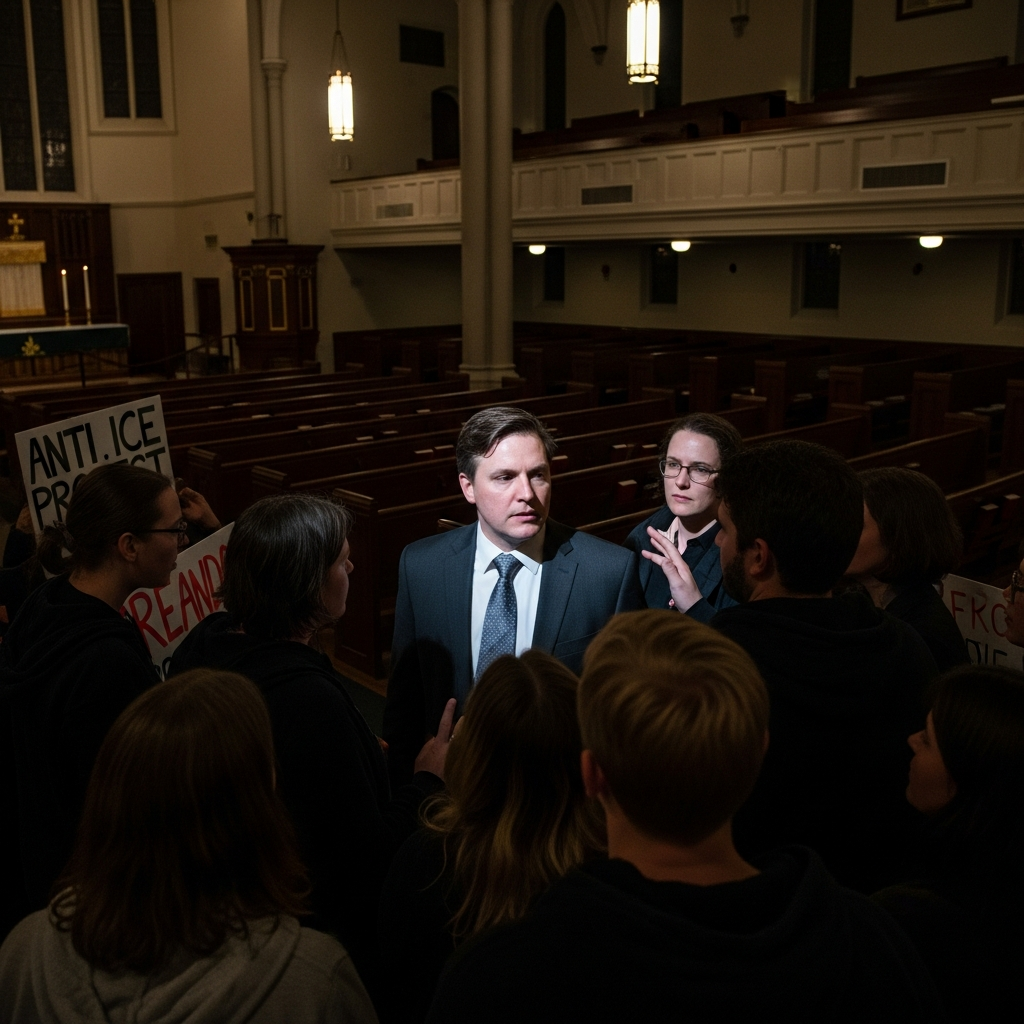
On Sunday, January 18, 2026, a group of approximately 30 to 40 protesters entered Cities Church during a livestreamed service. Video footage, including clips posted by Black Lives Matter Minnesota, captured the scene as demonstrators chanted slogans like “ICE out!” and “Justice for Renee Good!” The objective, as stated by activist Nekima Levy Armstrong, was to raise critical awareness about what they perceive as an egregious conflict of interest.
The core of the protest targeted Pastor David Easterwood, who the activists allege simultaneously holds a leadership position as the acting field director for the St. Paul ICE field office. Protesters claimed Easterwood oversees operations involving “violent tactics” and “illegal arrests,” making his dual role within a house of worship fundamentally problematic. While Easterwood was not leading the service at the time of the disruption, and it was unclear if he was present, the protest drew immediate attention from congregants and law enforcement alike.
Allegations and the Call for Justice
Protest organizers, including Black Lives Matter Minnesota and the Racial Justice Network, amplified their grievances. They specifically invoked the name “Renee Good,” a 37-year-old mother of three whose recent fatal shooting by an ICE agent in Minneapolis served as a major catalyst for the intensified demonstrations. This tragedy, combined with a reported surge in federal immigration enforcement activities across Minnesota, fueled the protesters’ conviction that Easterwood’s alleged dual role was morally indefensible.
Nekima Levy Armstrong, an ordained reverend and a protest leader, articulated the ethical dilemma. “You expect someone to align with the teachings of Christianity. Loving thy neighbor, showing care for each other and spreading the Good News,” Armstrong stated. “However, when you are also serving as the director of the ICE office in St. Paul, from my perspective, that’s a problem.” This sentiment underscores a theological challenge to Easterwood’s alleged position, suggesting an inherent contradiction between pastoral duties and immigration enforcement policies.
Swift Federal Response and the FACE Act
The U.S. Department of Justice (DOJ) wasted no time launching a civil rights investigation into the church disruption. Attorney General Pam Bondi condemned the incident, declaring that “attacks against law enforcement and the intimidation of Christians are being met with the full force of federal law.” She further warned state leaders that if “lawlessness” persisted, the DOJ would “remain mobilized to prosecute federal crimes.”
Assistant Attorney General for the Civil Rights Division, Harmeet Dhillon, echoed these sentiments, labeling the act “heinous” and confirming it received the “highest level of attention” from the DOJ. Dhillon emphasized the sanctity of the First Amendment right to religious freedom and confirmed the investigation would explore potential violations of the federal Freedom to Access Clinic Entrances (FACE) Act of 1994. This act prohibits interference with anyone exercising their religious freedom at a place of worship. Notably, the FACE Act also makes it a federal crime to interfere with those seeking or providing reproductive health services, a law originally designed to address violence against abortion providers.
Legal Complexities and Challenges for Prosecution
The application of the FACE Act to this incident introduces significant legal complexities. While the law prohibits physical obstruction or force to interfere with religious worship, it explicitly states it “shall not be construed: to prohibit any expressive conduct (including peaceful picketing or other peaceful demonstration) protected from legal prohibition by the First Amendment.” This clause could become a central point of contention in any federal prosecution.
Furthermore, state-level prosecution for disorderly conduct in Minnesota might prove difficult. The Minnesota Supreme Court ruled in 2017 that disturbing an assembly cannot be considered disorderly conduct, finding the state law “substantially overbroad” and violating the First Amendment. This creates a challenging legal landscape, where federal charges under the FACE Act become the primary avenue for legal action against the protesters. The DOJ’s assertive stance, including Dhillon’s suggestion that a journalist livestreaming the event could be implicated as an “embedded part of a criminal conspiracy,” signals a robust federal push to apply the law.
Connecting the Pastor to ICE Operations
Evidence supporting David Easterwood’s dual role is substantial. The Cities Church website indeed lists David Easterwood as a pastor. His personal details reportedly align with a David Easterwood identified in court filings as the acting director of the ICE St. Paul field office. Further corroboration came in October 2025, when Department of Homeland Security Secretary Kristi Noem publicly identified Easterwood as an ICE acting field office director for Enforcement and Removal Operations in the region during a Minneapolis press conference, where he appeared alongside her.
This alleged dual capacity is central to a class-action lawsuit filed by the ACLU. The lawsuit names Easterwood, along with Secretary Noem and acting ICE Director Todd Lyons, alleging “unlawful policies and practices” by ICE in Minnesota. These claims include racial profiling and arrests without warrants or probable cause, directly implicating the leadership overseeing regional ICE operations. In a January 5 court filing, Easterwood himself defended ICE tactics, such as swapping license plates and using chemical irritants, citing increased threats and aggression against agents. He denied knowledge of agents “knowingly targeting or retaliating against peaceful protesters or legal observers.”
Broader Political and Community Divides
The St. Paul incident quickly became a flashpoint in the broader, escalating tensions between federal immigration enforcement and local governance in Minnesota. ICE itself issued a statement attributing the disruption to Minnesota Governor Tim Walz and Minneapolis Mayor Jacob Frey, claiming they “are responsible for whipping these mobs into a frenzy.” However, a spokesperson for Gov. Walz countered that the governor consistently urged peaceful protest and “in no way supports interrupting a place of worship.” Mayor Frey, while not directly addressing the church protest, posted a quote from Dr. Martin Luther King Jr. reflecting on “injustice anywhere is a threat to justice everywhere,” which some interpreted as an indirect commentary on federal actions.
President Trump also weighed in on Truth Social, condemning the protesters as “agitators and insurrectionists” and calling for them to be jailed or “thrown out of the Country.” The situation in Minnesota has reached a critical point, with the Trump administration reportedly considering invoking the 19th-Century Insurrection Act, potentially deploying active-duty military personnel. This echoes the heightened federal presence that has led to over 3,000 arrests in Minneapolis since recent deployments, alongside ongoing protests at the Whipple building, the local headquarters for federal agents.
The Debate Among Faith Leaders
The disruption at Cities Church has also exposed deep divisions within the Christian community regarding immigration enforcement and the appropriate forms of protest. While the Minnesota-Wisconsin Baptist Convention, to which Cities Church belongs, described the event as “an unacceptable trauma,” calling for compassion for migrant families alongside protection of worship spaces, other leaders offered nuanced views.
Miles Mullin of the Southern Baptist Convention’s Ethics and Religious Liberty Commission acknowledged the right of faith leaders to protest social issues but insisted such actions should never prevent others from worshipping. Conversely, protest leader Nekima Levy Armstrong, an ordained pastor herself, framed the action in religious terms, stating on Facebook, “It’s time for judgment to begin and it will begin in the House of God!!!” This highlights a profound disagreement on whether “justice” can sometimes necessitate challenging authority within sacred spaces.
Frequently Asked Questions
What triggered the St. Paul church protest targeting an ICE director pastor?
The protest at Cities Church in St. Paul was primarily triggered by the allegation that one of its pastors, David Easterwood, also serves as the acting field director for the local U.S. Immigration and Customs Enforcement (ICE) office. Protesters cited Easterwood’s alleged role in overseeing operations involving “violent tactics” and “illegal arrests.” The recent fatal shooting of Renee Good by an ICE agent in Minneapolis further fueled their demands for “Justice for Renee Good” and an end to perceived ICE “atrocities.”
Which federal law is the DOJ using to investigate the Cities Church disruption?
The U.S. Department of Justice (DOJ) is investigating the Cities Church disruption under the federal Freedom to Access Clinic Entrances (FACE) Act of 1994. This act makes it a federal crime to use force, threat of force, or physical obstruction to interfere with individuals exercising their First Amendment right of religious freedom at a place of worship. The DOJ’s Assistant Attorney General for the Civil Rights Division, Harmeet Dhillon, confirmed this investigation, emphasizing the sanctity of religious spaces.
How does this St. Paul incident reflect broader tensions between federal immigration enforcement and local communities?
The St. Paul church protest serves as a stark reflection of escalating tensions between federal immigration enforcement and local communities, particularly in Minnesota. It underscores the profound disagreement over ICE tactics and policies, especially following incidents like Renee Good’s killing. The incident also highlights a significant federal-local conflict, with the Trump administration blaming state and city leaders for “whipping these mobs into a frenzy,” while Minnesota Governor Tim Walz and Minneapolis Mayor Jacob Frey express opposition to federal deployments and urge peaceful protest. This complex situation involves not only clashes on the streets but also legal battles, political rhetoric, and ethical debates within religious institutions.
An Ongoing Clash of Rights and Beliefs
The disruption at Cities Church in St. Paul is more than just a local incident; it is a potent symbol of the ongoing national struggle over immigration policy, civil liberties, and the boundaries of protest. The clash between the right to religious freedom and the right to protest, particularly when targeting individuals allegedly involved in controversial government actions, creates a complex legal and ethical dilemma. As the Department of Justice pursues its investigation, and local activists continue to demand accountability, the events in St. Paul will undoubtedly shape future discourse on these deeply divisive issues, emphasizing the profound challenges facing communities grappling with immigration enforcement.