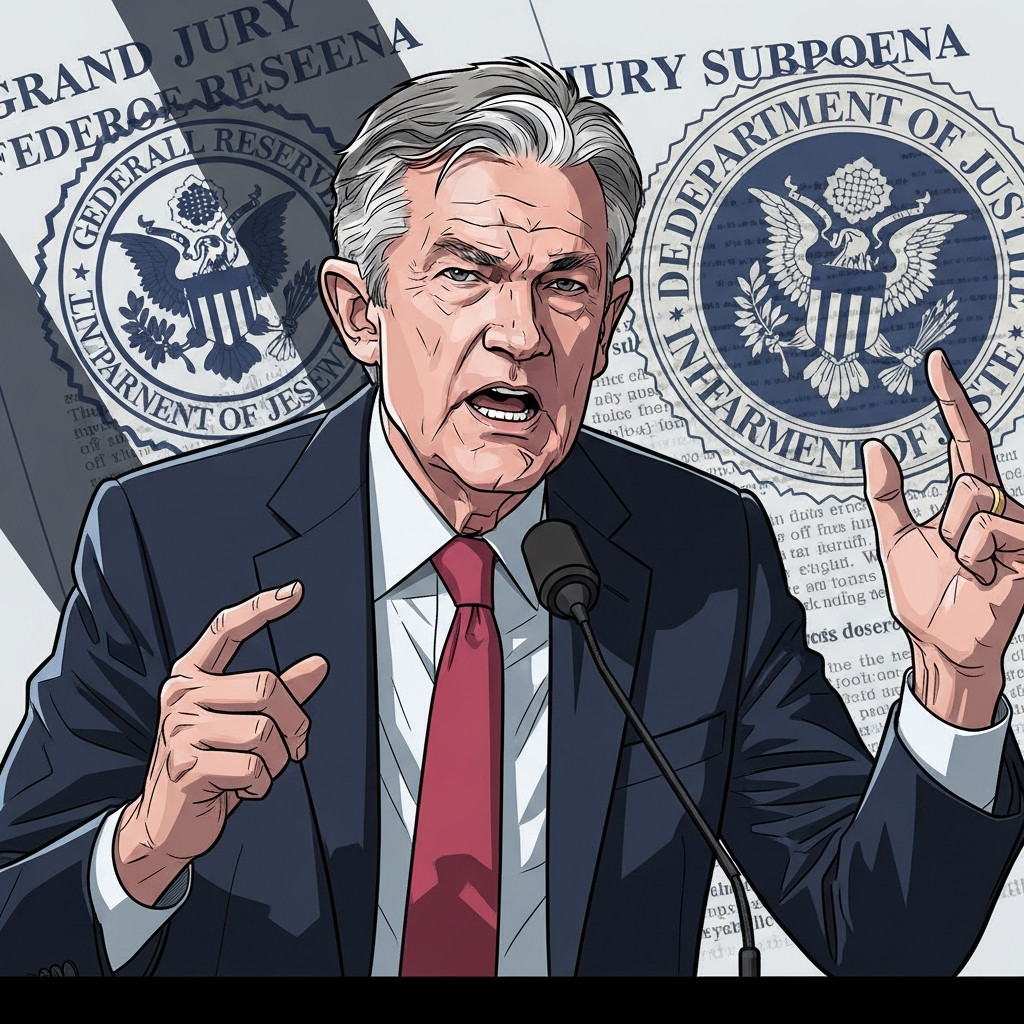
In an extraordinary move sending shockwaves through Washington D.C., the U.S. Department of Justice (DOJ) has issued grand jury subpoenas to the Federal Reserve, explicitly threatening criminal indictment against its Chair, Jerome Powell. This unprecedented development, announced by Powell himself in a forceful statement on January 11, 2026, has ignited a fierce debate about the independence of the nation’s central bank and the integrity of the executive branch. While the subpoenas ostensibly concern a multi-year renovation project of Federal Reserve buildings and Powell’s related testimony, the Fed Chair vehemently asserts these reasons are mere “pretexts” for a politically motivated attack on monetary policy.
Unpacking the Justice Department’s Explosive Action
The bombshell announcement revealed that the Department of Justice served grand jury subpoenas on a Friday, directly targeting the Federal Reserve and its Chairman, Jerome Powell. The core of the matter centers on Powell’s testimony before the Senate Banking Committee in June 2025, which included discussions about the multi-year project to renovate several historic Federal Reserve office buildings. This serious legal escalation, threatening criminal charges, immediately placed a spotlight on the often-delicate balance between government branches and independent institutions.
The Renovation: A Pretext or a Problem?
The renovation project itself has been a point of contention. The budget for the Federal Reserve headquarters renovation notably increased from $1.9 billion to $2.5 billion, drawing criticism from the Trump administration. Office of Management and Budget Chair Russell Vought, in particular, had previously accused Powell of overseeing an “ostentatious” renovation that might be “violating the law.” Vought specifically questioned the existence of new marble, “special elevators,” water features, or rooftop gardens.
In his June 2025 Senate testimony, Powell had directly refuted these claims, describing them as “misleading and inaccurate.” He denied any new marble beyond necessary replacements, special elevators, or new water features. Despite acknowledging that scrutiny of the construction project is “legitimate,” Powell’s recent statement strongly implies an “ulterior motive” behind the DOJ’s probe. For many, the timing and aggressive nature of the subpoenas suggest a larger agenda than mere oversight of building expenses.
The Battle for Federal Reserve Independence
Jerome Powell’s statement made it unequivocally clear: he believes the threat of criminal charges is not truly about building renovations or past testimony. Instead, he argues it is “a consequence of the Federal Reserve setting interest rates based on our best assessment of what will serve the public, rather than following the preferences of the President.” This assertion highlights a profound clash over the fundamental independence of monetary policy in the United States.
Why Fed Independence Matters
The Federal Reserve is designed to operate independently of political pressure. This insulation allows policymakers to make objective, sometimes unpopular, decisions — such as raising interest rates to combat inflation or keeping them stable amidst calls for cuts — based solely on economic data and conditions, rather than electoral cycles or presidential demands. This institutional autonomy is considered crucial for maintaining economic stability and public confidence in the financial system. If monetary policy were to become politicized, there is a significant risk of short-term political expediency overriding long-term economic health, potentially leading to increased inflation or instability.
A Pattern of Presidential Pressure
The Justice Department’s action comes amidst a long-standing and well-documented period of friction between President Trump and the Federal Reserve. President Trump has been consistently vocal in his demands for “much lower” interest rates to stimulate the economy, despite the Fed having already implemented several rate cuts. He has also openly criticized the Fed’s decisions and its leadership, consistently expressing dissatisfaction with the pace of interest rate adjustments.
Beyond public complaints, the administration’s pressure campaign against the Fed has included more direct and controversial actions. President Trump had openly threatened to fire Chairman Powell, whose term is slated to expire in May 2026. There was also an attempt to remove another Fed board member, Lisa Cook, citing “unsubstantiated allegations of mortgage fraud,” though the Supreme Court temporarily blocked this effort. These incidents, combined with the current subpoena, paint a picture of sustained executive branch efforts to exert influence over the central bank’s personnel and policies.
The Justice Department Under Scrutiny
While a Department of Justice spokesperson, Attorney General Pam Bondi, stated that U.S. Attorneys were instructed to prioritize investigations into any “abuse of taxpayer dollars,” the specific targeting of Powell has raised questions about the DOJ’s own independence. President Trump, speaking to NBC News, claimed ignorance of the Powell probe but added critical remarks about Powell’s performance and management skills. This juxtaposition further fuels speculation about political motivations behind the investigation.
Historical Parallels and Concerns
The article from Jurist.org draws parallels between the current action against Powell and previous instances where the Trump administration allegedly used legal actions against perceived political adversaries. Examples include the DOJ charging former FBI head James Comey with lying (charges later dismissed due to an unlawfully appointed prosecutor) and charges against New York Attorney General Leticia James (also dismissed due to an unlawfully appointed prosecutor, with a grand jury declining to indict on another charge). These historical examples bolster Powell’s argument that the subpoena might fit a pattern of the administration seeking indictments against political opponents, suggesting a political rather than purely substantive legal basis. The integrity and credibility of the Department of Justice are now under significant public scrutiny.
Bipartisan Outcry and Implications for the Future
The Justice Department’s subpoena has not only prompted a strong defense from Jerome Powell but also generated significant bipartisan criticism from Capitol Hill. Republican Senator Thom Tillis of North Carolina, a member of the Banking Committee that oversees Fed nominations, voiced profound concern. He viewed the action as definitive proof of the Trump Administration’s efforts to undermine the Federal Reserve’s independence and questioned the credibility of the DOJ itself. Senator Tillis vowed to oppose any future Fed nominees until the matter is resolved, signaling serious legislative fallout.
Similarly, Democratic Senate Minority Leader Chuck Schumer (D-NY) condemned the probe as “an assault on the Fed’s independence” and “the kind of bullying that we’ve all come to expect from Donald Trump and his cronies.” Senator Elizabeth Warren (D-MA), a ranking member of the Senate Banking Committee, accused the President of “abusing the authorities of the Department of Justice like a wannabe dictator,” pledging to oppose any Trump Fed nominee, including for Fed Chair. Senator Mark Warner (D-VA) reiterated the Fed’s design to operate independently to ensure long-term economic health, warning of economic instability if political pressure dictates its decisions.
Jerome Powell, initially nominated as Fed chair by Mr. Trump and confirmed overwhelmingly, later received a nomination for a second term by former President Joe Biden. He has served under four administrations, both Republican and Democratic, consistently affirming his commitment to duties “without political fear or favor, focused solely on our mandate of price stability and maximum employment.” Powell concluded his statement with a firm resolve, stating that “public service sometimes requires standing firm in the face of threats” and pledging to continue his job “with integrity and a commitment to serving the American people.” This ongoing legal battle represents a critical test for the institutional independence of the Federal Reserve and the broader checks and balances within the U.S. government.
Frequently Asked Questions
What prompted the Justice Department’s subpoena against the Federal Reserve and Jerome Powell?
The Justice Department issued grand jury subpoenas to the Federal Reserve and its Chair, Jerome Powell, ostensibly concerning Powell’s June 2025 testimony before the Senate Banking Committee regarding a multi-year renovation project of Federal Reserve office buildings. This renovation, with a budget that escalated from $1.9 billion to $2.5 billion, had previously drawn criticism from the Trump administration for alleged cost overruns. However, Powell has publicly asserted that these stated reasons are “pretexts,” believing the true motivation behind the criminal threat is the Federal Reserve’s independent decisions on interest rates, which have often diverged from President Trump’s preferences.
How does the Justice Department’s action challenge the Federal Reserve’s independence?
The DOJ’s subpoena and threat of criminal indictment directly challenge the Federal Reserve’s long-held institutional independence by appearing to politicize its operations and leadership. Fed independence is crucial for monetary policy decisions to be made free from political influence, ensuring they are based on economic conditions rather than short-term political cycles. By targeting the Fed Chair with criminal threats over issues Powell deems “pretexts,” the action could intimidate policymakers, potentially coercing them to align interest rate decisions with executive branch preferences. This undermines the central bank’s ability to maintain price stability and maximum employment without fear of retribution.
What are the potential consequences of politicizing the Federal Reserve’s interest rate decisions?
Politicizing the Federal Reserve’s interest rate decisions could lead to significant economic instability and erode public and market confidence. If interest rates are set based on political pressure rather than sound economic principles, it could result in increased inflation, asset bubbles, or prolonged recessions. For example, prematurely lowering rates to boost an economy for electoral purposes could overheat it, while artificially raising them could stifle growth. Such actions would undermine the Fed’s credibility, making it less effective in managing the economy, and could lead to capital flight or investor uncertainty, ultimately harming American citizens and businesses.
Conclusion: A Defining Moment for Institutional Integrity
The Justice Department’s grand jury subpoenas against the Federal Reserve and its Chair, Jerome Powell, mark a watershed moment in the ongoing struggle for institutional independence in the United States. What began as scrutiny over a building renovation has rapidly escalated into a direct challenge to the Fed’s ability to conduct monetary policy free from political interference. With bipartisan condemnation from senators and Powell’s steadfast commitment to his duties “without political fear or favor,” this controversy underscores the critical importance of safeguarding the autonomy of key governmental institutions. The outcome of this unprecedented probe will undoubtedly have lasting implications for the balance of power and the future of economic governance in America.