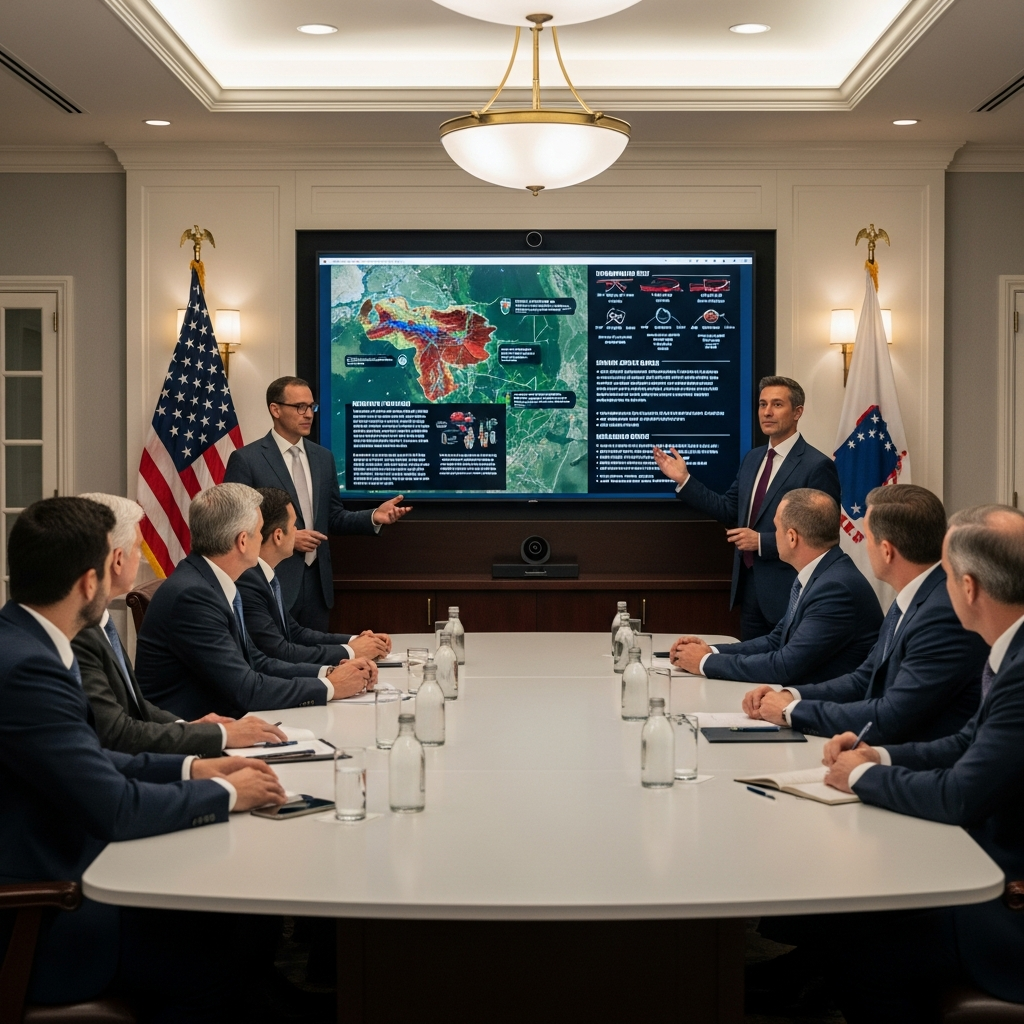
The White House recently hosted a pivotal, high-stakes meeting with an array of prominent oil and gas executives, charting an ambitious new course for U.S. engagement with Venezuela’s energy sector. This unprecedented summit, convened in the wake of significant geopolitical shifts, signals a dramatic reorientation of American foreign policy and economic strategy in the region. The primary agenda focused on unlocking Venezuela’s vast oil potential, securing substantial American investment, and establishing U.S. oversight in the post-Maduro era. This comprehensive strategy aims to rebuild a long-dilapidated industry, stabilize global oil markets, and potentially reshape the economic landscape of South America.
A New Era for Venezuela: Post-Maduro Operations
The critical White House meeting occurred shortly after a successful U.S. military operation that led to the capture of former Venezuelan President Nicolás Maduro and his wife, Cilia Flores. Both were apprehended on drug-trafficking charges and subsequently extradited to New York City. This decisive action paved the way for President Trump to announce a cancellation of any “second wave” of attacks on Venezuela, citing the nation’s cooperation with U.S. plans. The objective pivoted swiftly from military intervention to a robust economic and infrastructure rebuilding initiative, with a strong emphasis on Venezuela’s lucrative oil resources.
The U.S. has since initiated diplomatic outreach, with a State Department delegation traveling to Caracas. These “exploratory” talks aim to assess a phased resumption of embassy operations, indicating a desire to normalize relations. Amidst these developments, the U.S. also conducted extensive maritime interdiction operations, seizing several oil tankers in the Caribbean Sea and North Atlantic as part of an ongoing blockade.
The High-Stakes Summit: Key Players and Bold Proposals
President Trump personally welcomed nearly two dozen leading oil and gas executives to the White House. High-ranking officials present included Vice President JD Vance, Secretary of State Marco Rubio, Secretary of Energy Chris Wright, and Secretary of the Interior Doug Burgum. Key industry leaders from giants like Chevron, ExxonMobil, ConocoPhillips, Marathon, and Shell were in attendance, underscoring the gravity of the discussions.
President Trump outlined a bold vision for Venezuela’s future, centered on an estimated $100 billion in U.S. oil industry investment to revitalize its “dilapidated” infrastructure. He articulated a strategy where the U.S. would effectively “run” Venezuela and immediately take control of a significant portion of its oil. Specifically, Trump announced the transfer of “between 30 and 50 MILLION Barrels of High Quality, Sanctioned Oil” to the United States. This oil would be sold at market price, with proceeds managed by the U.S. President to benefit both nations. A pivotal condition of this new arrangement dictates that Venezuela would be required to purchase “ONLY American Made Products” with its received funds.
Securing American Interests and Investments
The proposed U.S. strategy in Venezuela extends beyond mere investment. President Trump emphasized the need for robust security guarantees for American firms. He envisioned a “large armada” of U.S. ships providing protection for investments, complemented by oil companies deploying their own security personnel and contributions from the Venezuelan populace. The U.S. would determine which firms could operate, essentially controlling the country’s energy landscape. Trump also indicated that the U.S. expects to oversee Venezuela’s oil operations for an “extended period,” potentially for years, ensuring its profitable rebuilding. He even floated the idea of inviting Russia and China to “buy as much oil as they want” from U.S. companies operating in Venezuela, a notable shift from prior intentions to exclude these nations.
Oil Executives Weigh In: Opportunities and Obstacles
While the White House meeting was described as exciting by attendees, oil executives expressed a blend of cautious optimism and significant concerns, particularly regarding past asset nationalizations.
ExxonMobil CEO Darren Woods notably declared Venezuela “uninvestable” in its current state. He stressed the necessity for “pretty significant changes” and a “win-win-win proposition” for all stakeholders before re-entering, recalling previous asset seizures.
ConocoPhillips executive Ryan Lance advocated for “bigger and bolder” thinking. He proposed a comprehensive restructuring of the entire Venezuelan energy system, including its national oil company, PDVSA, and suggested involvement from the U.S. Export-Import Bank. ConocoPhillips alone lost an estimated $12 billion from past nationalizations.
Chevron Vice Chairman Mark Nelson struck a more confident tone. As the only major U.S. oil company still operating in Venezuela (with over 3,000 employees and a century-long history), Chevron remains committed. The company expects its operations to drastically increase by 50% over the next 18 months to two years, building on its current investments.
Despite the expressed challenges, President Trump assured executives they would make significant money, positioning the U.S. to ensure Venezuela’s survival while recovering investments.
Beyond Venezuela: Geopolitical Threads and Domestic Updates
The White House meeting, though centered on Venezuela oil investment, also touched upon several other critical topics, highlighting the wide scope of the administration’s foreign and domestic policy agenda.
Greenland Acquisition and Strategic Imperatives
During the discussions, President Trump reiterated his strong desire for the United States to acquire Greenland from Denmark. Citing strategic necessity, he emphasized that “countries have to have ownership and you defend ownership, you don’t defend leases.” He maintained that U.S. ownership would prevent adversaries like China or Russia from acquiring it, a scenario he deemed unacceptable. While European allies reaffirmed Greenland’s sovereignty, Trump’s insistence on “doing something on Greenland” underscored a broader strategic imperative to expand U.S. influence and control.
The White House Ballroom: A Brief Interruption
In an unexpected moment during the critical meeting, President Trump briefly paused the discussions to show off the ongoing construction of a new ballroom at the White House. This project, announced in October 2025, aims to modernize the White House, allowing it to accommodate larger events. Trump highlighted that the construction, funded privately and “ahead of schedule” and “under budget,” would feature advanced security measures like “bulletproof glass, drone-proof ceilings.” The project, however, has faced controversy, with critics condemning the demolition of parts of the historic East Wing’s facade.
Other Notable Discussions
The meeting also saw discussions on a range of other topics:
Iran Protests: Trump expressed support for ongoing anti-government protests and threatened U.S. intervention if violence escalated.
Credit Card Interest Rates: He proposed a one-year, 10% cap on credit card interest rates, though this proposal drew criticism from Senator Bernie Sanders and billionaire Bill Ackman.
Child Care Subsidies: A federal judge blocked the administration’s attempt to withhold funds from five Democratic-led states.
Minnesota Fraud Investigations: Treasury Secretary Scott Bessent announced new initiatives to investigate alleged fraud in Minnesota.
California Wildfires: Trump considered an executive order to expedite rebuilding after last year’s devastating fires.
Broader Implications and Congressional Scrutiny
The comprehensive U.S. oil strategy in Venezuela carries profound geopolitical implications. Trump’s assertion that the U.S. would “run” Venezuela and oversee its economic recovery for an extended period suggests a long-term commitment. This interventionist approach has not gone unnoticed, with the Senate advancing a war powers resolution (52-47) to limit the President’s ability to conduct military operations in Venezuela without congressional authorization. Senator Tim Kaine, the resolution’s proponent, warned of a potential “few years of U.S. occupation.”
Economically, the prospects for ordinary Venezuelans remain challenging. The nation continues to grapple with hyperinflation and widespread poverty. While the U.S. strategy promises rebuilding and financial benefits, economists remain cautious about immediate improvements. International bodies, including the Vatican, have called for respect for Venezuelans’ will and human rights, implicitly critiquing interventions that undermine international legal order. The audacious U.S. plan signifies a definitive pivot towards assertive economic and strategic control in a nation rich with critical energy resources.
Frequently Asked Questions
What was the primary outcome of the White House meeting regarding Venezuela?
The primary outcome was the unveiling of a bold U.S. strategy to revitalize Venezuela’s oil industry following Nicolás Maduro’s capture. President Trump outlined a plan for U.S. oil companies to invest at least $100 billion, with the U.S. taking control of 30-50 million barrels of Venezuelan oil. Proceeds would be managed by the U.S., and Venezuela would be required to purchase only American-made products, marking a significant shift towards direct U.S. economic oversight and resource management.
Who were the key players involved in these discussions about Venezuela’s oil future?
The meeting gathered President Trump, Vice President JD Vance, Secretary of State Marco Rubio, Secretary of Energy Chris Wright, and Secretary of the Interior Doug Burgum. Key industry leaders from major oil companies like Chevron, ExxonMobil, ConocoPhillips, Marathon, and Shell were present. These officials and executives discussed strategies for substantial investment and the operational specifics of re-engaging with Venezuela’s energy sector.
What are the main challenges for oil companies considering investment in Venezuela?
Oil executives highlighted significant challenges despite expressing excitement. Companies like ExxonMobil and ConocoPhillips, which previously lost billions due to asset nationalizations by former regimes (ConocoPhillips alone lost $12 billion), emphasized that Venezuela is “uninvestable” without “pretty significant changes” to its legal system. They seek a “win-win-win proposition” for all stakeholders, underscoring the need for strong legal reforms and security guarantees before committing to massive new investments.
Conclusion
The recent White House summit marks a decisive and ambitious turn in U.S. foreign policy toward Venezuela. By convening top oil executives, the administration has laid out a comprehensive plan for economic reconstruction centered on the nation’s vast oil reserves, following the dramatic capture of Nicolás Maduro. This strategy not only aims to inject billions into Venezuela’s dilapidated infrastructure but also seeks to secure long-term U.S. control over its energy assets and influence its economic trajectory. While facing both excitement from industry leaders and calls for caution due to past challenges, this bold U.S. oil strategy in Venezuela reflects a new geopolitical reality, with potential implications for global energy markets, regional stability, and the future of U.S. foreign engagement.