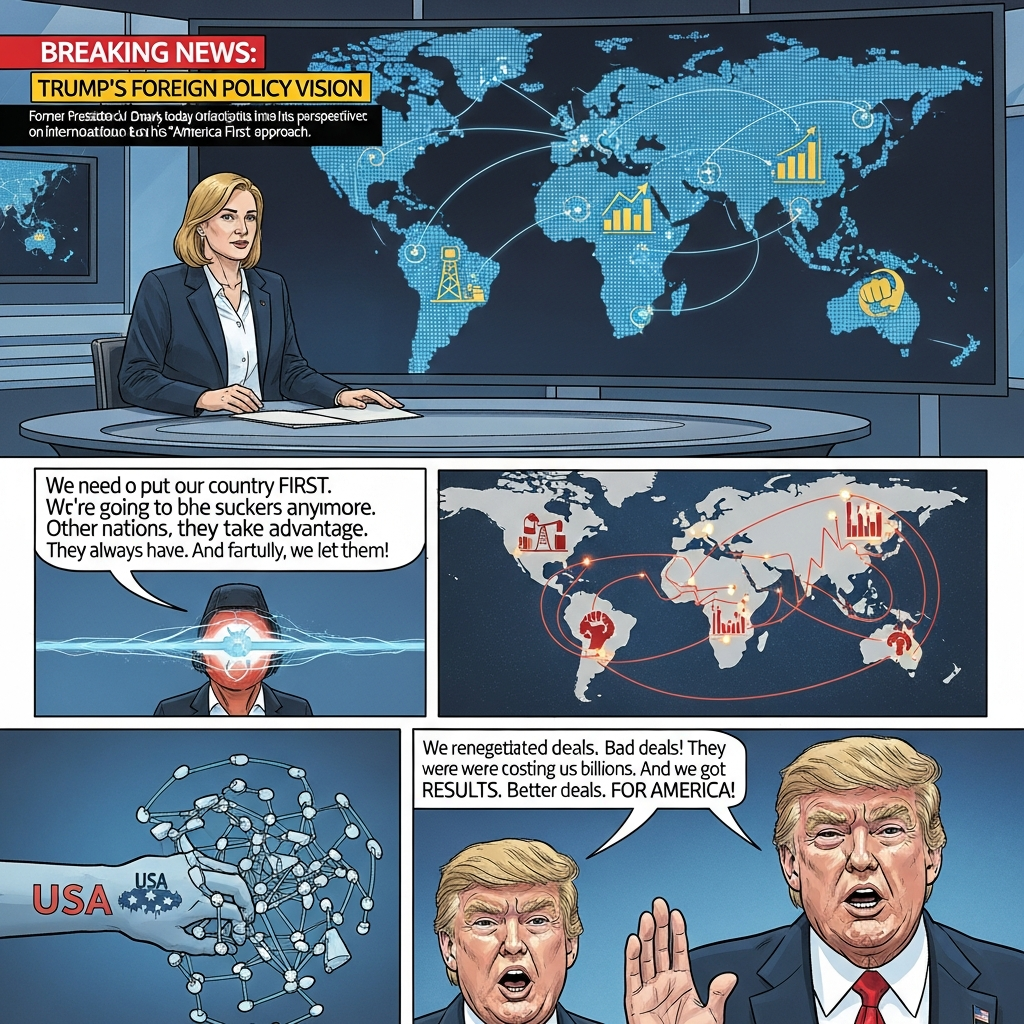
Understanding the intricacies of contemporary international relations requires a critical look at the motivations and impacts behind a nation’s foreign policy. Donald Trump’s unique approach to global affairs has consistently sparked debate among experts and allies alike. Characterized by a blend of personal conviction, transactional deal-making, and an often-unpredictable style, his foreign policy has defied traditional diplomatic norms. This comprehensive analysis dives into the core tenets, critical shortcomings, and lasting implications of a Trump foreign policy, aiming to provide clarity on its global ramifications.
The Shifting Sands of “America First”: From Isolation to Intervention
Initially championed under the banner of “America First,” Trump’s foreign policy rhetoric often promised a retreat from costly foreign entanglements and nation-building. However, a deeper examination reveals a complex and sometimes contradictory evolution. What began as a perceived isolationist stance has, at times, morphed into an “America Everywhere” interventionist posture, particularly evident in proposals like the “takeover” of Gaza or the attempted purchase of Greenland. This puzzling shift leaves many observers “slack-jawed,” questioning the underlying strategy.
A Policy Defined by Personal Motives, Not Grand Strategy
Experts frequently argue that Trump’s foreign policy approach is less guided by a coherent grand design and more by personal vanity, vindictiveness, and immediate self-interest. William Kristol notes that Trump often appears “drunk on fantasies of power,” his public statements brimming with “frantic boasts and foolish words.” This focus on individual perception rather than strategic objective, critics suggest, can lead to a foreign policy that lacks consistency and long-term vision. Such an approach, rooted in personal “quirks, fixations, and derangements,” can accelerate American decline rather than fortify its position on the global stage.
The “Madman Theory” vs. True Unpredictability
While some leaders, like former President Richard Nixon, deliberately cultivated an image of irrationality—a calculated “madman theory”—to deter adversaries, analysts contend Trump’s unpredictability is inherently different. It often stems not from strategic calculus but from genuine impulsiveness, leading to a genuinely chaotic and muddled global strategy. This lack of consistent messaging can throw “a wrench in NATO allies’ long-term budgeting” and create opportunities for rivals like Russia and China, who “are playing the long game” against perceived U.S. inconsistencies.
Key Pillars of Trump’s Foreign Policy Doctrine
A closer look at the recurring themes in Trump’s international relations reveals several core characteristics that diverge significantly from previous administrations. These pillars, while sometimes presented as innovative, have drawn sharp criticism for their potential to destabilize existing alliances and undermine global order.
Transactional Diplomacy and Resource Acquisition
A cornerstone of Trump’s diplomatic strategy involves viewing international relations as a series of transactions. This approach prioritizes securing strategic natural resources, a motivation highlighted in proposals to acquire Greenland for its wealth or to demand “sole source contracts” for U.S. companies in the Western Hemisphere. Venezuela’s vast oil reserves, for example, are seen by some as a primary driver behind aggressive U.S. actions, rather than democracy promotion or drug enforcement. This resource-centric view, often articulated through claims like “We need Greenland from the standpoint of national security,” underscores a pragmatic, yet controversial, element of his policy.
Undermining Alliances: NATO and the Liberal Order
Trump’s skepticism towards multilateral institutions and traditional alliances is well-documented. He has frequently pushed for European allies to increase defense spending, questioning the value of organizations like NATO. While calling for NATO to cease “perpetually expanding,” this stance raises concerns about the integrity of an alliance system that underpins international order. The real danger, as Kristol suggests, is that Trump’s “vanity and grandiosity” could lead to actions that signal the “end of an already tottering NATO,” potentially causing conflict with allies like Denmark over territories like Greenland. This approach can be perceived as undermining rather than strengthening US alliances.
The “Belly-Button Rule”: A Crisis of Accountability
Effective foreign policy, especially during complex operations like regime change, demands clear leadership and accountability. Drawing from decades of command experience, Mark Hertling introduces the “belly-button rule”: for any difficult task, a senior leader must be able to point to one person and say, “You’re in charge.” Hertling criticizes Trump’s tendency to gesture towards a group of senior advisors, diffusing responsibility rather than assigning it to a single accountable official. This lack of focused leadership, mirroring the “strategic incoherence and chaos” seen in post-invasion Iraq, can lead to failed missions and blurred outcomes because “hope…is not a method or a plan.”
Case Studies: Unpacking Specific Foreign Policy Decisions
Examining specific events provides concrete illustrations of Trump’s foreign policy in action, revealing both the stated intentions and the often-unforeseen consequences of his decisions. These examples highlight the tension between rhetoric and reality on the global stage.
Venezuela: Oil, Overreach, and Ousted Leadership
The U.S. stance on Venezuela offers a powerful example of Trump’s foreign policy at play. While publicly framed as a response to drug trafficking, experts like Daniel Litvin argue that access to Venezuela’s massive oil reserves is a key, if not primary, motivator for seeking regime change. Trump’s boasts about “running” Venezuela and American oil companies reaping profits, according to Kristol, are “empty boasting” with potential costs. Even the industry itself reportedly viewed administration outreach as “sporadic” and a “shoot-ready-aim exercise,” underscoring the gap between political rhetoric and practical implementation. The dismissal of opposition leader María Corina Machado, reportedly due to her acceptance of a Nobel Peace Prize that Trump “openly coveted,” further illustrates the personal drivers behind policy decisions.
Greenland and Gaza: Expansionist Fantasies
Trump’s reported interest in purchasing Greenland from Denmark and his controversial proposal to “take over” and reconstruct Gaza into the “Riviera of the Middle East” exemplify an expansionist, real-estate-developer’s approach to international affairs. These ideas, met with “widespread rejection” internationally and sharp criticism domestically from figures like Senator Rand Paul, suggest a willingness to disregard international law and allied concerns in pursuit of ambitious, yet often legally and practically unfeasible, goals. The paradox of proposing such grand foreign projects while simultaneously dismantling U.S. aid agencies like USAID further highlights the inconsistencies within this foreign policy framework.
Putin’s Edge: Adversaries Exploiting Inconsistency
Despite reports of “Putin’s Humiliations” in early 2026, including debunked drone claims and the swift capture of Maduro (a Kremlin ally), Trump’s foreign policy often appears to empower adversaries through its inconsistency. While a headache for Putin might be a “silver lining” for some, the broader perception of U.S. unpredictability could allow rivals to “play the long game.” The notion that “Ego-driven petulance is no substitute for strategy” suggests that a lack of unified resolve can leave the U.S. vulnerable, dividing allies and failing to truly unite adversaries against common threats.
Domestic Repercussions and Global Perceptions
The impact of a nation’s foreign policy extends beyond international borders, deeply influencing domestic priorities and global perceptions of its values and leadership. Trump’s approach has been criticized for intertwining foreign policy with domestic cultural battles, often at the expense of broader national interests.
Eroding Institutions: Law, Science, and Diplomacy
Critics argue that Trump’s foreign policy stance, as articulated in documents like his National Security Strategy (NSS), “undermines the very institutions that helped make America great.” This includes the rule of law, scientific excellence, and a traditional openness to foreigners. By elevating immigrants and drugs as the greatest threats while “utterly dismiss[ing]” catastrophic climate change, pandemics, and inequality, the administration is seen as exacerbating domestic vulnerabilities. This internal focus on perceived threats, rather than addressing complex global challenges, can weaken both domestic resilience and international credibility.
The Rise of “White Nationalist Racism” as a Strategic Tool
A particularly controversial aspect highlighted in critiques of the NSS is its “avid propagation of white nationalist racism.” This perspective, which celebrates America as a “blood and soil” nation and aims to eliminate diversity, equity, and inclusion (DEI) programs, extends into foreign policy by interpreting Europe as threatened by “civilizational erasure” due to migration. Consequently, the strategy suggests U.S. intervention in European domestic affairs by “cultivating resistance” and aiding far-right “patriotic European parties,” making the rise of white nationalist parties a strategic global focus. This intertwining of domestic ideology with international relations marks a significant departure from conventional diplomatic strategy.
The Cost of “Foolish Words”: A Legacy of Dishonor?
The cumulative effect of a Trump foreign policy driven by personal motives, unpredictable actions, and a transactional view of alliances raises profound questions about the nation’s long-term standing. William Kristol warns that if the U.S. permits this path, the legacy will be one not just of policy failure but of “national dishonor.” This sentiment underscores a deeper concern that without a foundation of responsible strength and adherence to principles, the nation risks both its reputation and its ability to effectively navigate complex global challenges.
Frequently Asked Questions
What are the core criticisms of Trump’s foreign policy approach?
Experts criticize Trump’s foreign policy for lacking coherent grand strategy, being driven by personal vanity and vindictiveness, and demonstrating significant unpredictability. Key criticisms include a transactional view of international relations, a tendency to undermine traditional alliances like NATO, and a lack of clear accountability in complex operations. This approach is seen as potentially leading to policy failures, eroding U.S. credibility, and accelerating national decline.
How has Trump’s foreign policy impacted key international alliances like NATO?
Trump’s foreign policy has significantly impacted NATO by frequently questioning its value and demanding increased defense spending from European allies. His skepticism towards multilateral institutions and proposals that could destabilize allied territories, such as the attempted acquisition of Greenland, have raised concerns about the alliance’s long-term integrity. This approach has caused uncertainty among allies and has been seen by some as a move that could ultimately weaken the liberal international order.
Why is accountability crucial in complex foreign operations, according to experts?
According to experts like Mark Hertling, clear accountability is crucial in complex foreign operations because it ensures effective planning, execution, and adaptation. His “belly-button rule” emphasizes that a single, identifiable leader must be in charge of difficult tasks. Without this clear responsibility, execution suffers, accountability disappears, and disciplined decision-making falters, leading to “strategic incoherence and chaos.” Experts argue that “hope is not a method or a plan” when it comes to successful international interventions.
Conclusion: Charting a Responsible Path Forward
Navigating the complexities of global politics demands a foreign policy that is both robust and principled. While the specific outcomes of a Trump foreign policy will continue to unfold, the preceding analysis highlights crucial areas of concern: the erosion of alliances, the perils of unpredictability, and the potential for a legacy defined by personal ambition rather than strategic foresight. For readers seeking to understand the ongoing shifts in international relations, recognizing these dynamics is the first step toward advocating for a more stable, accountable, and principled engagement with the world.