The cosmos holds countless wonders, but few discoveries are as pivotal as identifying a completely new type of celestial object. The Hubble Space Telescope has achieved just that, definitively confirming Cloud-9—a groundbreaking starless dark matter cloud. Heralded as the universe’s first confirmed “failed galaxy,” this object, formally a Reionization-Limited H I Cloud (RELHIC), offers unparalleled insights into the early universe and the enigmatic nature of dark matter.
This monumental finding, meticulously detailed through a series of deep observations released in early 2026, validates a decades-old theoretical prediction. For the first time, scientists have direct evidence of a gravitationally bound structure rich in gas but entirely devoid of stars. Cloud-9 serves as a pristine cosmic laboratory, shedding new light on the fundamental processes of galaxy formation.
Unveiling Cloud-9: A Cosmic Relic Confirmed
Modern cosmology posits that dark matter orchestrated the universe’s large-scale structure long before the first stars ignited. Numerical simulations predicted countless small dark matter halos would form shortly after the Big Bang. While some captured cold gas to become luminous galaxies, others were theorized to “fail”—their gas never cooling enough for stars to form. Until now, these “failed galaxies” remained theoretical. Hubble’s observations provide the first direct confirmation.
The hunt for such elusive objects presented significant challenges. Without stars, they emit almost no visible light. Dark matter itself is inherently invisible. Only a faint signal from neutral hydrogen (H I) offered a detectable trace. For years, radio surveys identified isolated hydrogen clouds, but most were later categorized as tidal debris or faint dwarf galaxies, making definitive “starless” proof elusive.
The first tangible clues emerged from China’s Five-hundred-meter Aperture Spherical Telescope (FAST). Its deep surveys of neutral hydrogen near the spiral galaxy Messier 94 (M94), located approximately 14 million light-years away, pinpointed a compact cloud with a clean velocity signature. This isolated cloud lacked an obvious optical counterpart and moved distinctly from known galactic debris, immediately capturing astronomical attention.
Subsequent observations by the Green Bank Telescope and the Karl G. Jansky Very Large Array in the United States confirmed the hydrogen signal. They refined its properties, revealing a gas mass roughly one million times that of the Sun. The cloud’s velocity structure suggested it was gravitationally bound. Still, the crucial question remained: was it genuinely starless, or did it harbor an extremely faint dwarf galaxy beneath ground-based detection limits? To resolve this, astronomers needed the unparalleled sensitivity of space-based imaging, turning to the Hubble Space Telescope.
Cloud-9: The Universe’s First Confirmed RELHIC
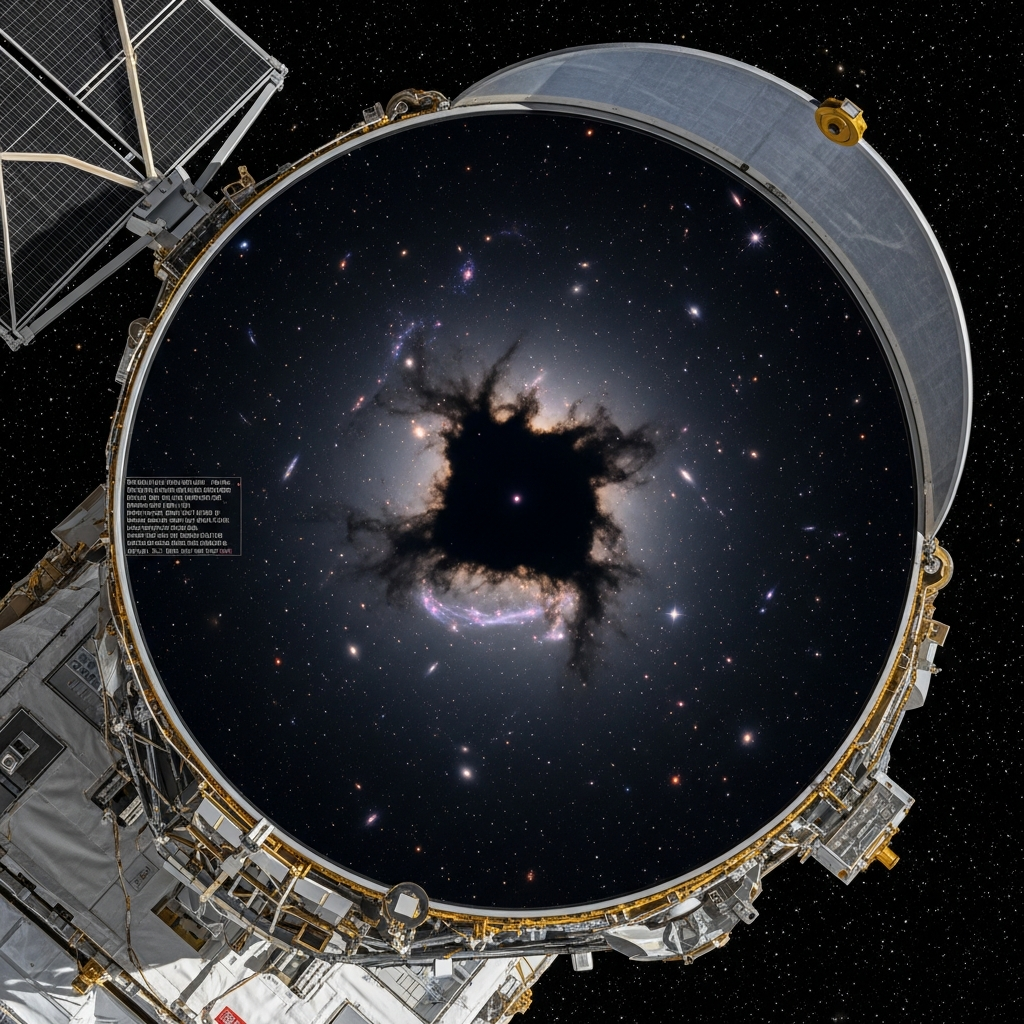
Hubble’s Advanced Camera for Surveys (ACS) delivered the definitive answer. With extreme sensitivity, it observed Cloud-9’s precise location. The goal: detect even the faintest stars. Images showed distant background galaxies and unrelated foreground stars. Crucially, within Cloud-9’s projected area, no stellar population was found. The data conclusively ruled out even ultra-faint dwarf galaxies. For the first time, astronomers confirmed a gravitationally bound object containing abundant gas but no stars. This finding remarkably aligns with predictions for a Reionization-Limited H I Cloud (RELHIC).
Lead author Gagandeep Anand, from the Space Telescope Science Institute, highlighted Hubble’s critical role in confirming the object’s starless nature. Principal investigator Alejandro Benitez-Llambay characterized Cloud-9 as “a tale of a failed galaxy,” describing it as a “fossil leftover” from the universe’s primordial building blocks.
Cloud-9’s dense core stretches about 4,900 light-years across. It remains compact and notably spherical. These characteristics distinguish it from typical hydrogen clouds formed by galactic interactions. Importantly, Cloud-9 shows no tidal connection to Messier 94, nor does it resemble stripped material. Instead, it appears dynamically stable. This strengthens its classification as a true dark matter relic, not a transient cosmic structure. Researchers estimate its total dark matter mass at around five billion solar masses, crucial for balancing its gas pressure against gravitational pull.
Why a “Failed Galaxy” Matters: Insights into Dark Matter and Cosmic Evolution
The discovery of Cloud-9 profoundly demonstrates that galaxy formation is not an inevitable outcome. Dark matter halos can persist without stars for billions of years. This supports models where intense ultraviolet radiation during the epoch of reionization suppressed star formation in low-mass systems. It also provides a significant clue for the “missing satellites problem.” Cosmological simulations predict more small dark matter halos than observed luminous dwarf galaxies. Cloud-9 suggests many of these halos may simply be dark, undetectable by traditional methods.
As team member Andrew Fox noted, Cloud-9 offers a unique “window into the dark universe.” It presents a rare chance to study a dark-matter-dominated cloud directly, free from the complexities of luminous stars. Most dark matter studies rely on stellar motions, which involve intricate baryonic physics. Stars evolve, explode, and influence their surroundings. Cloud-9 avoids these complications. Here, gas directly traces gravity. This makes Cloud-9 an exceptionally clean system for testing dark matter behavior on small scales.
A Pristine Laboratory for Dark Matter Research
This singular object near M94 is a pristine natural laboratory. Its lack of stars eliminates the “noise” of stellar evolution. This allows astronomers to isolate and scrutinize the interactions between dark matter and neutral hydrogen gas. Such direct insight is invaluable for refining dark matter density profiles. It also helps test alternative dark matter models.
Cloud-9 is the first confirmed example, but it is likely not unique. Its rarity and distinctive features—smaller, more compact, and remarkably spherical than other hydrogen clouds—underscore its importance. The discovery paves the way for future astronomical surveys to uncover more such “relics.” These findings promise to further enrich our understanding of the universe’s hidden components and its evolutionary paths. Rachael Beaton likened these objects to “abandoned houses” in the galactic neighborhood, silent witnesses to cosmic history.
The Delicate Balance: Why Cloud-9 Never Formed Stars
Cloud-9 exists within a fascinating cosmic “sweet spot.” If its dark matter halo mass had been significantly greater—exceeding, for example, five billion solar masses—its gas would likely have collapsed. This would have ignited star formation, creating a dwarf galaxy. Conversely, a much less massive halo might have lost its gas. Environmental factors in the early universe could have stripped or ionized it, erasing its neutral hydrogen signature.
The prevailing theory suggests that following the epoch of reionization, intense ultraviolet radiation flooded the intergalactic medium. This radiation, originating from the first stars and quasars, heated gas. It made it difficult for small dark matter halos to retain gas or cool it sufficiently for star formation. Cloud-9, therefore, represents a perfect natural experiment. It held onto its gas, yet remained just below the critical threshold for star formation. This allowed it to persist as a long-lived, starless relic until today.
Cloud-9’s future is also a subject of scientific intrigue. It could, theoretically, accrete more mass over eons, eventually forming stars and evolving into a true galaxy. Alternatively, if its environment changes or its gas disperses, its unique signature could vanish. For now, it remains a stable, compact, and remarkably spherical testament to a critical phase of cosmic evolution.
Frequently Asked Questions
What makes Cloud-9 unique compared to other cosmic objects?
Cloud-9 is groundbreaking as the first definitively confirmed Reionization-Limited H I Cloud (RELHIC). This means it’s a starless dark matter cloud containing a vast amount of neutral hydrogen gas but has never formed any stars. Unlike typical galaxies, which are vibrant with stellar activity, Cloud-9 represents a “failed galaxy” or a “fossil leftover” from the early universe. Its existence allows astronomers to study dark matter and the initial stages of galaxy formation without the complicating presence of light from stars, offering a pristine cosmic laboratory.
Which telescopes were crucial in discovering and confirming Cloud-9?
The discovery and confirmation of Cloud-9 involved a multi-telescope approach. The initial detection of its neutral hydrogen signature came from the Five-hundred-meter Aperture Spherical Telescope (FAST) in China. Subsequent detailed measurements, tracing gas distribution and dynamics, were performed by the Green Bank Telescope and the Karl G. Jansky Very Large Array (VLA) in the United States. However, the conclusive proof of its starless nature—ruling out faint dwarf galaxies—was provided by the NASA/ESA Hubble Space Telescope’s Advanced Camera for Surveys (ACS), which precisely imaged the cloud without finding any stars.
Why is studying objects like Cloud-9 so important for astronomy?
Studying Cloud-9 is profoundly important because it addresses several fundamental questions in astrophysics. It provides direct observational evidence supporting long-predicted theoretical models of “failed galaxies” and offers key insights into the “missing satellites problem” in cosmology. Most importantly, Cloud-9 presents a unique, unobstructed view of dark matter in isolation. Without stellar interference, scientists can observe how gas responds directly to gravity, enabling better refinement of dark matter density profiles and rigorous testing of alternative dark matter models. It also illuminates the harsh conditions of the early universe and how they suppressed star formation.
Conclusion
The confirmation of Cloud-9 by the Hubble Space Telescope marks a profound achievement in our ongoing quest to comprehend the universe. This starless dark matter cloud, a cosmic relic from an early epoch, bridges the gap between theoretical predictions and observational reality. It underscores that the universe harbors mysteries far beyond its luminous components, revealing a “dark universe” critical to cosmic evolution. As astronomers continue their explorations, Cloud-9 stands as a powerful testament to the intricate and sometimes unexpected pathways of galaxy formation, offering an unparalleled laboratory for unraveling the enduring enigma of dark matter. Its existence propels further investigation, promising more incredible revelations about the hidden structures that shape our cosmos.
References
- science.nasa.gov
- <a href="https://www.esa.int/ScienceExploration/SpaceScience/Cloud-9anewcelestialobjectfoundby_Hubble”>www.esa.int
- <a href="https://www.spacedaily.com/reports/HubbleconfirmsdarkstarlessreliccloudneargalaxyM94_999.html”>www.spacedaily.com
- www.miragenews.com
- www.nasa.gov