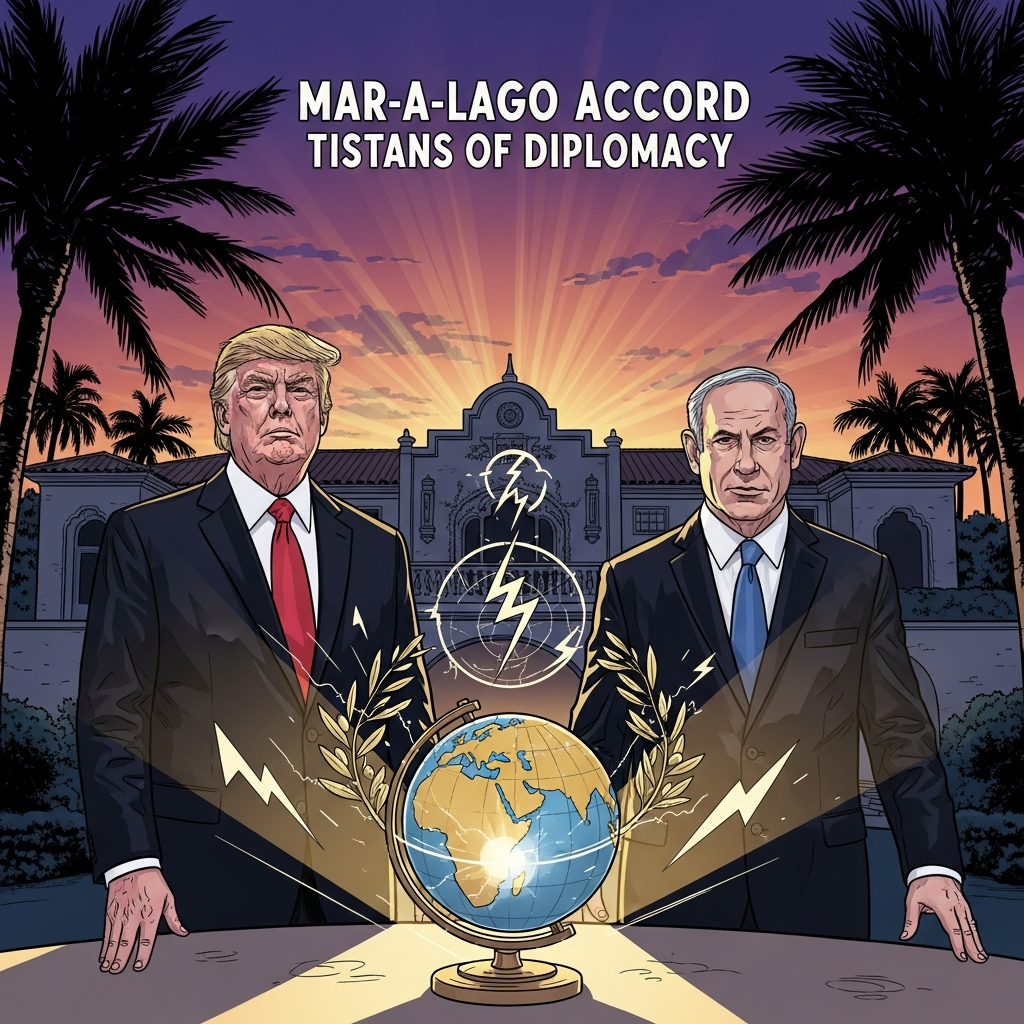
In a pivotal December 2025 summit at Mar-a-Lago, President Donald Trump and Israeli Prime Minister Benjamin Netanyahu presented a remarkably united front. Their discussions, centered on the delicate Gaza peace plan and mounting tensions with Iran, signaled a potentially transformative shift in Middle East diplomacy. Despite previous reports of underlying strains, the leaders exchanged effusive praise, hinting at a deepening alliance amidst complex regional and global challenges. This high-stakes meeting outlined stern warnings, personal accolades, and a clear vision for the next steps in an evolving geopolitical landscape.
A United Front: Trump and Netanyahu’s Mar-a-Lago Summit
The meeting between President Trump and Prime Minister Netanyahu, held at Trump’s private Florida club, unfolded with notable displays of camaraderie. Both leaders lauded each other’s leadership, downplaying any past disagreements and emphasizing their shared objectives for regional stability. This “brotherly romance,” as some observers termed it, aimed to project unwavering resolve on critical issues from Gaza to Iran.
Gaza Peace Plan: Demands and Divisions
Central to the discussions was the ongoing Gaza peace plan, a multi-phase initiative following nearly two years of intense conflict ignited by the October 2023 Hamas attacks. Trump unequivocally stressed the critical necessity for Hamas to disarm, cautioning that refusal would lead to “horrible” consequences. He asserted that other nations were prepared to “wipe them out” if the militant group resisted. While US Secretary of State Marco Rubio had previously detailed a second phase involving a technocratic Palestinian administration and an international police force, Trump’s immediate focus remained on Hamas’s demilitarization.
The “first phase” agreement, brokered with Trump’s “personal touch,” included a temporary pause in fighting and the release of Israeli hostages in exchange for Palestinian prisoners. This crucial initial step, confirmed by Israeli officials, Hamas, and mediator Qatar, marked a significant diplomatic achievement. However, the broader 20-point (or sometimes referenced as 21-point) peace plan extends further, stipulating Israeli troop withdrawal, increased humanitarian aid delivery, and the establishment of a civilian governing authority for Palestinians in Gaza.
Despite Israeli military actions in Gaza post-ceasefire, which included reported casualties and restrictions on humanitarian aid, Trump maintained that Israel was “100 percent” fulfilling its commitments, expressing no concerns about their actions. Prime Minister Netanyahu, for his part, fully endorsed Trump’s plan, aligning it with Israel’s war aims of dismantling Hamas and securing a future free from threats originating in Gaza. Yet, Netanyahu reiterated his strong opposition to a Palestinian state, referencing the October 7th attacks as justification.
Iran’s Nuclear Ambitions: A Line in the Sand
A significant point of discussion at Mar-a-Lago involved Iran. President Trump delivered a stark warning, threatening further US military action if Iran were to rebuild its nuclear program or missile capacity. He explicitly stated, “if they are, we’re going to have to knock them down… We’ll knock the hell out of them,” particularly if missile development continued or nuclear efforts accelerated. Trump also credited prior US air strikes against Iranian nuclear facilities in June 2025 as instrumental in paving the way for the Gaza ceasefire.
This stance came despite Iran’s consistent denials of seeking nuclear weapons and its refusal to negotiate over its missile program. The regional context is further complicated by Israel’s widely believed, yet undeclared, nuclear arsenal. The US commitment to backing Israeli strikes under these conditions marks a resolute US foreign policy position towards Tehran.
“Brotherly Romance”: The Personal Dynamics
The Mar-a-Lago meeting starkly contrasted with earlier media speculation about potential friction between the two leaders. Trump hailed Netanyahu as a “hero,” crediting his wartime leadership with safeguarding Israel’s existence and reaffirming steadfast US support. Trump also publicly mentioned his efforts to secure a presidential pardon for Netanyahu, who faces corruption charges in Israel, though Herzog’s office quickly denied any immediate decision. In a reciprocal gesture, Netanyahu announced that Trump would be awarded the Israel Prize, the country’s highest cultural honor, for his “exceptional contribution to the Jewish people.” Education Minister Yoav Kisch excitingly announced this unprecedented award for a non-Israeli citizen, reflecting the “overwhelming sentiment of Israelis.”
Deeper Dive: Trump’s Vision for Regional Stability
Trump’s overarching vision for the Middle East, codified in the 20-Point Peace Plan, seeks to redefine regional governance and security. A key proposal is the establishment of an international transitional “Board of Peace,” which Trump confirmed he would chair. This board aims to oversee Gaza’s governance, with former U.K. Prime Minister Tony Blair also slated for membership. Gaza would be managed by a temporary, technocratic, apolitical Palestinian committee, excluding the Palestinian Authority unless significant reforms are undertaken. The plan clearly states that Israel “will not occupy or annex Gaza,” emphasizing the territory’s redevelopment for its people’s benefit.
Beyond the Middle East: Broader Trump Administration Actions
While the Trump-Netanyahu meeting dominated headlines, other significant actions by the Trump administration were underway globally and domestically in late 2025.
Venezuela Under Pressure: Covert Strikes and Drug Interdiction
The administration unveiled an aggressive new phase in its pressure campaign against the Maduro government in Venezuela. This included a CIA drone strike on a port facility in Venezuela, believed to be used by a narcotics gang. This operation, the first known American strike inside Venezuela, marked an escalation beyond previous military actions in international waters, which had targeted boats suspected of drug trafficking. President Trump confirmed the US responsibility for a “major explosion in the dock area,” stating it was an “implementation area” for drugs that was “no longer around.” This campaign has led to numerous fatalities, drawing criticism from legal experts who question the legality of these “extrajudicial killings.”
Domestic Controversies: Kennedy Center and Immigration
Domestically, the Trump administration faced ongoing cultural and legal battles. The John F. Kennedy Center for the Performing Arts endured intensified protests and cancellations after its controversial renaming to include President Trump. Prominent artists, including a veteran jazz ensemble and a New York dance company, pulled out of scheduled performances, citing moral objections. Kennedy Center Chairman Richard Grenell, however, dismissed the protesting artists as “far-left political activists,” threatening lawsuits against those who canceled.
Separately, the Justice Department initiated a lawsuit against Virginia over its policy of granting in-state financial aid to unauthorized immigrants. This legal challenge, part of a broader administration effort against similar state-level policies, argued that such assistance violates federal law by discriminating against U.S. citizens from other states. The lawsuit touched upon the contentious issue of immigration and tuition benefits, potentially signaling a move towards challenging the 1982 Supreme Court decision of Plyler v. Doe, which guarantees free public education for unauthorized immigrant children through high school.
The Ukraine Stalemate: Diplomacy Amidst Conflict
The article also touched upon ongoing peace talks between President Volodymyr Zelensky of Ukraine and President Trump regarding the conflict with Russia. Despite a stalemate in Sunday’s discussions and Russia’s hardening stance, Zelensky viewed continued engagement as a success. Trump signaled continued involvement, notably backing away from previous deadlines for a peace deal and refraining from echoing Russia’s maximalist demands. While a full peace deal remains distant, the talks aimed to align Kyiv and Washington more closely, with discussions focusing on security guarantees and the fate of Ukrainian territory. Trump agreed to 15-year security guarantees, shorter than Ukraine’s preference, and progress was made on a potential future meeting involving European leaders.
Frequently Asked Questions
1. What were the main outcomes of the Trump-Netanyahu meeting?
The December 2025 meeting between President Trump and Prime Minister Netanyahu resulted in a united stance on the Gaza peace plan, with Trump emphasizing Hamas’s disarmament and warning of “horrible” consequences if they refused. Trump also issued a stern threat of US military action against Iran if it rebuilt its nuclear or missile programs. The leaders exchanged strong praise, with Trump calling Netanyahu a “hero” and Netanyahu awarding Trump the unprecedented Israel Prize, underscoring a seemingly robust alliance despite past rumored tensions.
2. How does the “20-Point Peace Plan” address Gaza’s future governance?
The 20-Point Peace Plan outlines the creation of an international transitional “Board of Peace,” chaired by President Trump, to oversee Gaza’s governance. Gaza would be run by a temporary, technocratic, apolitical Palestinian committee, explicitly excluding the Palestinian Authority unless significant reforms are enacted. The plan also stipulates that Israel will not occupy or annex Gaza, aiming for the territory to be redeveloped for the benefit of its people and ensuring it no longer poses a threat.
3. What were the broader foreign policy actions by the Trump administration in late 2025?
In late 2025, the Trump administration significantly escalated its pressure campaign against Venezuela, including the first known US drone strike inside the country against a suspected drug facility. Internationally, President Trump also continued peace talks with Ukraine’s President Zelensky, indicating ongoing US engagement despite a stalemate and a hardening Russian stance. These actions highlight a multifaceted foreign policy agenda beyond the Middle East.
Conclusion
The Mar-a-Lago summit between President Trump and Prime Minister Netanyahu cemented a shared vision for Middle East stability, marked by firm stances on Gaza’s future and Iran’s nuclear ambitions. This display of unity, coupled with significant gestures of mutual admiration, projects a determined alliance to reshape regional dynamics. Beyond these critical discussions, the Trump administration’s broader actions, from assertive moves in Venezuela to ongoing diplomatic efforts in Ukraine and domestic legal battles, underscore a period of intense geopolitical engagement and policy shifts. The coming months will reveal the true impact of these strategies on an increasingly complex global stage.