Prepare for a truly spectacular celestial treat this holiday season! In December 2025, the mighty gas giant Jupiter will blaze forth in our night sky with an intensity rarely seen, offering a magnificent display that harkens back to ancient tales of the Star of Bethlehem. This isn’t just a fleeting glimpse; Jupiter’s exceptional brightness will dominate the heavens, making it an unforgettable spectacle for stargazers of all ages. From its prominent position in the eastern sky to the opportunity to spot its four largest moons, this comprehensive guide will equip you with everything you need to witness Jupiter’s unrivaled brilliance and explore a sky brimming with festive wonders.
Jupiter’s Unrivaled Brilliance: The Star of the Show
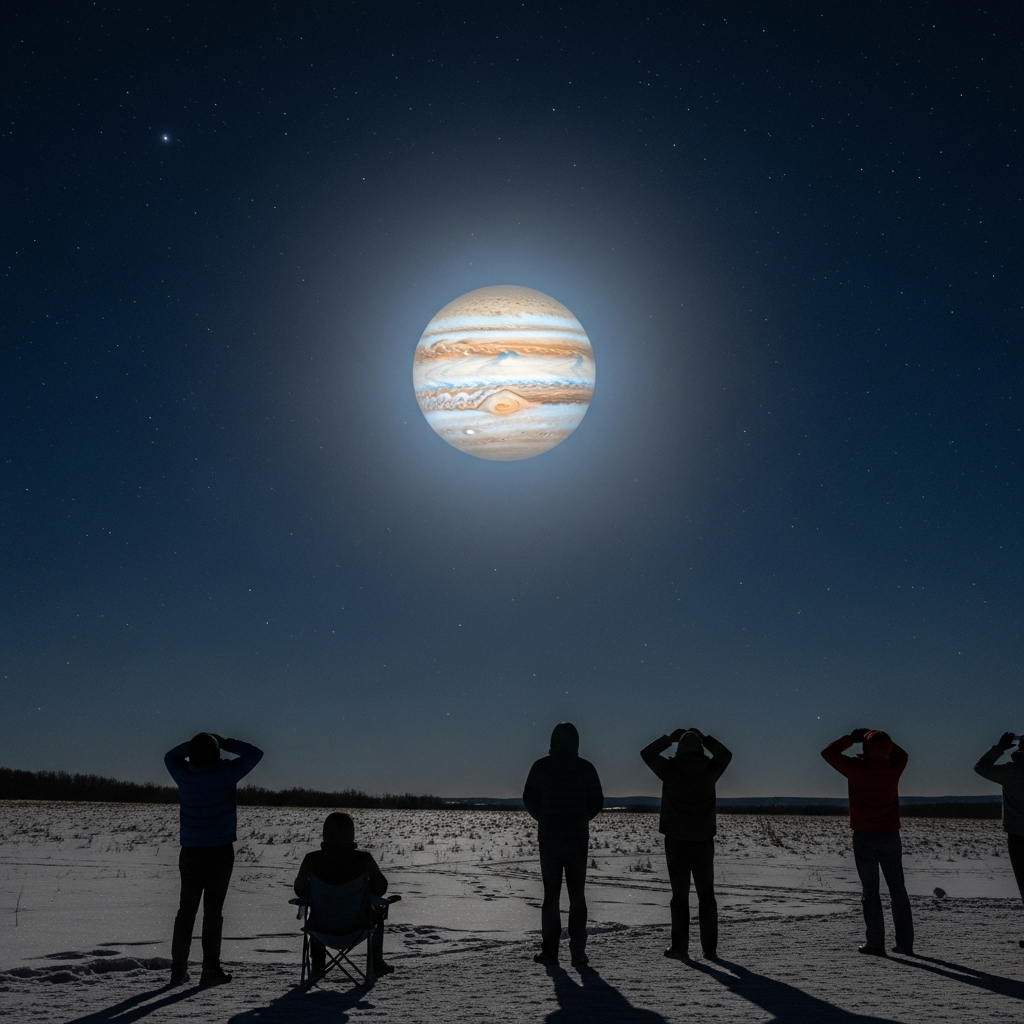
This Christmas, Jupiter emerges as the undisputed monarch of the night sky, outshining every other star and planet with its steady, brilliant glow. At a staggering magnitude of approximately -2.6 to -2.7, Jupiter will be an unmistakable beacon, easily visible to the naked eye. Its enhanced luminosity is no accident; the planet is rapidly approaching “opposition,” a special alignment occurring on January 10, 2026. During opposition, Earth positions itself directly between Jupiter and the Sun, bringing the gas giant closer to us than at any other point in its orbit. This proximity makes Jupiter appear larger and significantly brighter, offering prime viewing conditions throughout the holiday period.
Around 6:30 PM local time each evening, observers in the Northern Hemisphere can simply cast their gaze towards the east or east-northeast to locate Jupiter. It will be nestled within the constellation Gemini, making a striking triangle with the bright twin stars Castor and Pollux. With a pair of binoculars (8×42 or 10×50 recommended) or a small telescope, you can transcend naked-eye observation and marvel at Jupiter’s four largest Galilean moons – Io, Europa, Ganymede, and Callisto – often appearing as tiny beads of light lined up beside the planet. This spectacular Jupiter Christmas sky display will continue nightly, remaining visible until it sets in the western sky in the early morning hours, reaching its highest point around midnight.
The Echoes of the Christmas Star
For centuries, humanity has looked to the heavens for signs and wonders. This year, Jupiter’s extraordinary brightness offers a poetic and timely connection to the fabled Star of Bethlehem. The Gospel of Matthew famously recounts a bright object guiding the Magi to the birthplace of Jesus, sparking centuries of astronomical debate. While astronomers propose various theories for the historical “Christmas Star”—ranging from unique planetary conjunctions to comets—Jupiter’s dazzling presence in the 2025 Christmas sky vividly reminds us of that enduring narrative. It’s a powerful moment when science and ancient symbolism beautifully intertwine, inviting contemplation and wonder.
A Galactic Spectacle: More Than Just Jupiter
While Jupiter commands center stage, the December 2025 night sky is a treasure trove of celestial events, inviting observers to explore beyond the gas giant.
Saturn and the Crescent Moon’s Dance
As Jupiter rises in the east, the western horizon offers its own captivating display. A slender waxing crescent Moon, illuminated around 20-40% through Christmas week, will gracefully traverse the sky. On Christmas Eve (December 24), expect to see beautiful “Earthshine,” where sunlight reflected off Earth subtly illuminates the Moon’s unlit side, creating a ghostly glow. The following night, December 25, the Moon will appear near Saturn. By December 26, the two bodies will form a close conjunction, separated by less than three to four degrees in the southern sky at dusk – a truly picturesque pairing ideal for photography. This is a particularly noteworthy event, as Saturn is gradually dimming and moving lower each night, making this one of the last easy opportunities to observe its famous rings with a telescope before it fades into the twilight of early 2026.
Elusive Mercury and Brilliant Sirius
For early risers, Christmas morning 2025 presents a rare chance to spot Mercury. Usually difficult to observe, the innermost planet will shine brightly at magnitude -0.6, appearing low on the southeastern horizon just before dawn. This marks its best visibility for observers in the Northern Hemisphere following its greatest western elongation in early December. As the night deepens, look towards the southeast for Sirius, the brightest true star in our night sky. Due to its remarkable luminosity and low position, Sirius often twinkles with vivid rainbow colors as its light is refracted by atmospheric turbulence, adding a festive sparkle to the December sky.
Navigating the Festive Constellations
The winter sky is a canvas painted with some of the most iconic and beloved constellations, many bearing festive associations.
Orion: The Celestial Present and Three Kings
High in the southeastern sky, the magnificent constellation Orion, often likened to a “Christmas Present,” takes pride of place. Its four bright corner stars – Betelgeuse (a reddish-orange giant), Bellatrix, Saiph, and Rigel (a brilliant blue-white supergiant) – outline the package. The three distinct stars of Orion’s Belt – Alnitak, Alnilam, and Mintaka – form a gleaming ribbon across the center. These “Three Kings” or “Three Wise Men” of the sky traditionally appear to point towards Sirius, further emphasizing the celestial symbolism of the season. Below the Belt, even a casual glance reveals the faint, fuzzy patch of the Orion Nebula, a stellar nursery where new stars are born, symbolizing renewal and hope.
The Winter Hexagon: A Celestial Wreath
Dominating the northern hemisphere’s winter sky is the vast and beautiful Winter Hexagon, or Winter Circle. This enormous six-sided asterism forms a “celestial wreath” connecting some of the sky’s brightest stars: Sirius, Procyon, Pollux (one of Gemini’s twins, near Jupiter), Capella, Aldebaran, and Rigel. Betelgeuse glows brightly within this grand circle. Finding Rigel in Orion can help you trace the outlines of this impressive cosmic pattern.
Taurus, Pleiades, and Auriga’s Golden Glow
Above Orion, the constellation Taurus the Bull presents its own set of delights. The Hyades star cluster, forming the Bull’s head with the topaz-hued star Aldebaran at its eye, is best appreciated with binoculars. Higher still, the breathtaking Pleiades star cluster, also known as the Seven Sisters, twinkles like a miniature dipper of hot blue stars. Extending towards Auriga, the Charioteer, you’ll find Capella, Auriga’s brightest star and the fourth brightest visible from mid-northern latitudes. Its distinct pentagonal shape, often accompanied by a small triangle of dimmer stars known as “the Kids,” makes Auriga an easy and beautiful constellation to locate.
Deep-Sky Delights and Other Phenomena
Beyond the planets and prominent constellations, December 2025 offers even more to explore.
Ursid Meteors and the Beehive Cluster
Though its peak passed on December 22, the Ursid Meteor Shower remains active through the end of the month. With the Moon’s modest brightness, there’s still a chance to spot these usually fainter meteors, particularly in the hours before dawn. For those with binoculars, M44 – the Praesepe, or Beehive Cluster – in the constellation Cancer offers a treat. Its name literally means “manger” in Latin, and in dark skies, it appears as a hazy patch that resolves into dozens of stars through optical aid. Another deep-sky target, NGC 2264 – the Christmas Tree Cluster – located about 2,500 light-years away in Monoceros, can be viewed with wide-field binoculars, though it’s more challenging.
ISS Flybys and Aurora Chances
Keep an eye out for the International Space Station (ISS) performing bright, silent flybys across the sky. These “moving stars” are distinguishable from aircraft by their steady light and lack of blinking. Check NASA’s “Spot the Station” tool for precise local timings. Furthermore, with heightened solar activity expected, there’s an elevated chance for aurora borealis displays at higher latitudes, including parts of Canada, Scandinavia, and the northern U.S. While no major geomagnetic storm is forecast, minor solar flares could trigger captivating green and red lights dancing across the horizon. Consult NOAA’s Space Weather Prediction Center for real-time forecasts.
Your Essential Stargazing Tips for the Holidays
To make the most of this spectacular Jupiter Christmas sky and other celestial events, consider these practical tips:
Find a Dark Spot: Minimize light pollution by venturing away from city lights.
Unobstructed Views: Seek a location with clear sightlines to the eastern, western, and southern horizons.
Dress Warmly: Winter nights can be cold; layer up to stay comfortable during extended observation.
Use Binoculars: Even a modest pair of binoculars can dramatically enhance views of Jupiter’s moons, Saturn’s rings (as small “handles”), and star clusters like the Pleiades and Hyades.
Stargazing Apps: Download a sky map app like “Sky Tonight” to easily identify constellations, planets, and other objects in real-time.
Patience is Key: Allow your eyes at least 15-20 minutes to adjust to the darkness for optimal viewing.
- Timing: The sky becomes darkest about 90 minutes after sunset, providing the best conditions until morning twilight.
- starwalk.space
- www.greenmatters.com
- whenthecurveslineup.com
- dailygalaxy.com
- ts2.tech
Frequently Asked Questions
Why is Jupiter so bright this Christmas season?
Jupiter will appear exceptionally bright this Christmas due to its approach to opposition, which occurs on January 10, 2026. This astronomical event happens when Earth passes directly between Jupiter and the Sun, bringing Jupiter closer to our planet than at any other time in its 13-month orbit. This proximity makes Jupiter appear larger and significantly more luminous, shining at a magnitude of -2.6 to -2.7, outshining every star in the night sky.
What other celestial wonders can I see in the 2025 Christmas sky?
Beyond Jupiter, the 2025 Christmas sky offers a wealth of observations. Look for a waxing crescent Moon forming a close conjunction with Saturn on December 26 in the western sky. For early risers on Christmas morning, elusive Mercury will be visible low in the southeast. The constellation Orion, with its bright stars Betelgeuse and Rigel and the Orion Nebula, will be prominent. You can also spot the “celestial wreath” of the Winter Hexagon, the Pleiades star cluster, and potentially the Ursid meteor shower or aurora borealis at higher latitudes.
What’s the best way to observe Jupiter and other planets this Christmas?
The best way to observe Jupiter and other celestial bodies this Christmas is to find a dark location away from city lights with an unobstructed view of the horizon. Jupiter will be easily visible to the naked eye in the eastern sky after sunset. For enhanced views of Jupiter’s moons or Saturn’s rings, a pair of 8×42 or 10×50 binoculars or a small telescope is highly recommended. Dress warmly, allow your eyes to adjust to the darkness, and consider using a stargazing app to help locate objects and plan your observations.
Embrace the Wonders Above
The 2025 Christmas season promises a truly magical experience for anyone who simply looks up. Jupiter’s extraordinary brilliance, coupled with the Moon’s graceful dance with Saturn, the festive glow of winter constellations, and the potential for fleeting meteors and auroras, creates a celestial tapestry unlike any other. This is more than just stargazing; it’s an opportunity to connect with ancient stories, marvel at scientific phenomena, and share moments of wonder with loved ones. So bundle up, step outside, and prepare to be dazzled by the unforgettable spectacle of the Jupiter Christmas sky. Mark your calendars and let the heavens inspire your holiday season!