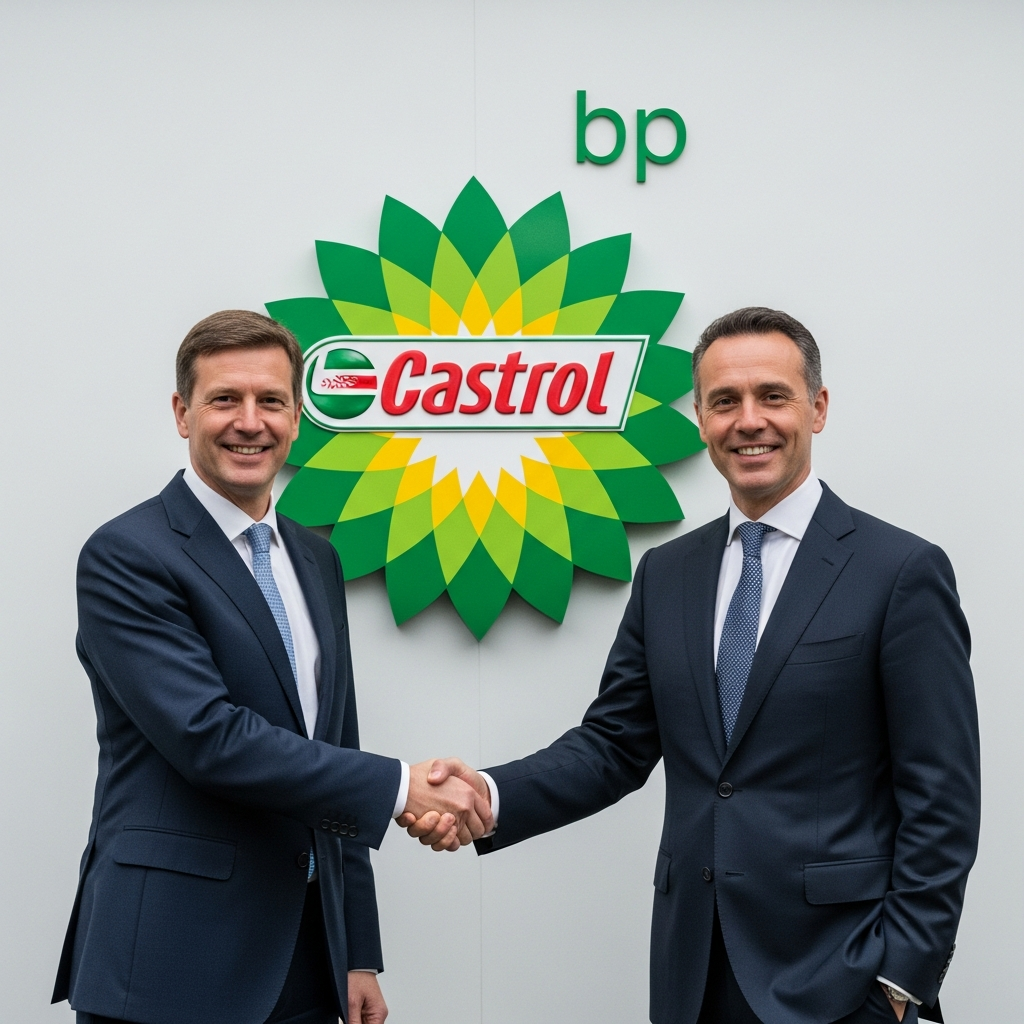
BP has announced a groundbreaking strategic move, agreeing to divest a 65% majority shareholding in its iconic Castrol lubricants business to Stonepeak, a prominent alternative investment firm. This significant transaction, valued at an impressive $10.1 billion enterprise value, is a pivotal step in accelerating BP’s ambitious “reset strategy.” Expected to finalize by the end of 2026, pending crucial regulatory approvals, the deal is set to reshape BP’s portfolio and fortify its financial standing.
The agreement will generate substantial net proceeds of approximately $6.0 billion for BP. This figure includes an estimated $0.8 billion from pre-payment of future dividend income on BP’s retained 35% stake in Castrol, alongside other customary adjustments. This cash injection is strategically earmarked for one primary purpose: significantly reducing BP’s net debt, aligning with the company’s aggressive financial targets.
The Landmark Deal Details: A New Era for Castrol
This landmark agreement marks a new chapter for Castrol, a brand renowned for its 126-year heritage in lubricants. Under the terms, a new joint venture will be incorporated, with Stonepeak assuming a 65% ownership stake. BP will retain a substantial 35% interest, ensuring continued exposure to Castrol’s future growth trajectory. This innovative structure allows BP to realize immediate value while maintaining a strategic presence in a business it knows intimately.
Stonepeak, an infrastructure investment firm, sees Castrol as a “mission-critical” industrial platform. Anthony Borreca, Senior Managing Director at Stonepeak, emphasized the essential nature of lubricants to the global economy. He highlighted Castrol’s strong brand, leading market position, and differentiated products. The firm’s involvement underscores a belief in Castrol’s enduring value and its potential for expansion. Notably, CPP Investments (Canada Pension Plan Investment Board) is also participating, investing up to $1.05 billion for an indirect, non-controlling interest in Castrol, further validating the deal’s attractiveness.
A New Partnership for Castrol’s Future
The formation of this new joint venture signifies a strategic partnership aimed at fostering continued innovation and growth for Castrol. Michelle Jou, Castrol Global CEO, expressed enthusiasm for Stonepeak’s capital support and energy-sector expertise. This collaboration is expected to position Castrol for further expansion, particularly within emerging sectors. Castrol currently operates through approximately 20 blending plants and over 100 third-party facilities, distributing its products across some 150 countries. Its products, from early aviation and the Concorde to space missions and motorsport, have a storied history of performance.
BP will appoint two Board seats to the new joint venture, ensuring its voice in governance and strategic direction. While BP expects to treat its retained 35% stake as an equity-accounted investment, it does not anticipate recognizing earnings or receiving dividends in the short-to-medium term. This is because Stonepeak will hold a preference on distributions. A two-year lock-up period will apply, after which BP will have the optionality to divest its remaining interest, providing a clear exit path.
BP’s Strategic Reset: Why This Sale Matters So Much
The divestment of a majority stake in Castrol is a cornerstone of BP’s broader “reset strategy.” Interim CEO Carol Howle described the sale as “an important milestone” in delivering this strategy. The primary objective is to simplify BP’s portfolio and refocus its downstream operations on core integrated businesses. This move is designed to reduce organizational complexity, enhance cash flow, and ultimately deliver greater shareholder value.
A crucial driver for this transaction is BP’s commitment to strengthening its balance sheet. The entire $6.0 billion in net proceeds will be channeled directly towards reducing net debt. BP has set an ambitious target of bringing its net debt down to $14-18 billion by the end of 2027, a significant reduction from $26.1 billion at the end of Q3 2025. This Castrol deal contributes significantly to BP’s previously announced $20 billion divestment program, bringing total completed and announced proceeds to approximately $11.0 billion.
Financial Implications and Future Outlook
The implied total equity value of Castrol is stated as $8.0 billion. This figure accounts for approximately $1.8 billion in joint venture minority interests and around $0.3 billion in other debt-like obligations. The transaction reflects an implied EV/LTM EBITDA multiple of roughly 8.6x, highlighting Castrol’s robust business fundamentals and attractive growth potential.
This divestment unfolds during a period of leadership transition for BP, with the recent appointment of Meg O’Neill as its next CEO. The strategic review of Castrol, initiated earlier in 2025, attracted considerable interest, underscoring the brand’s strength. This deal exemplifies how major energy companies are balancing immediate financial relief with retained upside exposure. By attracting capital partners like Stonepeak, BP can strategically high-grade its portfolio, strengthen its financial position, and continue to invest with discipline.
Global Impact and Regional Nuances
Castrol’s global footprint means this deal has implications across various jurisdictions. The transaction includes existing minority interests in Castrol operations in several key regions. Specifically, this covers BP’s stakes in joint ventures such as 49% in India, 35% in Vietnam, 50% in Saudi Arabia, and 40% in Thailand. A substantial portion of these minority interests relates to the shareholding in Castrol India Limited.
News of the transaction led to a notable rise in Castrol India shares, reflecting market confidence. A mandatory tender offer (MTO) for Castrol India’s public shareholders is anticipated under Indian takeover regulations. However, this MTO is conditional upon the completion of the broader Castrol transaction, which is not expected until late 2026. This highlights the intricate global nature of such a significant corporate divestiture.
Castrol’s Enduring Value Proposition
Stonepeak’s investment strategy aligns with Castrol’s profile as an essential industrial asset. The firm emphasizes Castrol’s role across diverse sectors and its strong brand reputation. Castrol’s products deliver significant value to customers, driven by continuous innovation. Looking ahead, CPP Investments specifically noted Castrol’s growth potential in burgeoning sectors. These include electric vehicles (EVs) and data centers, positioning Castrol as a “picks-and-shovels” investment in the evolving industrial landscape. This forward-looking perspective underpins the long-term value seen in the lubricants business.
Frequently Asked Questions
What is the core reason for BP selling a majority stake in Castrol?
BP’s primary motivation for divesting a 65% stake in Castrol is to accelerate its “reset strategy.” This involves simplifying its portfolio, focusing on core integrated businesses, and crucially, significantly strengthening its balance sheet through debt reduction. The estimated $6.0 billion in net proceeds from the sale will be fully allocated to bringing BP’s net debt closer to its target range of $14-18 billion by the end of 2027, as part of its broader $20 billion divestment program.
How will Castrol’s operations and brand be affected by the new joint venture?
Under the new joint venture, Stonepeak will hold a 65% ownership, with BP retaining 35%. Castrol will continue to operate globally, leveraging its 126-year heritage and strong brand. Stonepeak views Castrol as a “mission-critical” industrial platform, and its capital support is expected to foster innovation and growth, especially in emerging sectors like electric vehicles and data centers. BP will also appoint two Board seats, ensuring a level of continued governance and strategic involvement in Castrol’s future direction.
What are the financial implications of this divestment for BP and its shareholders?
The divestment generates approximately $6.0 billion in net proceeds for BP. This cash injection is central to BP’s strategy to reduce its net debt and improve its financial resilience. The deal, valued at a $10.1 billion enterprise value for Castrol, allows BP to realize substantial value for shareholders while retaining a 35% stake that offers exposure to Castrol’s future growth. After a two-year lock-up period, BP will have the option to fully monetize its remaining interest, providing future flexibility for its portfolio management.
In conclusion, BP’s decision to sell a majority stake in Castrol to Stonepeak is a transformative move. It underscores the energy giant’s unwavering commitment to its strategic reset. This significant divestment strengthens BP’s balance sheet, simplifies its operational focus, and unlocks considerable value from a venerable brand. For Castrol, this marks the beginning of a new partnership. It promises sustained growth and innovation under Stonepeak’s guidance, benefiting from a focused investment strategy. The transaction, anticipated to close by late 2026, will serve as a crucial benchmark for BP’s ongoing efforts to reshape its future and deliver enhanced shareholder returns in a dynamic energy landscape.