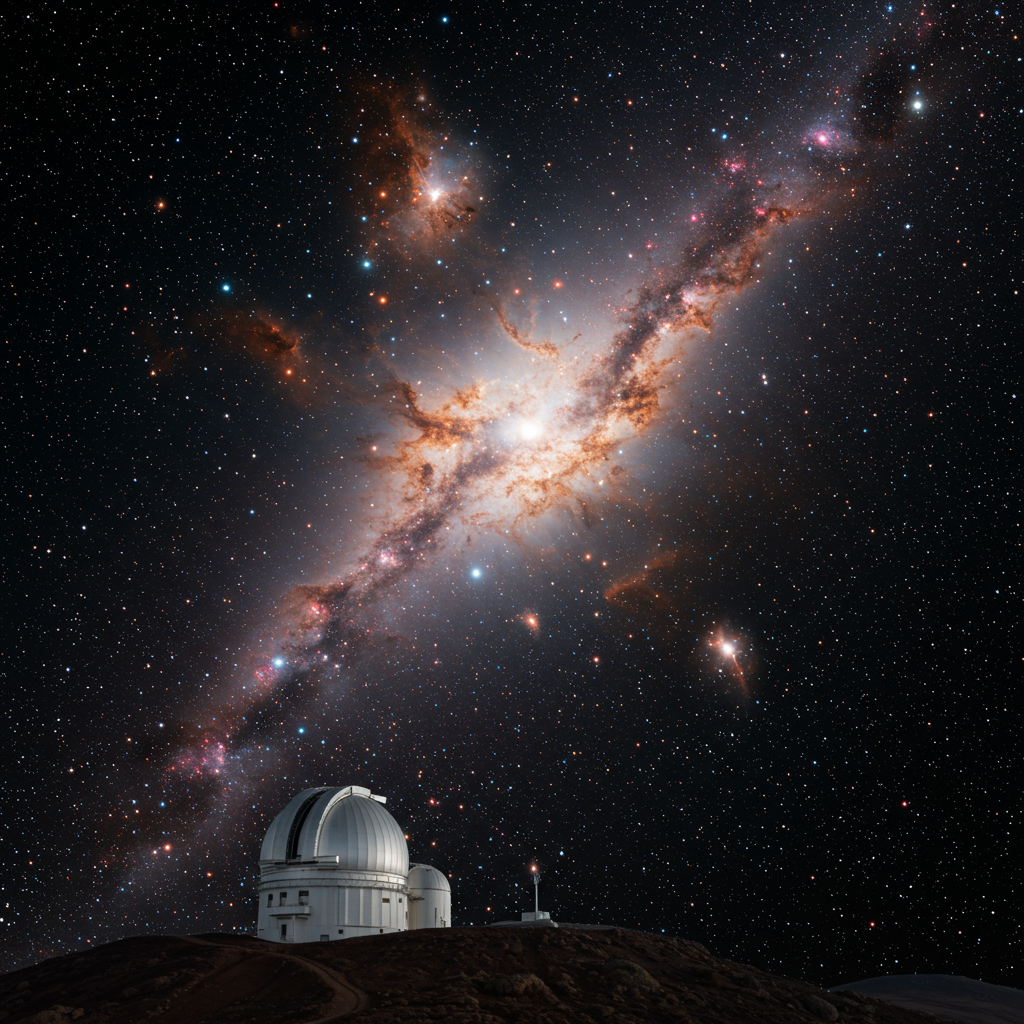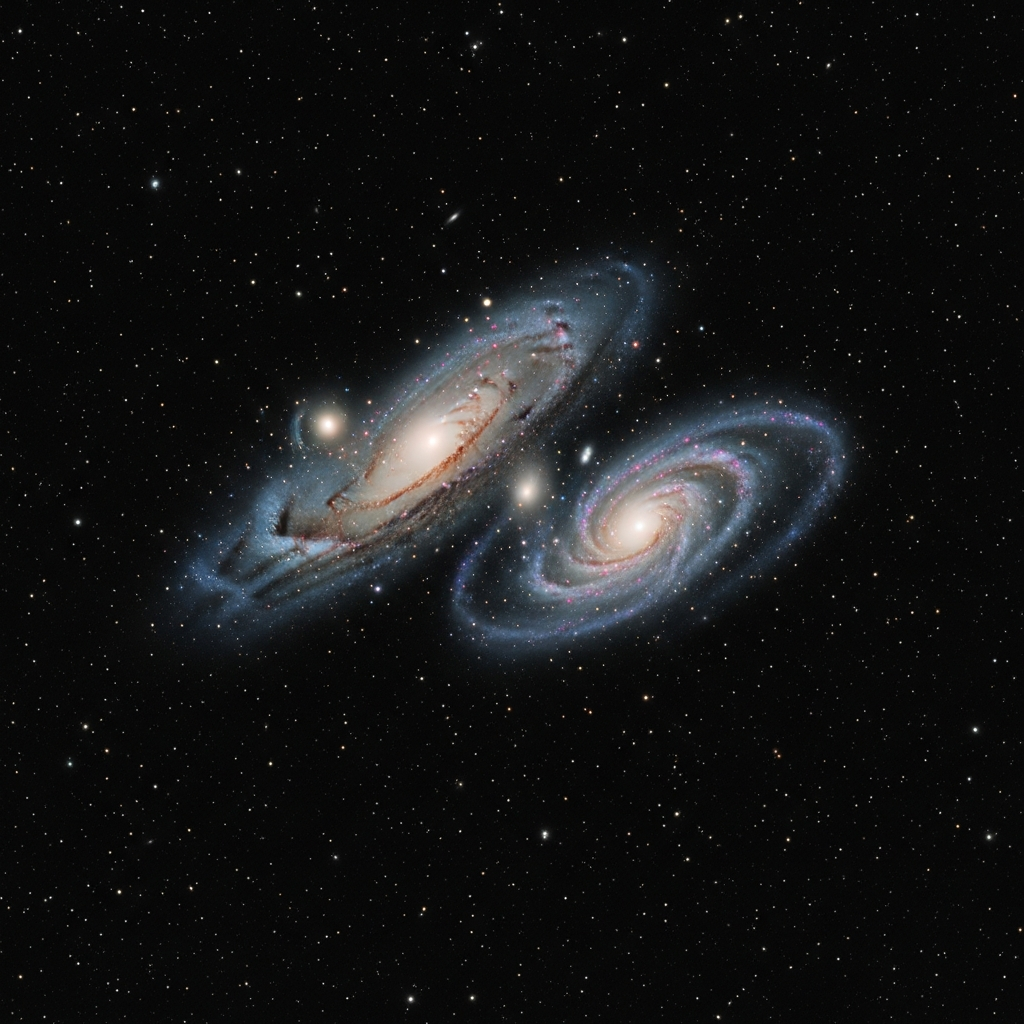
Deep within the constellation Canes Venatici, roughly 24 million light-years away, an extraordinary celestial ballet is unfolding. NASA’s James Webb Space Telescope recently captured this mesmerizing interaction, showcasing two dwarf galaxies, NGC 4490 and NGC 4485, in a gravitational embrace. This stunning image, released on December 2, 2025, offers a rare, close-up view of the universe’s smallest interacting galaxy system where individual stars can be resolved. Such observations are not merely beautiful; they are pivotal to decoding the universe’s most profound secrets, particularly how galaxies formed and evolved in the early cosmos.
Unveiling the Cosmic Ballet of Dwarf Galaxies
The stars of NGC 4490 and NGC 4485 are locked in a slow-motion dance, a testament to the pervasive force of gravity across the cosmos. These aren’t just any galaxies; they are dwarf galaxies, celestial bodies with significantly less mass than galactic giants like our own Milky Way. Their proximity and the clarity of the James Webb Space Telescope (JWST) have allowed astronomers to observe their intricate gravitational interactions with unprecedented detail. This includes the remarkable ability to distinguish individual stars within these distant systems.
A Glimpse into the Universe’s Infancy
Why are dwarf galaxies so crucial to our understanding of the universe? Scientists believe that galaxies in the early universe largely resembled these smaller, less massive structures. They were often rich in gas, held relatively few stars, and contained only trace amounts of elements heavier than helium. By studying dwarf galaxy interactions and mergers today, researchers can piece together how the earliest galaxies grew and evolved billions of years ago.
This cosmic “dance” provides vital clues to events like the epoch of reionization. This pivotal period, approximately 12 billion years ago, saw the dark, neutral early universe illuminated by the first stars and galaxies. Just as a Harvard astrophysics student once used dance to visualize photons ionizing hydrogen atoms, the actual gravitational dance of dwarf galaxies illustrates the fundamental processes that shaped the universe from its earliest moments, allowing light to travel freely and transforming the cosmos into the bright, hot, and ionized state we know today.
The Universal Rhythm: Gravity’s Choreography
The concept of a “cosmic dance” extends far beyond these two dwarf galaxies. Our entire universe is a dynamic arena of motion. Even our seemingly stable Milky Way is in constant, dizzying motion. Its central region spins at an astonishing 220 kilometers per second – fast enough to orbit Earth in just over three minutes! This incredible velocity, and the graceful curl of its spiral arms, are choreographed by the immense gravitational pull of its total mass, balancing the inward tug of gravity with the outward momentum of billions of stars.
At the heart of our galaxy lies Sagittarius A (Sgr A), a supermassive black hole weighing more than four million times the mass of our Sun. It dictates the orbits of everything around it. Yet, the vast majority of this gravitational influence comes from an unseen force: dark matter. This mysterious substance provides the invisible scaffold that prevents galaxies from flying apart due to their rapid rotation. The intricate movements of interacting dwarf galaxies, therefore, are not just about visible matter; they are profound illustrations of dark matter’s pervasive influence on galactic structure and evolution.
More Than Just a Pair: Complex Galactic Encounters
While NGC 4490 and NGC 4485 offer a clear view of a two-body interaction, galactic dances often involve more complex partners. The Hubble Space Telescope has, for instance, captured images of groups like Arp-Madore 2339-661. This group, residing 500 million light-years away in Tucana, was initially thought to be a pair but revealed a hidden third galaxy, NGC 7733N, embedded within one of its prominent members. Its distinct velocity, identified through redshift analysis, confirmed it as an independent entity. This underscores the challenges and exciting discoveries in observing these cosmic ballets.
Another striking example is Arp 91, also observed by Hubble, where NGC 5953 visibly “tugs” at NGC 5954, stretching one of its spiral arms downward. Such gravitational interactions are common and crucial. Astronomers widely believe that these collisions between spiral galaxies are the precursors to the formation of the more uniform elliptical galaxies. These massive cosmic collisions unfold over hundreds of millions of years, making the “dance” an extremely slow-motion spectacle from our perspective, yet a fundamental process in the grand scheme of galaxy evolution.
Decoding the Gravitational Tango: Beyond Galaxies
The study of gravitational interactions extends even to the most extreme objects in the universe: black holes. NASA’s Spitzer Space Telescope achieved a remarkable feat by precisely timing the “dance” of two massive black holes within the OJ 287 galaxy. Here, a smaller black hole, 150 million times the Sun’s mass, orbits a colossal counterpart over 18 billion times more massive. Twice every 12 years, the smaller black hole crashes through the larger one’s gas disk, creating a flare brighter than a trillion stars.
Predicting these flares with extreme accuracy (within a four-hour window!) required accounting for profound physics, including gravitational waves – ripples in spacetime predicted by Einstein and directly observed by LIGO. Furthermore, these precise observations provided strong evidence for the “no-hair” theorem of black holes, which postulates that a black hole’s surface is perfectly smooth. The precision needed to map the smaller black hole’s orbit revealed that the larger black hole must be symmetric, as any “bump” would alter its partner’s path. This demonstrates how even at immense cosmic distances and scales, the fundamental laws of physics govern every “dance.”
Why These Cosmic Dances Matter to Us
The cosmic interactions of galaxies, from the gentle tug of dwarf galaxies like NGC 4490 and NGC 4485 to the violent mergers of supermassive black holes, are more than just distant spectacles. They are fundamental processes that dictate the evolution of the universe and our place within it. By observing these events, we gain invaluable insights into the origins of the first stars, the assembly of galactic structures, and the invisible influence of dark matter.
Understanding these gravitational ballets helps us contextualize our own cosmic journey. Our Milky Way is not only spinning but also hurtling towards the Andromeda Galaxy at 110 kilometers per second. In about four billion years, these two giants will engage in their own spectacular merger, forming a new, larger elliptical galaxy. These interactions remind us that the cosmos is a vibrant, ever-changing stage, and humanity is a passenger on an epic, gravity-choreographed voyage through space and time.
Frequently Asked Questions
What are dwarf galaxies and why are their interactions important?
Dwarf galaxies are relatively small galaxies, containing significantly less mass, fewer stars, and typically more gas than larger galaxies like the Milky Way. Their interactions are crucial because they are thought to closely resemble the conditions and processes of galaxy formation in the early universe. By studying how these present-day dwarf galaxies merge, astronomers gain insights into how the first galaxies grew and evolved billions of years ago, helping to unlock secrets about cosmic origins and the epoch of reionization.
How do telescopes like Webb observe distant galaxy interactions?
Telescopes like the James Webb Space Telescope (JWST) use advanced infrared technology to observe distant galaxy interactions. Unlike visible light, infrared light can penetrate the dust clouds that often obscure stellar nurseries and galactic centers, providing clearer images. For distant objects like NGC 4490 and NGC 4485, located 24 million light-years away, Webb’s unparalleled sensitivity allows astronomers to not only capture their gravitational dance but also resolve individual stars within them, offering unprecedented detail vital for scientific analysis.
What can the “cosmic dance” of galaxies tell us about the future of the Milky Way?
The “cosmic dance” of interacting galaxies provides crucial insights into the future of our own Milky Way. Observations of merging galaxies suggest that such gravitational encounters are a common part of galactic evolution, often leading to the formation of larger elliptical galaxies. The Milky Way itself is on a collision course with the Andromeda Galaxy, projected to merge in about four billion years. Studying other galactic interactions helps scientists predict how our galaxy might evolve, giving us a glimpse into the long-term cosmic fate of our celestial home.