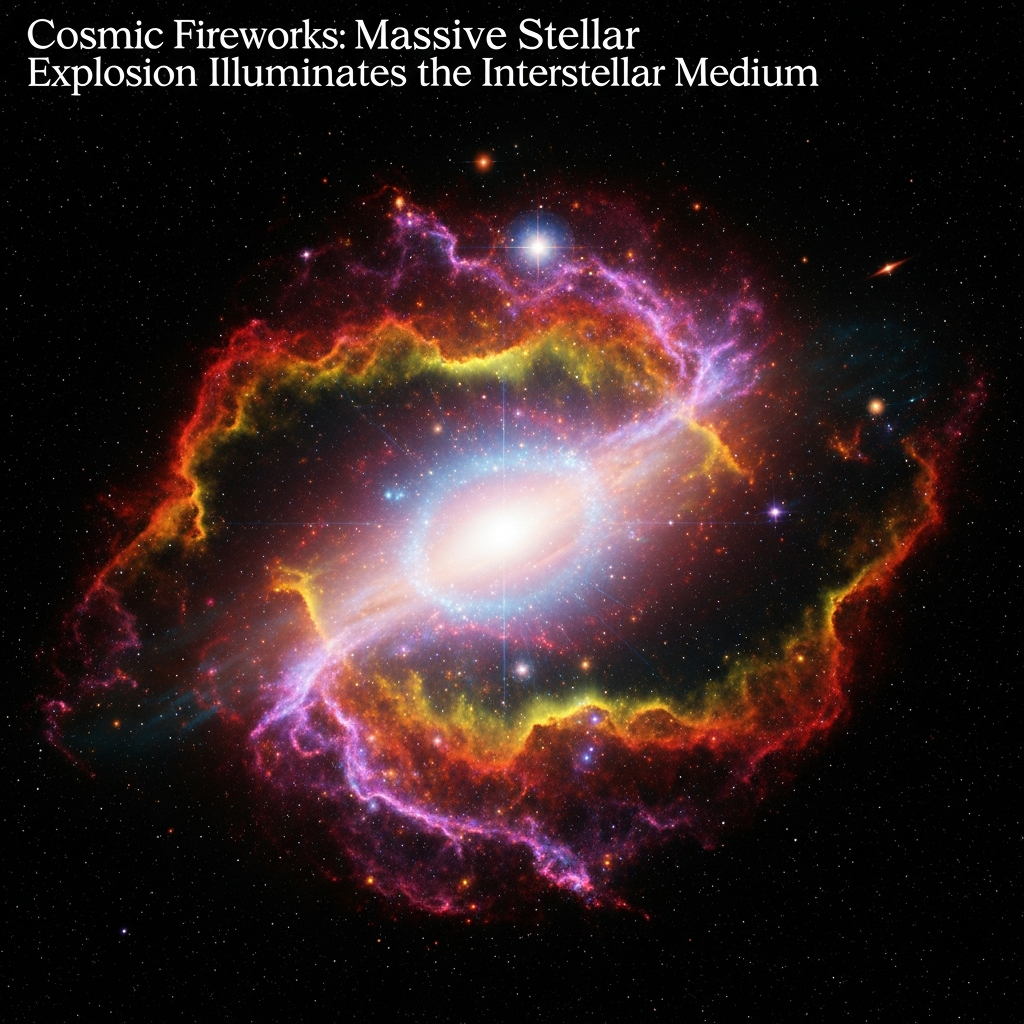
The universe is a canvas of awe-inspiring phenomena, but few events captivate humanity quite like stellar explosions. These cataclysmic finales mark the death of massive stars or the dramatic outbursts of smaller ones, scattering cosmic material across light-years. Witnessing these incredible cosmic blasts, even through the lens of our most advanced telescopes, offers profound insights into the life and death of stars, the origins of elements, and the very fabric of the cosmos. This guide dives into the spectacular imagery and science behind stellar explosions, revealing what these powerful events teach us about our universe.
Understanding the Drama: What are Stellar Explosions?
Stellar explosions represent the most violent and energetic processes known in the cosmos. Far from a gentle fading, these events are sudden, brilliant releases of energy, often outshining entire galaxies for a brief period. The most well-known type is the supernova, a colossal explosion marking the end of a massive star’s life or the runaway nuclear fusion of a white dwarf in a binary system. Other forms, like novae and hypernovae, also offer spectacular visual displays and unique scientific data.
The Different Faces of Cosmic Blasts
Not all stellar explosions are created equal. Each type offers a distinct astronomical spectacle and contributes differently to the universe’s evolution.
Supernovae: These are the titans of stellar explosions. A Type II supernova occurs when a massive star exhausts its nuclear fuel, its core collapses, and the outer layers rebound in a spectacular blast. Type Ia supernovae, on the other hand, happen in binary systems where a white dwarf star siphons material from a companion, eventually triggering a thermonuclear runaway.
Novae: Less powerful than supernovae, novae occur in binary star systems where a white dwarf accretes hydrogen from a companion star. This hydrogen accumulates on the white dwarf’s surface, eventually igniting in a thermonuclear explosion, temporarily brightening the star thousands of times.
- Hypernovae: These are even more energetic than typical supernovae, often linked to the collapse of exceptionally massive, rapidly rotating stars. Hypernovae are thought to be a primary source of long-duration gamma-ray bursts, the most powerful explosions in the universe.
The images we capture of these events are not just pretty pictures; they are snapshots of fundamental cosmic processes, showing us how stars recycle matter and enrich the universe with heavy elements essential for planet formation and life itself.
Capturing the Cosmos: How We Image Stellar Explosions
Capturing images of stellar explosions requires extraordinary technology and patience. Many of these events occur millions or even billions of light-years away, meaning the light we see today began its journey through space long ago. Powerful telescopes, both on Earth and in space, are crucial in bringing these distant cosmic blasts into focus.
The Eyes of Humanity: Telescopes That See Star Deaths
Ground-based observatories utilize vast mirrors and advanced adaptive optics to peer through Earth’s atmosphere. Telescopes like the European Southern Observatory’s Very Large Telescope (VLT) or the Keck Observatory routinely produce stunning visuals of supernova remnants and distant galaxies where these explosions occur.
However, space-based telescopes offer an unparalleled advantage by observing above the atmospheric distortion. The Hubble Space Telescope has delivered iconic images of supernova remnants, showing their intricate structures and dynamic expansion. More recently, the James Webb Space Telescope (JWST), with its infrared capabilities, is pushing the boundaries even further, allowing astronomers to see through dust clouds that might obscure optical views, providing unprecedented detail of these dramatic celestial events. These advanced instruments not only take beautiful pictures but also collect vital spectroscopic data that reveal the composition, temperature, and velocity of the exploding material.
What Images of Stellar Explosions Reveal
Beyond their breathtaking beauty, images of stellar explosions are invaluable scientific tools. They allow astronomers to study the physics of extreme environments, the dispersal of elements, and the formation of new structures in space. Each photograph tells a story of cosmic violence and creation.
Unveiling Cosmic Aftermath and Creation
The remnants left behind by these explosions are often as spectacular as the blasts themselves. Supernova remnants, like the famous Crab Nebula (M1) or the Veil Nebula, are vast, expanding clouds of gas and dust. These nebulae glow in various colors, indicative of the different elements – hydrogen, oxygen, sulfur – ejected during the explosion. The intricate filaments and shockwaves visible in these images provide direct evidence of how the explosion reshapes interstellar space.
Furthermore, these images often show the birthplaces of new stars. The shockwaves from a supernova can compress nearby gas and dust clouds, triggering gravitational collapse and initiating the formation of new stars and planetary systems. This cosmic recycling means that the death of one star can be the genesis of many more, perpetually renewing the galactic landscape. Studying these supernova images helps scientists trace the origin of many elements heavier than iron, elements crucial for building planets and life.
Famous Examples of Stellar Explosion Photography
Throughout history, astronomical photography has captured numerous iconic images of stellar explosions and their enduring legacies. These visuals not only illustrate complex scientific concepts but also inspire wonder and curiosity about the universe.
Iconic Supernova Remnants and Dynamic Novae
One of the most celebrated stellar explosion images is that of the Crab Nebula. This supernova remnant, the result of a star exploding in 1054 AD, is a vibrant, expanding cloud driven by a rapidly rotating neutron star at its core. Hubble’s images of the Crab Nebula showcase its intricate filamentary structure and dynamic central pulsar.
Another stunning example is the Vela Supernova Remnant, a sprawling network of glowing gas that marks the site of an explosion thousands of years ago. Telescopes like the XMM-Newton have captured its X-ray emissions, revealing superheated gas and shockwaves. More recently, observations of distant supernovae, such as SN 2014J in Messier 82, provide real-time data on these events, allowing astronomers to track their light curves and study the initial stages of the explosion. These cosmic blasts offer a direct window into processes that shape galaxies.
The captivating visuals extend to novae as well. Images of recurrent novae, like T Pyxidis, show periodic brightenings, offering a glimpse into the ongoing stellar interactions that fuel these smaller but still dramatic eruptions. These images are not merely aesthetic; they are scientific data points that contribute to our understanding of stellar evolution and galactic chemistry.
The Scientific Value of Studying Stellar Explosions
The scientific importance of stellar explosions cannot be overstated. They are fundamental to astrophysics, playing critical roles in element creation, galaxy evolution, and even our understanding of dark energy. Every image, every light curve, every spectrum contributes to a larger cosmic puzzle.
From Element Forges to Cosmic Distant Markers
Supernovae are the universe’s primary factories for heavy elements. Elements like gold, silver, uranium, and much of the iron in our blood were forged in the intense heat and pressure of these explosions. Without these events, the chemical diversity required for planets and life would simply not exist. Images of their remnants allow us to map the distribution of these newly formed elements, tracing their journey into the interstellar medium.
Moreover, Type Ia supernovae serve as “standard candles” for measuring vast cosmic distances. Because they all explode with a very similar intrinsic brightness, astronomers can use their observed brightness to calculate how far away they are. This technique led to the groundbreaking discovery that the universe’s expansion is accelerating, implying the existence of dark energy, a mysterious force counteracting gravity. The accuracy of these measurements relies heavily on precise imaging and spectroscopic analysis of these specific cosmic blasts. Understanding the intricacies of stellar explosion images is therefore key to understanding the scale and fate of the entire universe.
Frequently Asked Questions
What causes different types of stellar explosions?
Stellar explosions arise from various mechanisms related to a star’s mass and evolutionary stage. Supernovae (Type II) are caused by the core collapse of massive stars (typically 8 times the Sun’s mass or more) that run out of nuclear fuel. Type Ia supernovae result from white dwarfs in binary systems accreting enough material from a companion to exceed a critical mass limit, leading to a runaway thermonuclear reaction. Novae, less powerful than supernovae, also occur in binary systems where a white dwarf periodically accumulates and ignites hydrogen on its surface. Hypernovae are extremely energetic supernovae associated with the collapse of very massive, rapidly rotating stars.
Where can I view the best images of stellar explosions?
The best images of stellar explosions and their remnants are primarily available through the archives of major space agencies and observatories. NASA’s Hubble Space Telescope and James Webb Space Telescope (JWST) galleries (nasa.gov/hubble and webbtelescope.org) offer stunning, high-resolution photographs. The European Space Agency (ESA) also maintains extensive archives (esa.int). Ground-based observatories like the European Southern Observatory (ESO) (eso.org) and the National Optical-Infrared Astronomy Research Laboratory (NOIRLab) (noirlab.edu) provide incredible imagery captured from Earth. Many universities and astronomical institutes also curate collections of these captivating cosmic blasts.
What can scientists learn from studying images of stellar explosions?
Scientists gain a wealth of knowledge from studying images of stellar explosions. These visuals help identify the types of stars involved, measure their distances, and determine the energy released during the event. Images of supernova remnants reveal the intricate structures and elemental compositions of the ejected material, providing insights into cosmic recycling and the creation of heavy elements like iron, gold, and silver. By observing how these remnants expand and interact with interstellar gas, astronomers can understand shockwave physics and their role in triggering new star formation. Critically, Type Ia supernovae images are vital for measuring the universe’s expansion rate and understanding the mysterious dark energy.
The Enduring Spectacle of Cosmic Blasts
From the fiery death throes of massive stars to the recurrent flare-ups of white dwarfs, stellar explosions are among the most dynamic and beautiful phenomena in our universe. The images we capture of these events are more than just pretty pictures; they are windows into the fundamental processes that govern cosmic evolution. They demonstrate the universe’s continuous cycle of destruction and creation, forging the very elements that make up planets and, ultimately, ourselves. As technology advances with new telescopes and observational techniques, our understanding and visual appreciation of these magnificent cosmic blasts will only continue to deepen, revealing even more profound secrets of the stars.