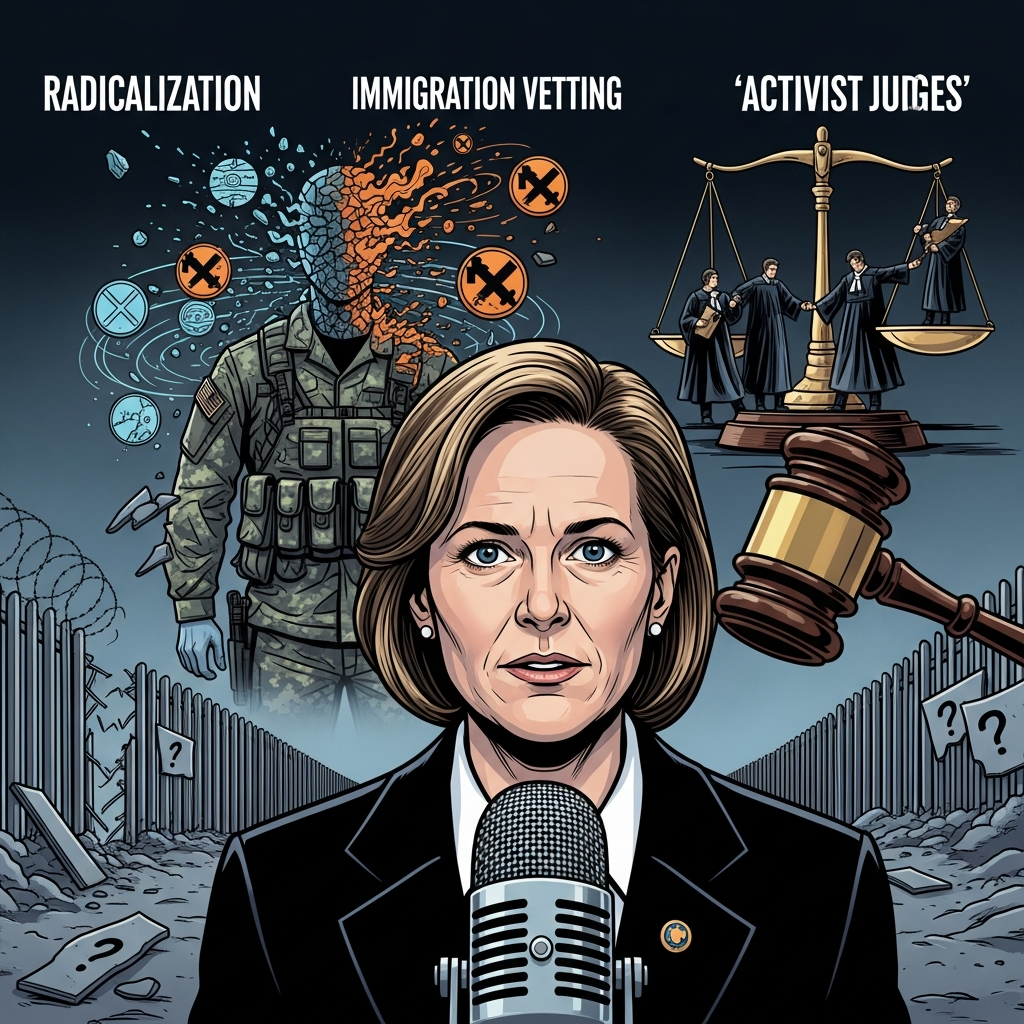
Following a tragic National Guard shooting in Washington D.C., Homeland Security Secretary Kristi Noem has ignited a fierce debate, alleging the suspect was “radicalized” within the United States. Her statements, made on Sunday, November 30, 2025, during appearances on “Meet the Press” and “This Week,” have drawn sharp criticism and sparked widespread discussion over immigration vetting processes and the role of “activist judges” in policy decisions. This article delves into Noem’s controversial claims, the factual context of the shooting, and the broader political implications for U.S. immigration policy.
Unpacking the National Guard Shooting and Suspect’s Background
The devastating incident involved Rahmanullah Lakanwal, a 29-year-old Afghan national, who stands accused of opening fire near the White House on National Guard members. Army Spc. Sarah Beckstrom, 20, tragically lost her life, while Air Force Staff Sgt. Andrew Wolfe, 24, remains hospitalized. Lakanwal was also shot by a National Guard member during the confrontation and is now hospitalized, facing first-degree murder charges.
Lakanwal’s journey to the U.S. is central to the political dispute. He arrived in September 2021 as part of Operation Allies Welcome, a program initiated by the Biden administration following the U.S. withdrawal from Afghanistan. Notably, he had a prior history of working with CIA-backed units in Afghanistan. Despite arriving during the Biden administration, Lakanwal was granted asylum in April 2025, under the Trump administration. This timeline creates a complex backdrop for the subsequent blame game regarding vetting procedures.
Kristi Noem’s Radicalization Claims and Contradictory Statements
Secretary Noem asserted that Lakanwal was “radicalized” after settling in the U.S., specifically suggesting this occurred through “connections in his home community and state.” She indicated that authorities were actively investigating those who interacted with him, including family members, to understand the alleged radicalization process. “We believe he was radicalized since he’s been here in this country,” Noem stated on NBC’s “Meet the Press.”
A significant point of contention arose from Noem’s shifting narratives regarding accountability for Lakanwal’s vetting. Initially, she claimed that the vetting process “was completely abandoned under Joe Biden’s administration.” However, in what appeared to be a contradictory statement, she also asserted, “All that vetting information was collected by Joe Biden’s administration,” attempting to shift the blame for any perceived failures onto the prior administration. This apparent inconsistency fueled the criticism from Democratic lawmakers and former security officials.
The Vetting Controversy: A Clash of Perspectives
Noem’s allegations quickly escalated into a heated debate over the thoroughness of immigration vetting processes. She specifically accused the Biden administration of providing “minimal to little vetting” for individuals entering under Operation Allies Welcome, alleging that they were brought into the country with the intent to “vet them later.” Noem contrasted this with the Trump administration’s “new, stringent standards,” which she claimed included biometric information, social media checks, and extensive communication analyses—measures she stated “was never done under Joe Biden.”
However, these claims have been strongly refuted by other officials and experts. Samantha Vinograd, a former top counterterrorism official, clarified that the vetting system is robust, involving biometric data and checks against terrorism and criminal history databases. She emphasized that vetting aims to identify existing threats, not predict future radicalization, stating it’s “not predicative of whether an individual with no derogatory information is or is not going to become violent.”
Experts like John Cohen, former Homeland Security undersecretary, corroborated that individuals under Operation Allies Welcome underwent extensive vetting against classified and unclassified intelligence, including biographical and biometric data, often spending days or months at “lilypad sites” for thorough checks. A senior U.S. official confirmed that Lakanwal himself had been vetted by the National Counterterrorism Center, with “nothing came up” during the review, indicating he was “clean on all checks.” Furthermore, his asylum application, approved under the Trump administration, would have entailed additional comprehensive vetting.
Democratic Senators Mark Kelly and Chris Van Hollen also pushed back, with Kelly acknowledging that “it sounds like there was some vetting done in the last administration” but that “they did not do enough vetting before they gave him his asylum claim.” Van Hollen criticized the administration for “collective punishment” by pausing asylum decisions without evidence of systemic vetting failure.
Trump Administration’s Swift Policy Revisions
In the immediate aftermath of the shooting, the Trump administration took decisive action, announcing a sweeping overhaul of immigration policies. U.S. Citizenship and Immigration Services (USCIS) director confirmed an immediate halt to all asylum decisions. This directive ensures that no new asylum applications will be processed until the existing backlog is cleared, and all future applications are vetted under the administration’s new, stricter standards.
President Trump also directed a “full scale, rigorous reexamination” of green card cases, specifically targeting nationals from 19 countries previously affected by travel and immigration suspensions. Secretary Noem affirmed that individuals already in the country under previous programs would undergo re-vetting under these enhanced standards, with immediate removal planned for those deemed ineligible. When questioned directly about deporting individuals with pending asylum claims, Noem responded with an emphatic “Absolutely, yes.”
The Deportation Flight Controversy
Beyond the shooting, Secretary Noem also faced intense scrutiny regarding her decision to continue deportation flights to El Salvador, seemingly in defiance of a judge’s order. The Department of Justice (DOJ) had alleged that Noem made the decision to continue these flights carrying Venezuelan immigrants, despite a March 2025 order from U.S. District Judge James Boasberg in Washington D.C. for flights already in the air to return to the U.S.
Noem vehemently denied defying the judge’s order, instead directing blame towards “activist” and “radical” judges. On ABC’s “This Week,” she unequivocally confirmed her decision: “Yes, I made that decision and that decision was under my complete authority and following the law and the constitution and the leadership of this president who is dedicated to getting dangerous criminal terrorists and gangs and cartels out of our country.” She maintained that it was an “activist judge” attempting to impede her efforts to protect Americans.
The DOJ, initially alleging a violation, later clarified that Noem’s decision did not constitute a breach of the order because the detainees were no longer considered to be in U.S. territory at the time her order was issued. Judge Boasberg, however, is currently conducting a contempt inquiry to determine whether the Trump administration indeed defied his March court order. This ongoing legal battle underscores the tension between executive authority and judicial oversight in immigration enforcement.
Broader Implications for U.S. Immigration Policy
The National Guard shooting and the ensuing political fallout have significant implications for the future of U.S. immigration policy. The Trump administration’s response, characterized by stricter vetting, paused asylum decisions, and aggressive deportation postures, signals a hardened stance on who is allowed into and remains in the country. The debate also highlights the ongoing partisan divide on immigration, with Democrats criticizing the moves as “collective punishment” and inhumane, while Republicans emphasize national security.
The intertwining of judicial review, executive action, and tragic events like the shooting will continue to shape the narrative around immigration, impacting countless individuals seeking refuge and new beginnings in the United States. The outcomes of the various investigations, from Lakanwal’s radicalization to the contempt inquiry against the administration, will undoubtedly influence future legislative and policy changes.
Frequently Asked Questions
What were the key allegations made by Kristi Noem regarding the National Guard shooting suspect?
Homeland Security Secretary Kristi Noem claimed that Rahmanullah Lakanwal, the suspect in the National Guard shooting, was “radicalized since he’s been here in this country,” attributing this to connections within his home community and state. She also initially blamed the Biden administration for failures in the vetting process that allowed Lakanwal to enter the U.S., despite his asylum being approved under the Trump administration in April 2025.
How did the Trump administration respond to the National Guard shooting in terms of immigration policy?
Following the shooting, the Trump administration enacted several restrictive immigration policies. This included an immediate pause on all asylum applications, a full-scale reexamination of green card cases for nationals from 19 specific countries, and a commitment to re-vet individuals already in the U.S. under previous programs. Secretary Noem stated that those deemed ineligible after re-vetting would face immediate deportation, including individuals with pending asylum claims.
What are the core arguments surrounding the vetting process for asylum seekers, according to the article?
The debate centers on the thoroughness and responsibility for vetting. Noem asserted that Biden’s administration conducted insufficient vetting, contrasting it with Trump’s “new, stringent standards.” However, former counterterrorism officials and senators argued that Lakanwal had undergone extensive vetting, including by the Trump administration for his asylum claim. They clarified that vetting identifies existing threats but cannot predict future radicalization, suggesting that the issue might not be a “vetting failure” but rather a complex radicalization process.
The contentious statements from Secretary Noem and the swift policy changes reflect a highly polarized political environment surrounding immigration. As investigations continue and legal battles unfold, the discourse around national security, humanitarian concerns, and judicial authority will remain at the forefront of American public life.