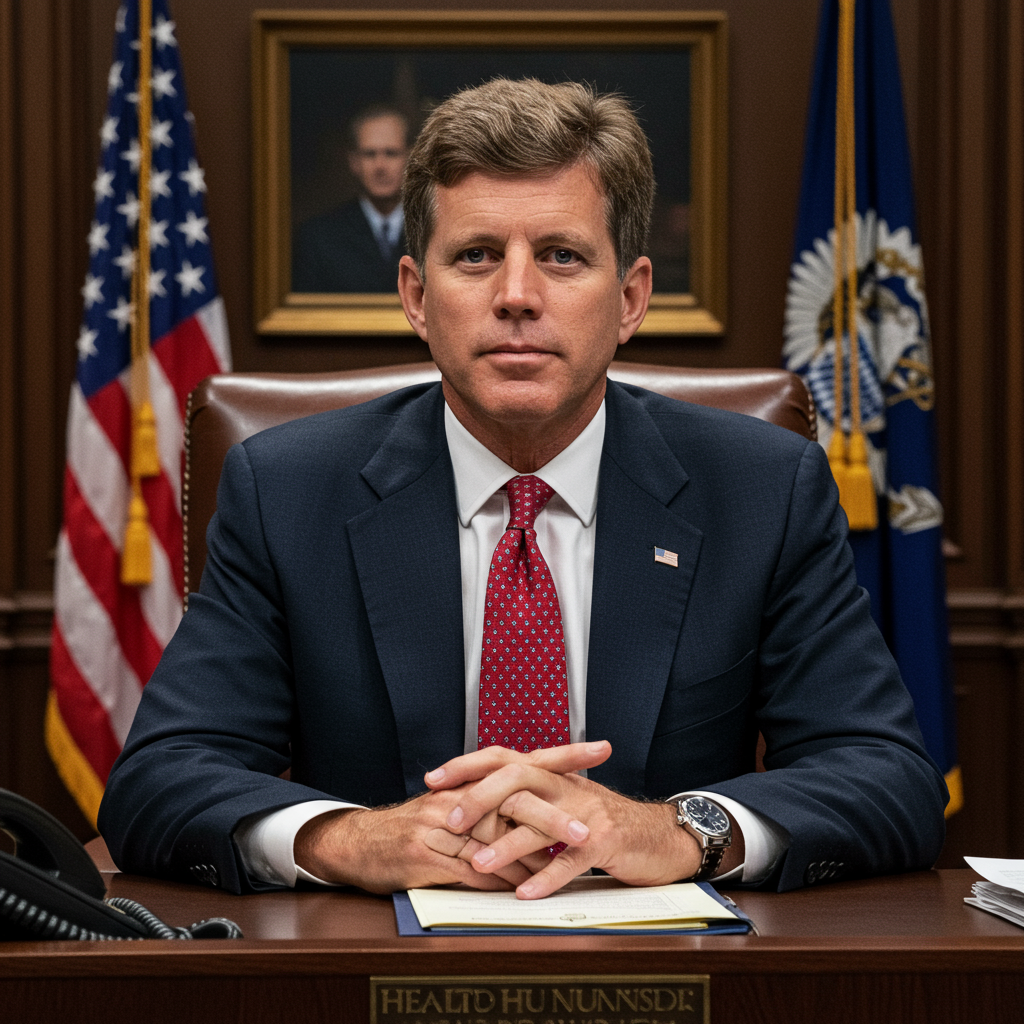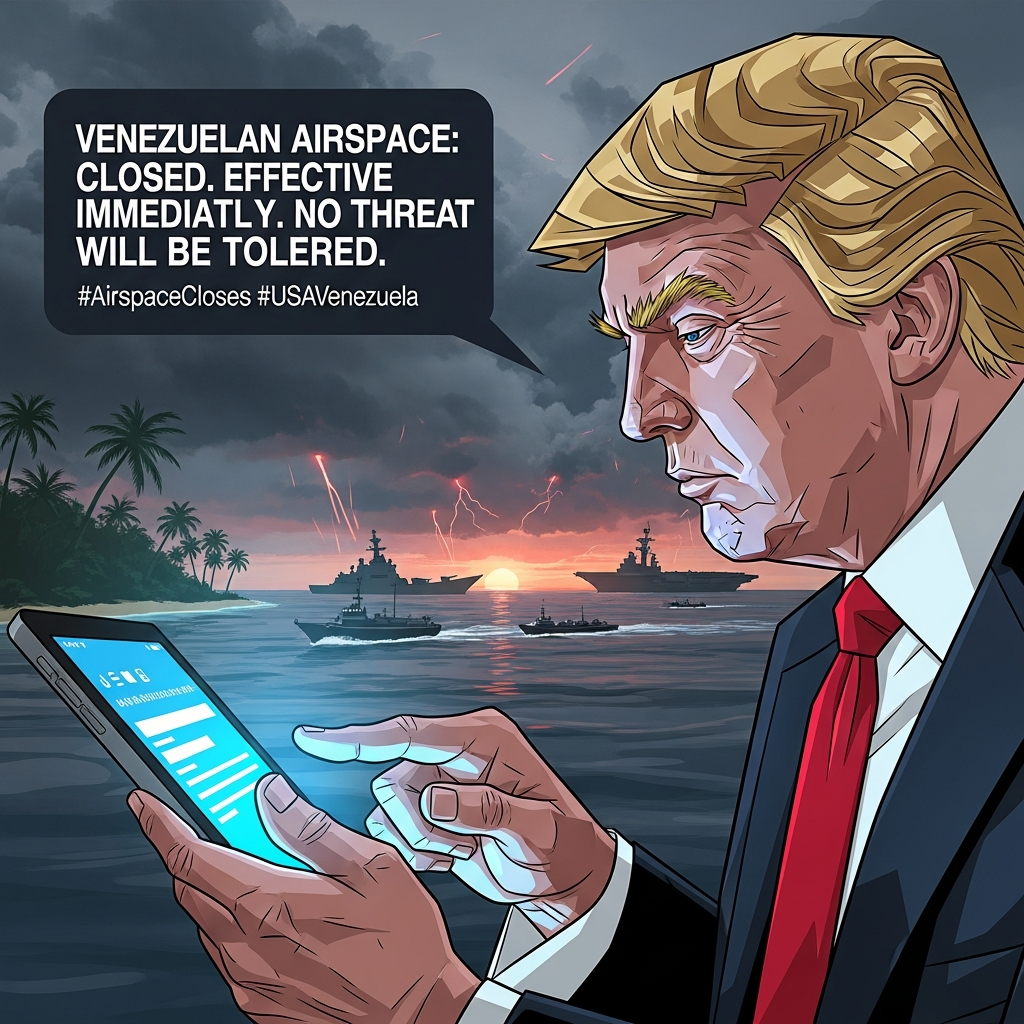
In a stunning move that dramatically escalated already strained relations, former President Donald Trump recently declared Venezuelan airspace “closed in its entirety.” This provocative statement, made via social media, intensified pressure on Caracas. It signaled a new phase in Washington’s assertive stance against the Nicolás Maduro government. Amidst a significant US military buildup in the Caribbean and expanded anti-drug operations, Trump’s directive sparked immediate international debate about its legality and potential repercussions for regional stability and global air travel.
Unpacking Trump’s Airspace Declaration
On Saturday, November 29, 2025, President Trump took to Truth Social to issue an unprecedented warning. He explicitly directed “all Airlines, Pilots, Drug Dealers, and Human Traffickers” to consider the skies above and around Venezuela completely off-limits. This declaration emerged after weeks of rising tensions between Washington and Caracas. Speculation about possible US military intervention had been increasing.
The Legal Landscape: Authority and International Law
Trump’s pronouncement immediately ignited questions regarding its legal basis. A US president lacks the legal authority to unilaterally close the airspace over a sovereign nation like Venezuela. However, such a declaration can sometimes precede military actions, like airstrikes or an enforced no-fly zone. The Maduro government swiftly and forcefully rejected Trump’s assertion. It condemned it as “a new extravagant, illegal, and unjustified aggression.”
Venezuela’s Foreign Ministry labeled the act a “colonial threat.” They stated it undermines the nation’s “territorial integrity, aeronautical security, and full sovereignty.” They stressed that no external authority can interfere with or condition the use of their national airspace. The international community, including the UN, was urged by Venezuela to reject what it described as an “immoral act of aggression.” Historically, imposing a no-fly zone, such as over Libya in 2011, has required a UN Security Council resolution. This provides international legitimacy, a crucial element absent in Trump’s unilateral declaration.
Immediate Reactions and Flight Disruptions
Despite Trump’s direct order, flight-tracking data on the same morning showed several commercial planes still operating within Venezuelan airspace. However, the Federal Aviation Administration (FAA) had already issued a prior warning to pilots. It advised them “to exercise caution” when flying over Venezuela. This earlier FAA alert cited “worsening security” and “heightened military activity.” It prompted some international carriers to reroute or suspend flights even before Trump’s statement.
In a retaliatory measure, Venezuela’s civil aviation authority subsequently stripped takeoff and landing rights from six commercial airlines. These carriers — Iberia, TAP Portugal, Gol, Latam, Avianca, and Turkish Airlines — were accused of “joining the actions of state terrorism.” They had unilaterally suspended their operations. The impact on Venezuelan citizens, already grappling with an unstable economy and political uncertainty, was immediate. Essential air links were disrupted.
Escalating Pressure: The Broader US Strategy
Trump’s airspace declaration is not an isolated incident. It forms part of a larger, aggressive strategy aimed at increasing pressure on the Maduro government. This multifaceted approach combines a significant military buildup, intensified anti-narcotics operations, and controversial allegations regarding drug trafficking.
Military Footprint: A Historic Buildup
The US has steadily increased its military presence in the Caribbean for months. This includes the deployment of the USS Gerald R. Ford, described as the world’s largest and most lethal aircraft carrier, to the region. With approximately 15,000 troops spread across numerous warships and support forces in Puerto Rico, this represents the largest US military buildup in the area in decades. It draws comparisons to the 1989 invasion of Panama.
Defense Secretary Pete Hegseth and Joint Chiefs chairman Gen. Dan Caine have also been active in the region. They met with friendly governments and discussed expanding military campaigns. This included temporary use of air bases in the Dominican Republic for refueling.
Drug Trafficking Allegations: US Justification
The Trump administration publicly justified its intensified actions. It alleged that Nicolás Maduro and his top security officials lead a powerful drug cartel. This group is known as the “Cartel de los Soles” (Cartel of the Suns). Washington formally designated this group as a foreign terrorist organization. This potentially provided a legal pretext for military strikes against Venezuelan government targets.
However, many experts dispute the “Cartel de los Soles” as a formal organization. The US has not publicly disclosed concrete evidence verifying that the victims of its sea strikes were indeed cartel members. It also has not proven that targeted boats were ferrying drugs. Maduro has vehemently denied any ties to the drug trade, accusing the US of “fabricating” a war against him. Interestingly, current and former US officials note that very little of Venezuela’s drug production actually reaches US borders. Most trafficking directs towards Europe or other Caribbean nations.
“Land Action” Threats and Diplomatic Fallout
Further amplifying the pressure, Trump indicated that “land action” against alleged Venezuelan drug traffickers would commence “very soon.” Speaking from Mar-a-Lago, he stated that while “85% stopped by sea,” “the land is easier.” This marks a significant expansion from previously sea-focused interdiction efforts. Since early September, these efforts have reportedly resulted in dozens of alleged drug smugglers’ deaths in the waters off Latin America.
The diplomatic fallout has been substantial. Venezuela unilaterally suspended its regular weekly deportation flights for migrants from the US. These flights had been negotiated earlier in the year. Critics, including Senator Tim Kaine, have also pointed to perceived inconsistencies in the Trump administration’s anti-narcotics stance. They cited the pardon of former Honduran President Juan Orlando Hernandez, who was convicted in the US for drug trafficking. This decision raised questions about the administration’s overall strategy and priorities in combating narcotics.
Implications for Venezuela and Regional Stability
The escalating rhetoric and military posturing by the US have profound implications for Venezuela. This nation of 28 million people also faces broader geopolitical consequences across Latin America.
Citizen Uncertainty Amidst Geopolitical Tensions
Venezuelans find themselves caught between the looming threat of a US attack and a government they distrust for accurate information. This situation breeds widespread uncertainty and anxiety. The disruption of international flights further isolates the mountainous nation. It potentially exacerbates economic hardships and limits access to essential goods and services. The lack of clear communication from both sides only intensifies the population’s predicament.
Potential Military Targets and Operational Scope
Should the US decide to enforce a no-fly zone or launch strikes, former US and Venezuelan military officials and regional defense analysts have outlined a range of potential targets. These could include Venezuelan military bases or key infrastructure linked to Maduro and his leadership. Alternatively, operations might focus more narrowly on disrupting drug trafficking. This could involve hitting cocaine refinery labs, clandestine airstrips, or guerrilla camps. Trump has remained ambiguous about specific strike plans. He stated, “If we can save lives, if you can do things the easy way, that’s fine. And if we have to do it the hard way, that’s fine too.” This leaves the door open for various forms of intervention, adding to the regional unpredictability.
Frequently Asked Questions
What did President Trump declare about Venezuelan airspace?
President Donald Trump declared that the airspace above and surrounding Venezuela should be considered “closed in its entirety.” This directive was issued via Truth Social on Saturday, November 29, 2025. It specifically targeted “all Airlines, Pilots, Drug Dealers, and Human Traffickers.” The statement came amid heightened tensions and a significant US military buildup in the Caribbean. It signaled an aggressive escalation of pressure on the Nicolás Maduro government.
Which airlines stopped flying over Venezuelan airspace after the warnings?
Following warnings from the US Federal Aviation Administration (FAA) about “heightened military activity” and subsequent pressure, several international carriers either rerouted or suspended flights over Venezuelan airspace. In a retaliatory move, Venezuela’s civil aviation authority stripped takeoff and landing rights from six major international airlines. These included Iberia, TAP Portugal, Gol, Latam, Avianca, and Turkish Airlines. These airlines were accused of “joining the actions of state terrorism” by unilaterally suspending their commercial operations.
What are the legal implications of the US ‘closing’ another country’s airspace?
Legally, the US President does not possess the authority to unilaterally close the airspace over a sovereign nation like Venezuela. International law generally upholds a nation’s control over its own airspace. Venezuela’s government vehemently condemned Trump’s declaration as “illegal and unjustified aggression.” It asserted that only Venezuelan institutional frameworks have the power to regulate national airspace. Historically, imposing a no-fly zone requires international consensus, often through a UN Security Council resolution, which was absent in this unilateral US declaration.
Conclusion
Donald Trump’s dramatic declaration regarding Venezuelan airspace marks a significant and controversial escalation in US-Venezuela relations. While the immediate legal enforceability of his statement remains highly contentious, it clearly signals a hardening of Washington’s stance. Coupled with a historic military buildup and persistent allegations of drug trafficking against the Maduro regime, this move creates substantial uncertainty for international aviation, Venezuelan citizens, and the broader stability of the Caribbean region. The coming weeks will reveal whether this declaration serves as a precursor to further military action or a continued strategy of economic and political pressure.