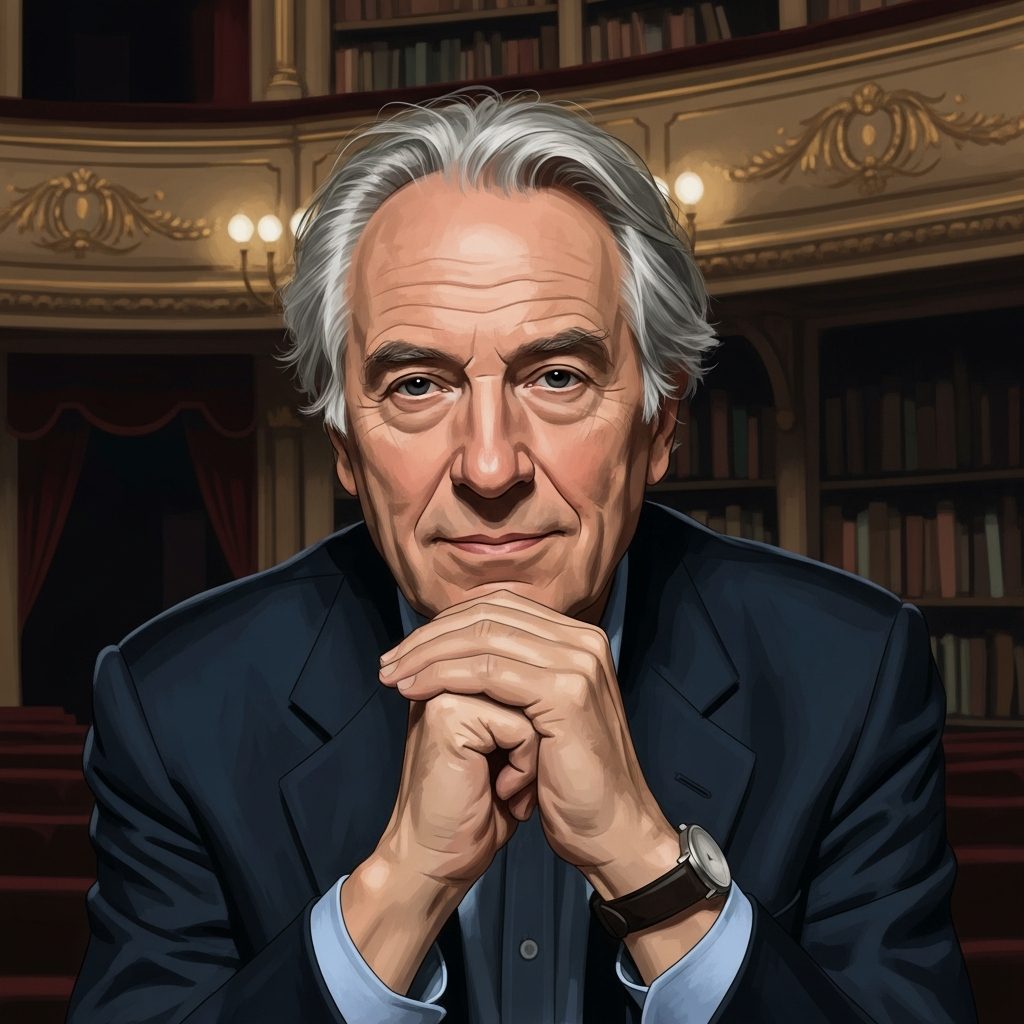
The world of theatre and literature mourns the passing of Tom Stoppard, the visionary British playwright whose dazzling intellect and profound wit reshaped modern drama. Sir Tom Stoppard, an Academy Award winner celebrated for his work on “Shakespeare In Love,” passed away peacefully at his home in Dorset, England, at the age of 88. His legacy spans over six decades, marked by a unique blend of philosophical depth, linguistic playfulness, and poignant human insight, securing his place as one of the greatest dramatists of his generation. This article delves into the remarkable life and enduring impact of the legendary Tom Stoppard.
A Life Forged in Exile: Stoppard’s Early Journey
Born as Tomáš Sträussler in Zlín, Czechoslovakia, in 1937, Stoppard’s early life was profoundly shaped by the upheaval of World War II. His Jewish family fled Nazi invasion in 1939, relocating to Singapore. As Japanese forces advanced in late 1941, he, his brother, and their mother sought refuge in India. Tragically, his father, a doctor for the Bata shoe company, perished attempting to escape Singapore later.
In 1946, a pivotal moment arrived when his mother married Kenneth Stoppard, an English officer. The family then moved to Britain. The eight-year-old Tom readily embraced his new English identity. He famously remarked, “I put on Englishness like a coat,” immersing himself in British culture, from cricket to Shakespeare. This early experience of displacement and assimilation undeniably influenced themes of identity and belonging woven throughout his later work.
From Journalism to Theatrical Breakthrough
Remarkably, Tom Stoppard bypassed university education. Instead, he embarked on a journalism career at 17, working for newspapers in Bristol. He later served as a theatre critic for Scene magazine in London. This foundation in language and storytelling proved invaluable. His initial forays into playwriting included radio and television works, such as “A Walk on the Water” in 1963.
His significant stage breakthrough arrived with “Rosencrantz and Guildenstern Are Dead”. This innovative play reimagined Shakespeare’s “Hamlet” through the eyes of two minor, bewildered characters. Blending tragedy with absurdist humor, it debuted at the Edinburgh Fringe Festival in 1966. Its subsequent move to Britain’s National Theatre, under Laurence Olivier, and then Broadway cemented Stoppard’s reputation. This seminal work established his distinctive voice: a master of verbal gymnastics combined with existential pondering.
A Dazzling Career: Innovation in Theatre and Screen
Following his initial triumph, Tom Stoppard embarked on a prolific and consistently inventive career. His plays frequently challenged conventional narratives and structures. He delved into complex themes, from the nature of reality to the mysteries of consciousness. His work showcased a remarkable breadth, often synthesizing science, philosophy, and history with sharp wit.
Iconic Stage Plays and Tony Award Triumphs
Stoppard’s stage career was adorned with numerous accolades. He earned five Tony Awards for Best Play, a testament to his consistent brilliance:
“Rosencrantz and Guildenstern Are Dead” (1968)
“Travesties” (1976), which famously brought together historical figures like James Joyce, Vladimir Lenin, and Tristan Tzara in a World War I-era Zurich café.
“The Real Thing” (1984), a poignant romantic comedy exploring love, fidelity, and the nature of artistic truth.
“The Coast of Utopia” (2007), an epic trilogy examining pre-revolutionary Russian intellectuals.
“Leopoldstadt” (2023), a deeply personal work exploring his Jewish family’s history.
Other notable plays include the meta-whodunnit “The Real Inspector Hound” (1968), the philosophical “Jumpers” (1972), and the celebrated “Arcadia” (1993), which masterfully wove together themes of chaos theory, poetry, and landscape design across different centuries. His collaboration with composer Andre Previn on “Every Good Boy Deserves Favor” (1977) highlighted his engagement with human rights issues.
Hollywood Acclaim: An Oscar-Winning Screenwriter
Beyond the stage, Tom Stoppard left an indelible mark on cinema. He won an Academy Award for Best Adapted Screenplay for the immensely popular 1998 romantic comedy “Shakespeare In Love,” shared with Marc Norman. His screenwriting credits also include:
“Brazil” (1985), a dystopian masterpiece directed by Terry Gilliam.
“Empire of the Sun” (1987), Steven Spielberg’s war drama.
“Enigma” (2001), a World War II code-breaking thriller.
- “Anna Karenina” (2012), a visually stunning adaptation.
- www.pressdemocrat.com
Stoppard also lent his distinctive touch as a “script doctor,” adding sparkle to dialogue in blockbusters like “Indiana Jones and the Last Crusade” and “Star Wars: Revenge of the Sith.” He even wrote and directed the 1990 film adaptation of his own “Rosencrantz and Guildenstern Are Dead.”
The Personal Becomes Universal: “Leopoldstadt” and His Jewish Heritage
While Stoppard was often perceived as a cerebral playwright, his later work, particularly “Leopoldstadt,” revealed a profound emotional core linked to his personal history. He began contemplating his Jewish heritage late in life. After his mother’s death in 1996, he uncovered the harrowing truth that many family members, including all four grandparents, had perished in concentration camps.
This revelation deeply informed “Leopoldstadt,” a powerful generational saga. It traces a Viennese Jewish family through the first half of the 20th century. Premiering in London in early 2020 to critical acclaim, it eventually moved to Broadway, securing four Tony Awards. The play served as a poignant testament to the lasting impact of history on individual lives. Stoppard remarked to The New Yorker in 2022 that while he knew he was Jewish, he “didn’t feel I had to find out in order to live my own life.” However, the play demonstrates a profound shift in this perspective, embracing a personal history previously kept at arm’s length.
A Champion of Free Speech and Enduring Legacy
Throughout his career, Tom Stoppard was a steadfast advocate for free speech. He worked with organizations such as PEN and Index on Censorship, supporting dissident writers in Eastern Europe and the Soviet Union. His translations of plays by Czech writer Václav Havel, who later became his country’s first post-Communist president, underscore this commitment. While sometimes criticized for his plays being more clever than emotional, biographer Hermione Lee noted their “sense of underlying grief.” This combination of intellectual brilliance and hidden pathos defined his distinctive artistic fingerprint.
Tributes poured in from across the globe following his passing. King Charles III remembered him as “a dear friend who wore his genius lightly.” Rolling Stones frontman Mick Jagger praised Stoppard as “a giant of the English theater, both highly intellectual and very funny in all his plays and scripts.” Jagger highlighted Stoppard’s “dazzling wit” and his love for music, which often featured in his works. As a fitting tribute, London’s West End theatres will dim their lights for two minutes, acknowledging the immense contribution of Sir Tom Stoppard to the arts. He was knighted by Queen Elizabeth II in 1997 for his services to literature. He is survived by his third wife, Sabrina Guinness, and four children, including actor Ed Stoppard, along with several grandchildren.
Frequently Asked Questions
What are the most famous plays written by Tom Stoppard?
Tom Stoppard crafted numerous highly acclaimed plays throughout his distinguished career. Among his most famous are “Rosencrantz and Guildenstern Are Dead,” which launched him to international fame by reimagining Shakespeare’s “Hamlet.” Other iconic works include the intellectually stimulating “Travesties,” the deeply moving romantic comedy “The Real Thing,” the historically rich trilogy “The Coast of Utopia,” and his intensely personal final masterpiece, “Leopoldstadt.” These plays showcase his unique blend of philosophical inquiry, sharp wit, and innovative narrative structures.
How did Tom Stoppard’s personal history influence his work, particularly “Leopoldstadt”?
Stoppard’s personal history, marked by his family’s flight from Nazi-occupied Czechoslovakia and the tragic loss of relatives in the Holocaust, profoundly influenced his later work, most notably “Leopoldstadt.” For much of his life, he did not delve deeply into his Jewish heritage. However, after his mother’s death in 1996 and subsequent discoveries about his family’s fate in concentration camps, he channeled these revelations into the play. “Leopoldstadt” became a powerful exploration of identity, memory, and the impact of history on a Jewish family in Vienna across the 20th century, bringing a deeply emotional and personal dimension to his intellectual prowess.
Besides his stage work, what were Tom Stoppard’s significant contributions to film?
Beyond his towering achievements in theatre, Tom Stoppard was also a highly successful and acclaimed screenwriter. His most notable cinematic contribution was the Oscar-winning screenplay for the 1998 film “Shakespeare In Love,” which earned him an Academy Award for Best Adapted Screenplay. He also penned the scripts for celebrated films such as Terry Gilliam’s dystopian classic “Brazil,” Steven Spielberg’s poignant war drama “Empire of the Sun,” and the visually stunning adaptation of Leo Tolstoy’s “Anna Karenina.” Additionally, he was a sought-after script doctor, contributing his distinctive dialogue and wit to various major Hollywood productions.
The Enduring Echo of a Master Dramatist
The passing of Tom Stoppard marks the end of an extraordinary era in contemporary theatre and literature. His plays challenged audiences to think, to question, and to marvel at the sheer power of language. From the existential musings of two minor Shakespearean characters to the deeply personal saga of a Jewish family grappling with history, Stoppard consistently demonstrated a fearless intellectual curiosity paired with an undeniable humanity. His legacy is not merely in the words he penned, but in the minds he opened and the profound conversations he sparked. The intellectual fireworks and emotional resonance of Sir Tom Stoppard’s work will undoubtedly continue to inspire and provoke for generations to come.