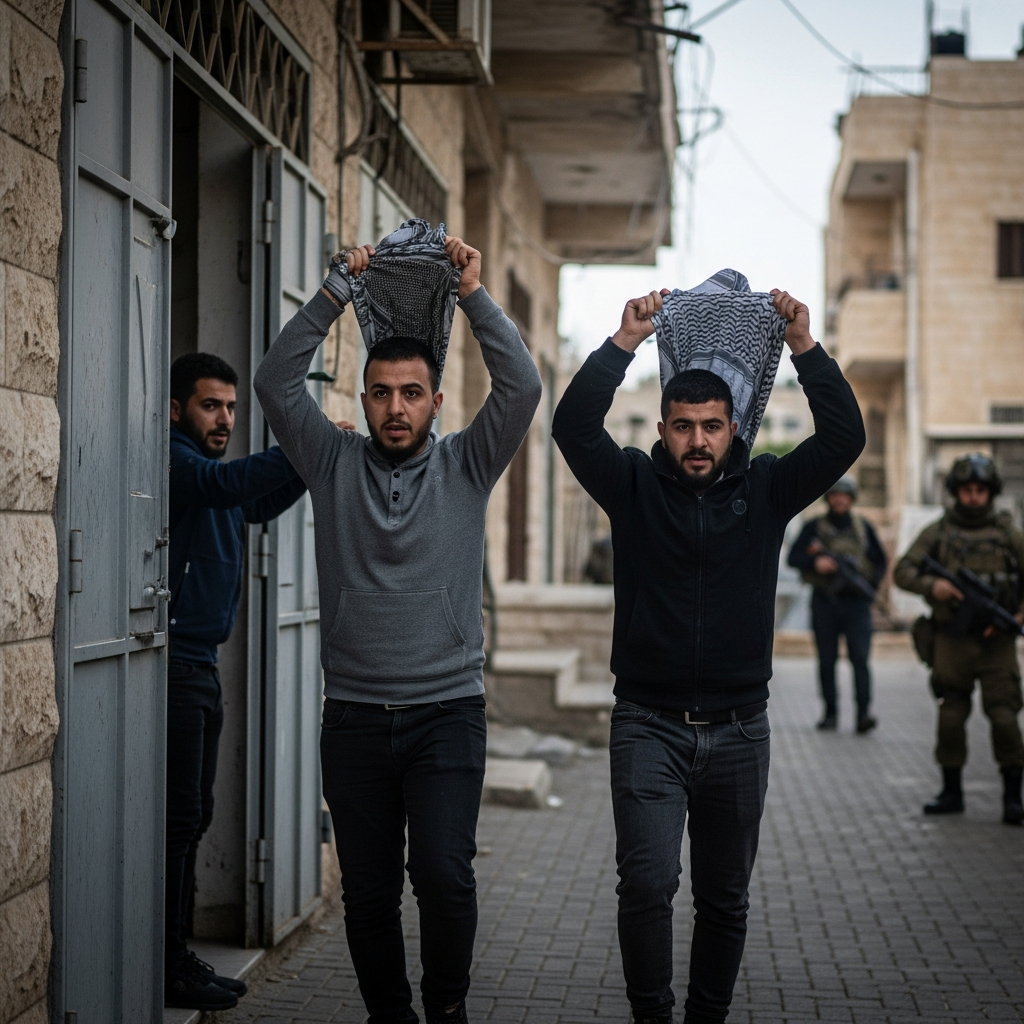
A deeply troubling incident in the occupied West Bank city of Jenin has ignited international outcry and calls for accountability. During a recent Israeli military operation, two Palestinian men, Al-Muntasir Mahmoud Qassem Abdullah, 26, and Youssef Ali Youssef Asasa, 37, were shot and killed by Israeli forces Jenin after they appeared to surrender. Video evidence circulating widely shows the men emerging from a building with raised hands, lifting their shirts to indicate they were unarmed. This tragic event underscores the intensifying West Bank violence and the urgent need for adherence to international humanitarian law in the region.
The incident, which occurred on November 27, 2025, has been described by the Palestinian Authority (PA) as a “fully-fledged war crime” and an “outright extrajudicial killing.” Conversely, Israeli officials maintain the men were “wanted terrorists” involved in hostile activities. The stark contrast in narratives highlights the complexities and deep divisions surrounding the ongoing conflict in the occupied territories. As investigations commence, global attention remains fixed on the outcome and its implications for human rights.
Unpacking the Jenin Incident: Conflicting Accounts Emerge
The fatal shooting unfolded in Jenin during a large-scale “counterterrorism” operation by the Israeli military. According to multiple reports and video footage, the sequence of events began with Israeli security forces surrounding a building. An engineering vehicle was reportedly used to breach the structure. Subsequently, two men, identified as Abdullah and Asasa, emerged.
Video footage, verified by human rights organizations like B’Tselem and circulated by Palestine TV and Reuters, depicts the men in a crouch, their hands raised above their heads in an apparent act of surrender. They also lifted their shirts, signaling they were not carrying weapons or explosive vests. Approximately half a dozen Israeli security personnel, positioned near an armored vehicle, reportedly had their weapons trained on the men. Further footage suggests that two armed Israelis kicked the Palestinians and seemed to instruct them to re-enter the building. As they complied, gunshots were heard, and the men collapsed.
Israeli Military’s Stance and Internal Review
In a joint statement, the Israel Defense Forces (IDF) and Israel Police acknowledged the operation. They stated that the target individuals had allegedly “carried out terror activities, including hurling explosives and firing at security forces,” and were part of a “terror network in the area of Jenin.” The IDF elaborated that a “surrender procedure” lasting several hours had been initiated. Following the use of engineering tools, the two suspects exited the building. The statement affirmed that “fire was directed toward the suspects” after their exit but notably omitted an explanation for why the shooting occurred after their apparent surrender.
The IDF confirmed that the IDF investigation into the incident is underway. Field commanders are reviewing the event, which will then be transferred to “relevant professional bodies.” Sharon Nahari, the lawyer representing the three Border Police personnel involved, stated his clients were interrogated and subsequently released on bail. Nahari claimed his clients genuinely believed their lives were in danger. He added that the Border Police had commanded the suspects to remove their clothes, but they did not comply, leading to the shooting, which he asserted was “merely for the sake of neutralizing them and not with the intention to kill.” However, this account directly conflicts with the video evidence showing the men indicating they were unarmed.
Palestinian and International Condemnation
The Palestinian Authority condemnation has been unequivocal. The PA described the incident as a “flagrant violation of all international laws, conventions, norms, and humanitarian values.” Palestinian Islamic Jihad (PIJ) identified the men as fighters, claiming they exchanged fire with Israeli forces Jenin until their ammunition was depleted. PIJ labeled their killing a “field execution.”
The international community has also voiced strong reactions. The United Nations Human Rights office declared itself “appalled by the brazen killing,” with spokesperson Jeremy Laurence characterizing it as “yet another apparent summary execution.” Human rights groups like B’Tselem condemned the killings as a result of “an accelerated process of dehumanization of Palestinians and the complete abandonment of their lives by the Israeli regime.” Amnesty International also raised concerns, referencing ongoing allegations of war crimes.
Adding to the controversy, Israel’s far-right National Security Minister Itamar Ben-Gvir publicly praised the Israeli military and police. He stated, “The fighters acted exactly as expected of them – terrorists must die!” This statement has drawn further criticism from human rights advocates.
Broader Context: Escalating West Bank Tensions
This tragic incident is not isolated but part of a disturbing pattern of escalating West Bank violence. Since the October 7, 2023, Hamas attack, military operations in the West Bank have intensified significantly. Israeli forces have conducted numerous raids, questioning dozens and arresting many individuals. For instance, over 100 people were detained in Tubas in the days surrounding the Jenin shooting.
The United Nations Office for the Coordination of Humanitarian Affairs (OCHA) reported a substantial increase in settler violence. October 2025 alone saw settlers stage at least 264 attacks on Palestinians, marking the highest monthly tally since the UN began tracking such incidents in 2006. This surge in violence, often occurring in the vicinity of Israeli troops, with settlers rarely facing punitive action, exacerbates tensions.
The UN humanitarian office reports over 200 Palestinians, including 50 children, killed by Israeli forces in the West Bank this year alone. Human Rights Watch (HRW) has also alleged that Israel committed war crimes during previous military operations in the occupied West Bank, leading to significant forced displacement of Palestinians from refugee camps. These figures highlight the severe humanitarian crisis and the urgent need for impartial investigations into all fatalities.
Frequently Asked Questions
What happened during the controversial Jenin operation?
During an Israeli military operation in Jenin on November 27, 2025, two Palestinian men, Al-Muntasir Abdullah and Youssef Asasa, were shot and killed by Israeli forces. Video footage widely circulated appears to show the men emerging from a building with their hands raised and shirts lifted, indicating surrender. Despite this, they were reportedly shot after being instructed to re-enter the building. Israeli authorities claimed the men were “wanted terrorists,” while Palestinian officials and human rights groups have condemned the killings as an extrajudicial execution and a war crime.
How has the international community reacted to the Jenin shooting?
The international community has largely condemned the Jenin incident. The United Nations Human Rights office expressed being “appalled” by what it called an “apparent summary execution.” The Palestinian Authority labeled the killing a “fully-fledged war crime” and a “flagrant violation of international laws.” Human rights organizations like B’Tselem and Amnesty International have also criticized the actions of Israeli forces Jenin, citing concerns about dehumanization and accountability. Conversely, Israel’s National Security Minister, Itamar Ben-Gvir, publicly supported the soldiers’ actions.
What are the common criticisms regarding Israeli military investigations into Palestinian deaths?
Skepticism surrounding Israeli military investigations into Palestinian deaths is prevalent among Palestinians and human rights groups. Critics argue that internal Israeli military review processes rarely lead to prosecutions of Israeli troops for alleged misconduct, particularly concerning the use of lethal force. This perception of a lack of accountability has led some organizations, like B’Tselem, to cease cooperation with military review processes, calling them a “whitewash.” The 2017 case of Israeli soldier Elor Azaria, convicted of manslaughter for shooting an already wounded Palestinian attacker but serving a reduced sentence, is often cited as an example reinforcing this skepticism.
Conclusion: A Call for Transparency and Accountability
The killing of Al-Muntasir Mahmoud Qassem Abdullah and Youssef Ali Youssef Asasa in Jenin represents a critical moment demanding comprehensive investigation and accountability. The stark visual evidence, juxtaposed with the conflicting narratives from Israeli authorities and Palestinian and international bodies, underscores the profound complexities of the conflict. This incident, set against a backdrop of intensifying West Bank violence and rising humanitarian concerns, highlights the urgent need for adherence to international law and transparent justice systems. Without credible and impartial investigations, the cycle of distrust and escalating tensions in the occupied territories will undoubtedly persist, further endangering lives and undermining prospects for peace.