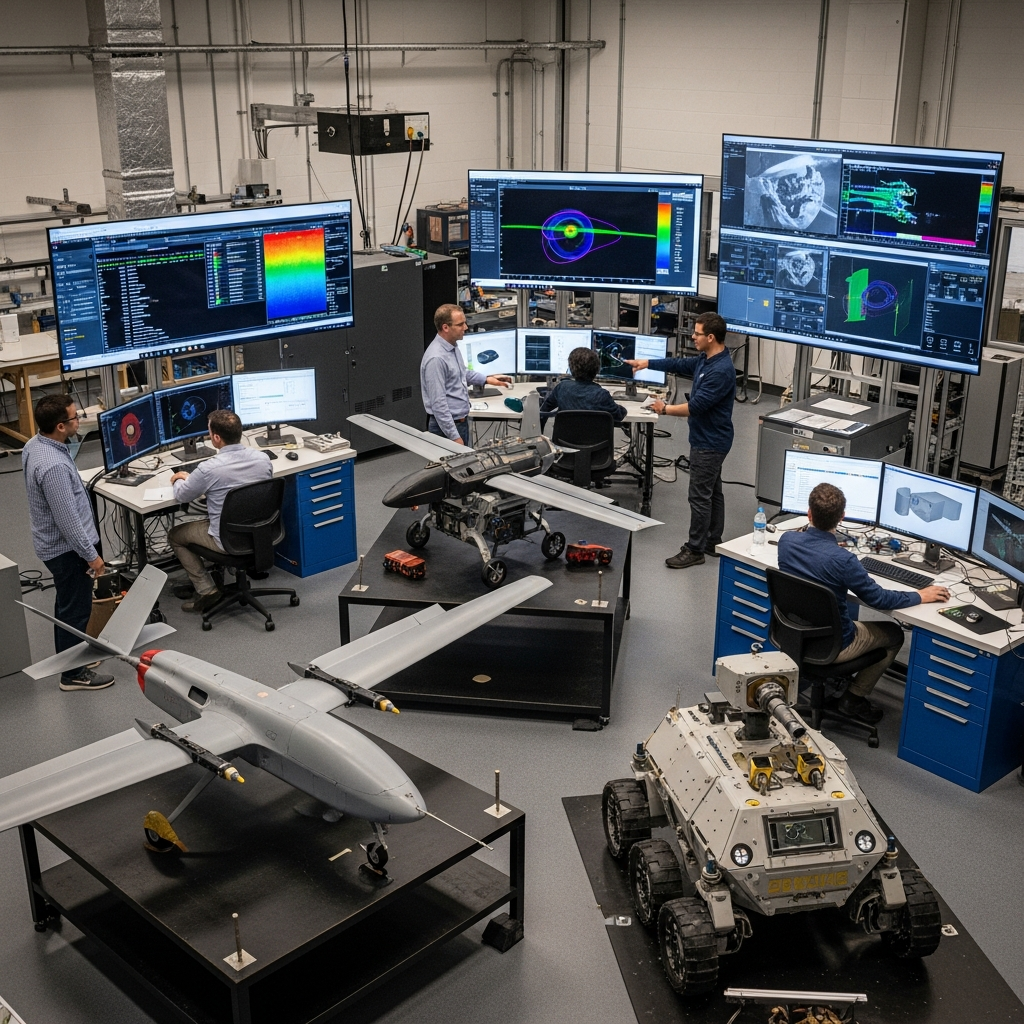
In the dynamic landscape of national security, the development of defense technology is often misunderstood. Far from a linear, flawless process, it’s a relentless cycle of rapid iteration, rigorous testing, and continuous learning, often under intense scrutiny. Recent media narratives, while highlighting specific incidents, frequently strip these events of context, painting an incomplete picture of how crucial military innovations actually get built and deployed. This article delves into the intricate, often messy, but ultimately effective methods driving modern defense advancements.
Challenging the Misconception: The Value of “Failure”
The journey of cutting-edge defense technology is rarely smooth. Journalists sometimes spotlight individual test setbacks—like a rudder malfunction on an uncrewed surface vehicle or issues during munitions trials—as evidence of widespread struggles. This approach, often fueled by competitive interests and isolated data points, can distort public perception. However, those familiar with high-stakes innovation recognize this pattern. Pioneers like SpaceX, Amazon Web Services, and Palantir faced similar skepticism when disrupting established paradigms, demonstrating that early “failures” are not endpoints but critical learning opportunities.
True innovation in defense necessitates pushing boundaries. New defense technology companies, embracing agile methodologies, deliberately stress-test their systems to uncover weaknesses. This means moving fast, testing constantly, failing often, and refining relentlessly. A few widely reported incidents represent a tiny fraction of the thousands of tests conducted annually across numerous global sites. Engineers actively seek to break hardware, crash software, and strain systems to their limits. These controlled setbacks, much like a rocket prototype exploding on launch, are an unavoidable and essential part of the development process, not a sign of broader shortcomings.
The Iterative Core of Modern Defense Technology Development
Modern defense technology thrives on an iterative model. This approach prioritizes speed and adaptability, acknowledging that initial designs will almost certainly encounter unforeseen challenges. For instance, during a recent drone demonstration, routine testing revealed a software issue causing an unexpected launch tube recoil. Instead of proceeding, the demo was halted. The root cause was identified, a fix was shipped, validated, and the successful flight occurred just two days later. Such incidents are not anomalies; they are intrinsic features of a healthy, rapid development cycle, catching issues in controlled environments before they emerge in operational zones.
Consider the evolution of uncrewed aircraft like the Ghost-X. An early training run saw an unstable spin, captured and shared online. This setback led to immediate analysis, a fix, and validation with the customer, enabling successful subsequent operations. This single incident is dwarfed by thousands of flight hours across diverse Army units and multinational exercises, where the system has consistently demonstrated reliability and effectiveness, even in challenging environments from the Arctic to the Middle East. Performance metrics often show units equipped with such technologies performing significantly better against opposing forces.
Software development for defense platforms, such as next-generation command and control systems, also follows this path. Early security reviews in testing environments might uncover vulnerabilities—a common occurrence in pre-deployment software. Swift identification and patching, often within weeks, are then followed by continuous authority to operate, allowing rapid security updates as the system evolves. This constant “experimentation” ensures robust and secure systems for the future.
Bridging the “Valley of Death” with Collaborative Frameworks
Beyond individual system development, integrating diverse defense technologies poses unique challenges. When multiple companies’ systems, built to different standards and timelines, must work together, integration exercises become crucial forcing functions. These events expose misalignments—incompatible data formats, conflicting communication protocols, or organizational interface issues—that no single entity could discover in isolation. For example, during an ambitious multi-agency prototyping program for autonomous sea and air assets, a software issue caused several boats to idle, requiring towing. The team rapidly identified the problem, deployed a fix, and returned to successfully control an unprecedented number of collaborative autonomous vessels within days.
To address these complex hurdles, frameworks like MITRE’s Transition Maturity Framework (TMF) are gaining prominence. The TMF helps bridge the notorious “defense acquisition valley of death”—not a single chasm, but a series of “ditches of death” that derail promising innovations. It expands on traditional Technology Readiness Levels (TRL) and Manufacturing Readiness Levels (MRL) by adding:
Requirements Readiness Level (RRL): Ensuring the technology genuinely aligns with validated mission needs.
Transition Readiness Level (TRL for acquirers): Evaluating the government’s ability to navigate acquisition steps.
- Warfighter Readiness Level (WRL): Assessing the end-user’s capacity to effectively employ the technology, including doctrine, logistics, and training.
- www.calcalistech.com
- federalnewsnetwork.com
- www.lockheedmartin.com
- finance.yahoo.com
- www.npr.org
This comprehensive, agile approach allows for parallel consideration of all readiness dimensions, preventing crucial factors like warfighter adoption from being an afterthought. This collaborative model, facilitated by neutral entities like MITRE, helps diverse stakeholders—from warfighters to startups—systematically overcome the complexities of defense procurement.
Ukraine: The Ultimate Testbed for Real-World Innovation
Nowhere is the relentless nature of defense technology development more apparent than in Ukraine. Described as the most contested and technologically volatile battlespace globally, it serves as an unparalleled “testbed” for innovation. Conditions shift weekly, and technologies that excel in one phase of conflict may require complete refactoring for the next. This environment forces constant adaptation, revealing how systems perform against a highly capable and adaptive enemy.
In the early stages of the conflict, many unmanned systems, including certain loitering munitions, struggled amidst intense electromagnetic pressure, GPS interference, and persistent jamming. Hit rates were often low. These harsh realities compelled a re-evaluation of designs and mission types. However, through continuous in-country presence, with engineers working directly alongside Ukrainian units, real-time data is collected, updates are deployed, and improvements are validated under combat conditions. This proximity has significantly accelerated the learning curve.
For example, systems like Ghost underwent substantial redesigns based on direct Ukrainian feedback, leading to significantly more resilient variants like Ghost-X. Hundreds of Altius systems have been delivered, successfully striking high-value targets despite degraded environments. This continuous cycle of battlefield observation, rapid feedback, and design iteration underscores that perceived “moments of failure” are part of a larger, ongoing adaptation essential for success in modern warfare. The lessons learned here not only improve systems for Ukraine but also strengthen capabilities for other allied forces.
The Evolving Landscape of Defense Innovation
The global landscape of defense innovation is undergoing a profound transformation. There’s a growing urgency, especially in regions like Israel, which Alex Moore of 8VC notes are cultivating next-gen defense tech giants due to a unique blend of urgency, engineering talent, and real-time battlefield data. The US military, unlike a decade ago, actively seeks new technologies and aims to disrupt the traditional “cartel” of prime contractors. A cultural shift among engineers also sees defense tech as a compelling sector to solve “real” problems, driven by geopolitical tensions and the transformative power of AI.
Startups are finding significant opportunities in emerging categories where traditional primes aren’t dominant, such as drones, electronic warfare, and advanced missiles. However, scaling these innovations for national defense also involves established players. Lockheed Martin’s “Golden Dome for America” concept, aiming for a layered missile defense shield, emphasizes a “whole of industry” approach. While open to integrating game-changing tech, it stresses building upon combat-proven foundational systems due to the inherent risks of unproven technology for such vital missions. This highlights the dual need for both agile, disruptive innovation and reliable, scaled deployment. The recent merger of AeroVironment and BlueHalo exemplifies how new defense technology leaders are forming, integrating diverse capabilities from autonomous systems to space and cyber, establishing national manufacturing scale and global reach.
The challenge, as Secretary Hegseth articulated, is delivering an “85 percent solution in the hands of our armed forces today,” which is “infinitely better than an unachievable 100 percent solution that arrives too late.” This means embracing productive iteration, even if it entails stumbling and learning along the way. Increased transparency about testing cycles, failure rates, and resolution timelines will be crucial to distinguish genuine learning from institutional dysfunction.
Frequently Asked Questions
How does defense technology development differ from commercial tech?
Defense technology development often operates under unique constraints not typically found in commercial sectors. While both aim for innovation, defense tech faces significantly higher stakes, demanding extreme reliability and resilience in combat environments. This leads to a more rigorous, iterative testing process involving thousands of simulated and real-world scenarios, often in harsh conditions like those seen in Ukraine. The “failure” rate is often intentionally high during development to identify and fix vulnerabilities, unlike commercial products where a perfect launch is typically paramount. Additionally, the defense acquisition process is highly complex, involving specific readiness frameworks (like MITRE’s TMF) to ensure alignment with warfighter needs and integration into existing military infrastructure, which adds layers of complexity beyond typical market-driven product cycles.
What frameworks or approaches help new defense tech reach the warfighter?
To overcome the “defense acquisition valley of death,” several frameworks and approaches are being adopted. MITRE’s Transition Maturity Framework (TMF) is a key example, integrating Technology Readiness, Manufacturing Readiness, Requirements Readiness, and Warfighter Readiness Levels. This framework fosters a collaborative, agile acquisition process, enabling program managers to systematically address hurdles from technology maturation to user adoption. Beyond frameworks, practices like establishing a continuous in-country presence in operational zones (as seen in Ukraine), rapid feedback loops between developers and end-users, and modular, open-architecture system designs are vital. These approaches ensure that innovations are not just technically sound but also relevant, producible, and usable by warfighters in real-world scenarios, accelerating the deployment of critical capabilities.
Are startups or established contractors better for modern defense innovation?
The modern defense landscape increasingly requires both startups and established contractors for comprehensive innovation. Startups, fueled by venture capital (like 8VC) and a culture of rapid iteration, excel at developing disruptive, cutting-edge technologies in niche areas such as autonomous drones, electronic warfare, and advanced AI. They often move faster and are unencumbered by legacy systems. However, established contractors like Lockheed Martin bring unparalleled expertise in systems integration, manufacturing at scale, and experience with combat-proven foundational systems crucial for national-level defense projects (e.g., layered missile defense). The trend points towards a “whole of industry” approach, where startups innovate rapidly in emerging categories, while primes integrate these advancements into larger, more complex defense architectures, sometimes through partnerships or acquisitions (e.g., AeroVironment/BlueHalo merger). This synergy ensures both groundbreaking innovation and reliable, scalable deployment.
Conclusion
The creation of modern defense technology is a testament to human ingenuity and resilience. It’s a journey defined not by the absence of setbacks, but by the commitment to learn from every challenge, iterating rapidly to forge superior capabilities. As geopolitical tensions rise and adversaries evolve, the imperative to innovate faster and smarter becomes ever more critical. This means embracing transparent, iterative development, leveraging real-world feedback from battlefields like Ukraine, and fostering a collaborative ecosystem where both agile startups and established industry leaders contribute to a stronger national defense. The factory floors, test ranges, and front lines will continue to be the crucible where the future of defense is forged, one learned lesson at a time.