A new chapter in human spaceflight is about to unfold. The Soyuz MS-28 mission is primed to launch three dedicated crew members to the International Space Station (ISS). This critical mission will inject fresh energy into ongoing orbital operations. Scheduled for Thursday, November 27, 2025, this launch promises another exciting spectacle from the Baikonur Cosmodrome. It reinforces the enduring spirit of international collaboration in space.
Soyuz MS-28: Liftoff to the Orbiting Laboratory
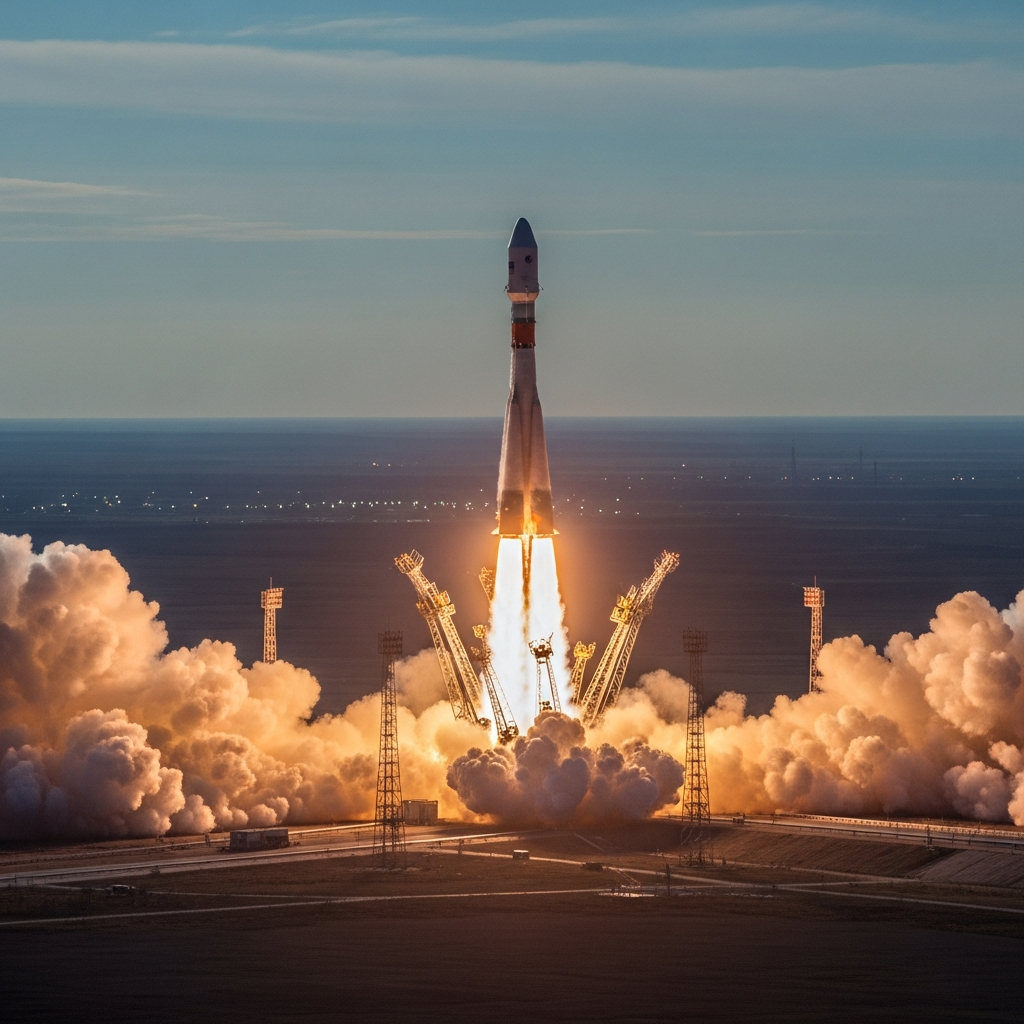
The world watches as the Soyuz MS-28 mission prepares for liftoff. This crucial crewed mission will depart from Site 31/6 at the Baikonur Cosmodrome in Kazakhstan. The launch is set for 09:27 UTC on Thursday, November 27. Aboard the Soyuz spacecraft are two experienced Roscosmos cosmonauts and one pioneering NASA astronaut. This flight marks the final launch contributing to Expedition 73. Soon after, Expedition 74 will officially commence in early December.
Following a flawless launch, the Soyuz spacecraft will undertake a rapid journey. It will complete just two orbits of Earth. An automated docking with the Rassvet module is planned for 12:38 UTC on the same day. This swift rendezvous ensures a quick transition for the new crew. Once securely docked, the hatches will open, welcoming the trio into their new home. These brave individuals will live and work aboard the orbiting laboratory for approximately eight months. Their return to Earth is anticipated in late July 2026.
Precision Prep: Cygnus Relocation and Rocket Rollout
Preparations on the ground and in orbit are meticulously coordinated. Just days before the Soyuz MS-28 launch, the Cygnus XL cargo spacecraft underwent a temporary relocation. This critical maneuver ensured ample clearance for the incoming Soyuz. NASA’s Mission Control Center in Houston directed the Canadarm2 robotic arm to move the Cygnus. NASA astronauts Jonny Kim and Zena Cardman monitored this complex operation from inside the ISS. The Cygnus XL will return to its original docking port on December 1. Its mission will conclude in March 2026.
On November 24, 2025, the powerful Soyuz rocket itself was rolled out to the launch pad. This traditional event at Site 31 of the Baikonur Cosmodrome signifies the final stages of pre-launch readiness. The entire process highlights the immense engineering and logistical efforts involved in every spaceflight. The instantaneous launch window at 09:27 UTC demands absolute precision. Any delays will necessitate a scrub and a new launch opportunity.
Meet the Elite Crew of Soyuz MS-28
The Soyuz MS-28 crew represents the pinnacle of space exploration. It comprises a seasoned commander and two diligent flight engineers. Each member brings a unique background and extensive training to this challenging mission.
Commander Sergey Kud-Sverchkov: A Veteran Returns
Leading the Soyuz MS-28 mission is Roscosmos cosmonaut Sergey Kud-Sverchkov. Born in Soviet Kazakhstan in August 1983, Kud-Sverchkov is embarking on his second journey to the ISS. He previously served as a flight engineer during the Soyuz MS-17 mission in 2020. That first mission saw him spend over 184 days in orbit.
Kud-Sverchkov’s impressive career began with a degree in rocket engineering from Moscow State Technical University. He then worked as an engineer at RSC Energia, the esteemed manufacturer of Soyuz spacecraft. In April 2010, he was selected for cosmonaut training. After completing his rigorous program in August 2012, he was assigned to ISS Expedition 63/64. His return to the station underscores his expertise and dedication.
Flight Engineer Sergei Mikayev: Maiden Voyage to Orbit
Joining the commander is Roscosmos cosmonaut Sergei Mikayev. Mikayev serves as one of the two flight engineers on this mission. Born in August 1986 in Irkutsk, Soviet Russia, he brings a strong military background. Mikayev is a former military pilot and Major in the Russian Air Force. He graduated from the prestigious Krasnodar Higher Military Aviation School of Pilots.
Roscosmos selected Mikayev for cosmonaut training in 2018. This two-year program prepared him for long-duration missions. He initially served as a reserve cosmonaut for Soyuz MS-27. Following that mission’s successful launch, Mikayev received his assignment to the primary crew of Soyuz MS-28. This marks his first thrilling flight into space and to the ISS.
Flight Engineer Christopher Williams: NASA’s Scientific Pioneer
The final crew member is NASA astronaut Christopher Williams. He serves as the second flight engineer. Born in New York City and raised in Potomac, Maryland, Williams boasts an exceptional academic and professional career. He earned a Bachelor of Science degree in physics from Stanford University. He further pursued his education, achieving a Ph.D. in physics from the Massachusetts Institute of Technology (MIT) in 2012.
Williams’ doctoral research focused on astrophysics and radio cosmology. He played a vital role in constructing the Murchison Widefield Array low-frequency radio telescope in Australia. After graduate school, Williams transitioned to Harvard Medical School. There, he served as a professor and clinical physicist. His research concentrated on innovative image-guidance techniques for cancer treatment. In 2021, NASA selected him as an astronaut candidate. He was part of Astronaut Group 23, affectionately known as “The Flies.” Williams completed his intensive two-year training in 2024. He received his assignment to Soyuz MS-28 in early 2025, marking his inaugural spaceflight.
The Engineering Marvels: Soyuz Rocket and Spacecraft
Every space mission relies on cutting-edge technology. The Soyuz MS-28 mission utilizes a robust launch vehicle and a proven spacecraft design. These Russian-built systems have a long history of reliability and innovation.
Powering the Ascent: The Soyuz 2.1a Rocket
The crew will ascend to orbit aboard a Russian Soyuz 2.1a rocket. This three-stage medium-lift launch vehicle is manufactured by RKTs Progress. The Soyuz 2.1a first flew in November 2004. It boasts an impressive record of successful missions. It can launch from several sites across Russia and Kazakhstan, including Baikonur’s Site 31/6.
The Soyuz 2.1a stands 46.3 meters tall with a diameter of 10.3 meters. Its first stage consists of four strap-on liquid-fueled boosters, each powered by a single RD-107A engine. The core stage, or second stage, features a powerful RD-108A engine. Finally, the third stage employs an RD-0110 engine. All three stages efficiently burn liquid oxygen and liquid kerosene (RP-1) propellants. This design provides the necessary thrust to achieve orbit.
The Modernized Soyuz MS Spacecraft
The crew will journey inside the Soyuz MS spacecraft, specifically Soyuz MS No. 753. This particular spacecraft carries the callsign “Gyrfalcon.” The “MS” designation signifies “modernized systems.” Introduced in 2016, this iteration provides significant upgrades over its predecessors. These improvements include enhanced navigation, communication, and other vital onboard systems. RSC Energia, a key Russian aerospace manufacturer, constructs all Soyuz MS spacecraft.
Notably, Soyuz MS No. 753 was not the original spacecraft slated for this mission. Soyuz MS No. 759 was initially assigned. However, it sustained significant heat shield damage during post-production testing. This led to a crucial switch. Soyuz MS No. 753 became available after Roscosmos’ commercial contracts were canceled. This followed Russia’s invasion of Ukraine in 2022. This re-allocation underscores the flexibility and adaptive nature of space logistics.
A Testament to Collaboration: Enduring the Challenges
The Soyuz MS-28 mission highlights the complex and often resilient nature of international partnerships in space. While geopolitical tensions have historically impacted Earth-bound relations, the International Space Station partnership has consistently persevered. The mutual dependence among partners, including the United States, Russia, Europe, Japan, and Canada, remains a powerful binding force. The U.S. segment provides much of the electrical power and attitude control. In contrast, the Russian section is crucial for propulsion and orbital re-boost capabilities. This synergy ensures the station’s continued operation.
This particular mission follows a period where Russia’s space agency head, Dmitry Rogozin, made strong statements regarding international space cooperation. Such instances recall a previous all-Russian crew launch to the ISS in 2022. Despite these challenges, the ISS stands as a beacon of what nations can achieve together. The Soyuz MS-28 flight continues this legacy, demonstrating a shared commitment to scientific discovery and human exploration beyond Earth.
Science in Orbit: Life Aboard the ISS
Beyond ferrying new crew members, the International Space Station remains a bustling hub of scientific inquiry. The current ISS crew consistently conducts a diverse array of experiments and maintenance tasks. These activities are vital for understanding the effects of microgravity and advancing scientific knowledge.
NASA astronauts Jonny Kim actively participates in the CIPHER investigation. This study uses an advanced resistive exercise device to analyze cardiorespiratory fitness, muscle strength, and endurance in space. Zena Cardman, another NASA astronaut, performs fluid physics experiments. She injects gas into specialized tanks, researching methods to protect super-cooled cryogenic fluids in orbit.
Flight Engineers Mike Fincke of NASA and Kimiya Yui of JAXA collaborate on offloading new science experiments and supplies. These items arrived via the HTV-X1 cargo spacecraft in October. Yui also ensures the Astrobee robotic helpers are in top condition. He performs maintenance tasks within the Tranquility module. Fincke, in turn, sets up a fluorescence microscope. This allows for observing particle behavior in fluids, contributing to material science research.
On the Roscosmos side, Commander Sergey Ryzhikov and Flight Engineer Alexey Zubritsky test a lower body negative pressure suit. This experiment aims to counteract the space-induced fluid shift towards a crew member’s head. This condition can cause head and eye pressure in microgravity. It may also aid crews in adapting faster upon returning to Earth. Roscosmos Flight Engineer Oleg Platonov contributes to microgravity adaptation studies. He wears virtual reality goggles and sensors. He responds to visual signals, observing how his vision and balance adjust to the unique space environment. These varied scientific investigations underscore the ISS’s role as humanity’s premier orbital research platform.
The Journey Ahead: Expedition 74 and Beyond
After docking, the three new Soyuz MS-28 crew members will begin their intensive eight-month stay. They will integrate seamlessly into Expedition 74, contributing to its scientific objectives and operational tasks. The Soyuz spacecraft, with its approximately 125 kg of crew and cargo, will serve as their lifeline and eventual ride home. Their mission promises valuable contributions to our understanding of space and its effects on the human body.
Should the primary Soyuz MS-28 crew members not require replacement, the backup team awaits their turn. This includes Roscosmos cosmonauts Pyotr Dubrov (backup commander) and Anna Kikina, alongside NASA astronaut Anil Menon (backup flight engineers). This talented trio is slated to comprise the next crewed Soyuz mission, Soyuz MS-29, scheduled for July 2026. This continuous cycle of crew rotations ensures the uninterrupted operation and scientific output of the International Space Station.
Frequently Asked Questions
What is the mission duration and primary purpose of Soyuz MS-28?
The Soyuz MS-28 mission is designed to transport three new crew members to the International Space Station (ISS) for an approximate eight-month stay. Its primary purpose is to refresh the station’s crew, bringing two Roscosmos cosmonauts and one NASA astronaut to replace outgoing personnel. This ensures the continuity of scientific investigations, maintenance, and operational duties aboard the orbiting laboratory. The crew is expected to return to Earth in late July 2026, contributing to the long-duration human presence in space.
Where is the Soyuz MS-28 mission launching from, and what module will it dock with?
The Soyuz MS-28 mission will launch from Site 31/6 at the Baikonur Cosmodrome in Kazakhstan, a historically significant launch facility. Following its launch on November 27, 2025, the Soyuz spacecraft will perform a rapid two-orbit rendezvous with the International Space Station. It is scheduled to perform an automated docking with the Rassvet module of the ISS at 12:38 UTC on the same day. This module is part of the Russian segment of the station, facilitating critical crew and cargo transfers.
How does international collaboration on the ISS, like the Soyuz MS-28 mission, persist despite geopolitical tensions?
International collaboration on the ISS, exemplified by the Soyuz MS-28 mission with its Russian and American crew, continues to thrive due to mutual dependence and a shared commitment to science. Despite past geopolitical tensions, the partnership among nations like the US and Russia is critical for the station’s survival. The U.S. segment provides vital power and attitude control, while the Russian segment offers essential propulsion and re-boost capabilities. This interconnectedness ensures that scientific exploration and human presence in space remain a priority, often transcending earthly political divides.
A New Era of Exploration
The Soyuz MS-28 mission represents more than just a routine crew transfer. It embodies the relentless pursuit of knowledge and the unwavering spirit of human ingenuity. As these three individuals embark on their extraordinary journey, they carry with them the hopes and aspirations of nations. Their work on the International Space Station will undoubtedly contribute invaluable data. This data will pave the way for future long-duration missions and deeper explorations of our solar system. The enduring partnership behind the ISS continues to prove that even in challenging times, humanity can unite for a common, inspiring goal.