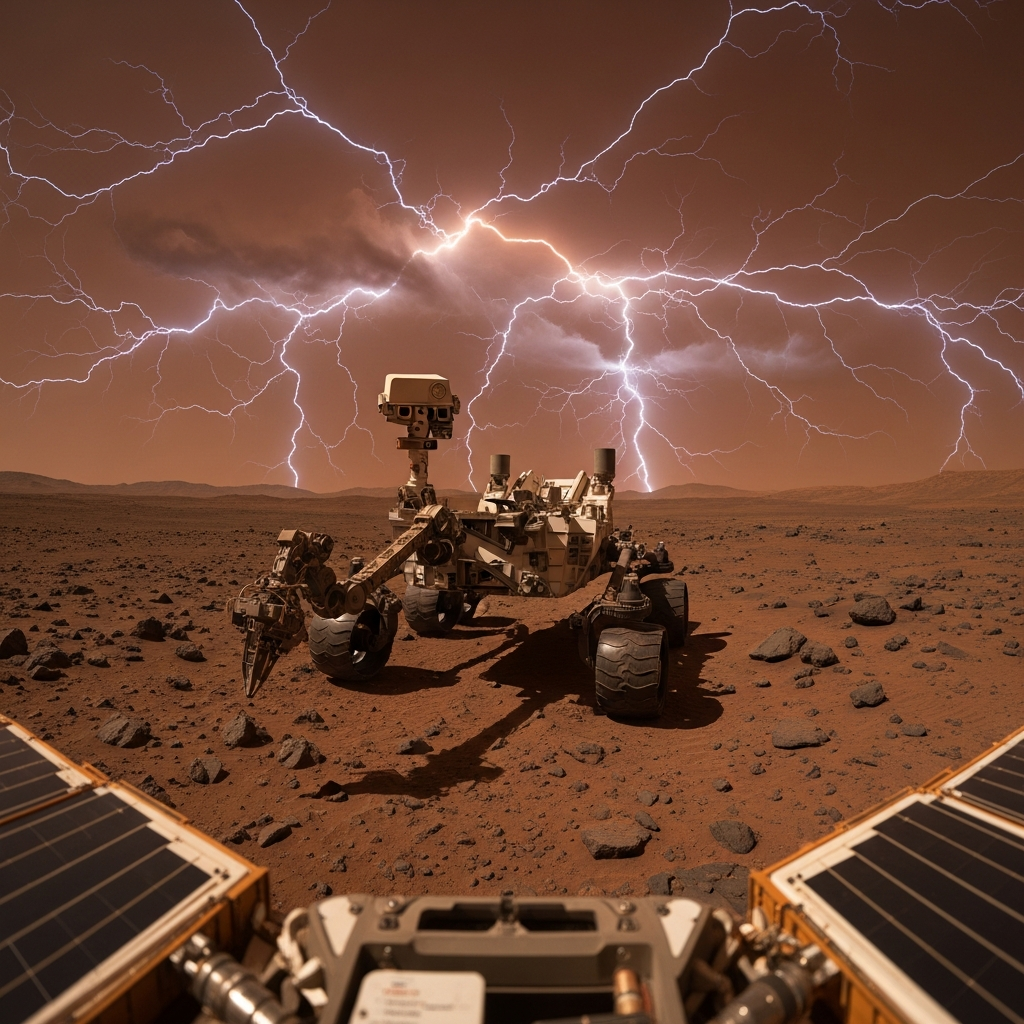
A groundbreaking discovery from NASA’s Perseverance rover has definitively confirmed the existence of electrical activity on Mars. For the first time, scientists have detected direct evidence of triboelectric discharges – a form of “mini-lightning” – crackling through the Red Planet’s dusty atmosphere. This monumental finding, enabled by the rover’s advanced SuperCam microphone, redefines our understanding of Martian atmospheric chemistry, climate dynamics, and the critical search for life beyond Earth. It also carries significant implications for the safety of future human and robotic exploration efforts on the planet.
Unraveling a Long-Standing Martian Mystery
For decades, the scientific community has theorized about electrical activity on Mars. Its perpetually dusty atmosphere, rife with aeolian processes like wind-blown dust and massive dust storms, offered a compelling parallel to Earth’s deserts. On our planet, similar dust phenomena generate static electricity through triboelectric charging, where friction between airborne particles leads to a buildup of electrical potential. While predictions suggested that significant electric fields could accumulate on Mars, direct in-situ measurements remained elusive. This new evidence provides the missing link, transforming speculation into confirmed observation and opening a new chapter in Martian atmospheric science.
Perseverance Listens: The Sound of Martian Sparks
The crucial breakthrough came from the SuperCam microphone aboard the Perseverance rover, which captured the characteristic electrical and acoustic signatures of these discharges. Over two Martian years, the microphone recorded 55 distinct events. These “mini-lightning” flashes weren’t just audible; they also produced clear electromagnetic signals. Researchers observed initial spikes, a subsequent overshoot, and a relaxation phase – a pattern identical to laboratory experiments using a Wimshurst machine to generate high-voltage sparks. Acoustically, the discharges manifested as shock waves. Their unique lobed-shape spectral patterns precisely matched those generated by the rover’s own laser-induced breakdown spectroscopy (LIBS) blasts, offering irrefutable proof of their electrical origin.
Linking Electrical Zaps to Dust Events
The data painted a clear picture: these Martian electrical activity events were strongly associated with intense dust phenomena. Most discharges occurred during encounters with dust devils and the turbulent convective fronts of larger dust storms. The rover’s Mars Environmental Dynamics Analyzer (MEDA) corroborated these observations. Corresponding pressure drops, temperature fluctuations, and reductions in shortwave flux, all characteristic indicators of passing dust devils, aligned perfectly with the discharge detections. Furthermore, Navigation Camera images showed increased boundary-layer dust during some of the detection periods. This reinforces the direct link between significant dust movement and the generation of electrical discharges on Mars. High wind speeds were also a common factor, providing the necessary kinetic energy for robust triboelectric charging.
The Electrified Atmosphere: How Sparks Form on Mars
The phenomenon of triboelectric charging is at the heart of this discovery. As fine dust particles collide and rub against each other within the swirling winds of a dust devil or storm, they exchange electrons. Typically, larger particles acquire a positive charge, while smaller particles become negatively charged. In the chaotic environment of a dust devil, these smaller, negatively charged particles are often lifted higher by turbulent updrafts, while the larger, positively charged particles tend to fall. This vertical separation of charge creates powerful electric fields.
On Earth, while dust can become charged in deserts and volcanic plumes, actual atmospheric discharges are relatively rare. Mars, however, presents a unique environment. Its thin atmosphere, primarily composed of carbon dioxide, requires significantly less charge to reach the breakdown threshold for an electric spark. This makes the formation of electric discharges on Mars much more probable than on Earth. The observed electric fields reached levels of several tens of kilovolts per meter (kV/m), consistent with the predicted breakdown threshold for the near-surface Martian atmosphere. Researchers estimated that some of the largest discharges packed an energy of about 40 millijoules, comparable to the zap from an electrical bug swatter.
Far-Reaching Implications for Mars
The confirmation of Martian electrical activity carries profound implications across several scientific disciplines, from planetary science to astrobiology and future human exploration.
Reshaping Martian Climate and Dust Dynamics
These newly discovered electrical charges are not merely a curiosity; they likely play a critical role in Mars’s complex climate system. The electric forces influence the motion of charged dust particles, potentially contributing to more efficient dust lifting and transport into the atmosphere. This enhanced dust mobilization could significantly impact the global Martian climate, affecting atmospheric opacity, temperature profiles, and overall dynamics, many aspects of which remain poorly understood.
Impact on Atmospheric Chemistry and the Search for Life
Perhaps one of the most significant implications for astrobiology is the role these discharges could play in shaping Mars’s atmospheric chemistry. The energetic sparks can ionize the surrounding atmosphere, fostering a highly reactive electrochemical environment. This process can significantly enhance the oxidizing capacity of the Martian atmosphere, leading to the formation of powerful oxidants like hydrogen peroxide. Such compounds are known to destroy organic molecules, which are crucial biosignatures in the search for past or present life. This enhanced oxidation could explain the surprisingly rapid disappearance of methane on Mars, a long-standing mystery. The findings highlight how challenging it might be to detect delicate organic molecules on the Martian surface due to these pervasive electrical zaps.
Risks for Future Missions and Human Explorers
The existence of frequent electric discharges on Mars also poses tangible risks for future robotic and human missions. While the individual “mini-lightning” zaps might not be lethal to humans, their continuous presence could degrade spacesuits over extended periods. More critically, these electrical phenomena could disrupt or damage sensitive electronic equipment on rovers, landers, and future habitats. This necessitates careful design considerations for the resilience of spacecraft electronics and the materials used in spacesuits. Rock and soil samples collected by Perseverance for future return to Earth are likely protected in their sealed tubes, but researchers acknowledge the possibility that these samples could have experienced electrical discharges prior to collection. This emphasizes the urgent need for a new generation of instruments specifically designed to measure electric fields on the Martian surface.
The SuperCam microphone, which delivered the very first sounds from Mars in 2021, has collected over 30 hours of unique audio, revealing not only winds and the hum of the Ingenuity helicopter but now also these significant electrical discharges. This achievement underscores the immense potential of acoustic data as an invaluable tool for planetary exploration and understanding.
Frequently Asked Questions
What is “mini-lightning” on Mars, and how does it form?
“Mini-lightning” on Mars refers to small-scale electrical discharges, scientifically known as triboelectric discharges. They form when dust particles in the Martian atmosphere rub against each other due to wind, building up static electricity. This process, called triboelectric charging, separates positive and negative charges. When the electric field becomes strong enough to overcome the atmospheric resistance, it triggers a visible spark or “zap,” much like static electricity on Earth but more common on Mars due to its thin atmosphere.
Which NASA rover detected electrical activity on Mars, and how was it confirmed?
The Perseverance rover detected the first direct evidence of electrical activity on Mars using its SuperCam microphone. The discharges were confirmed by identifying distinct electrical and acoustic signatures in the microphone’s recordings. These signatures, including specific electromagnetic patterns and shock wave acoustics, were then validated by comparing them to laboratory experiments and the rover’s own laser-induced blasts, confirming their origin as atmospheric electrical discharges.
What are the key implications of Martian electrical discharges for future exploration and habitability?
Martian electrical discharges have several critical implications. They influence dust dynamics, potentially increasing dust lifting and impacting the planet’s climate. For habitability, these discharges can create strong oxidants that destroy organic molecules, making the search for past or present life more challenging. For future human and robotic missions, they pose a risk to sensitive electronics and could degrade spacesuits, necessitating advanced protective measures and the development of new instruments to better study Mars’s electrical environment.
A New Frontier in Planetary Science
The direct detection of Martian electrical activity by the Perseverance rover marks a pivotal moment in planetary science. It moves beyond theoretical predictions to provide tangible evidence of a dynamic, electrically charged environment on the Red Planet. This discovery not only enhances our fundamental understanding of Mars’s atmosphere and climate but also profoundly impacts the astrobiological quest for life and the strategic planning for human exploration. As scientists continue to analyze data from SuperCam and other instruments, the mysteries of Mars continue to unfold, revealing a planet far more active and complex than previously imagined.