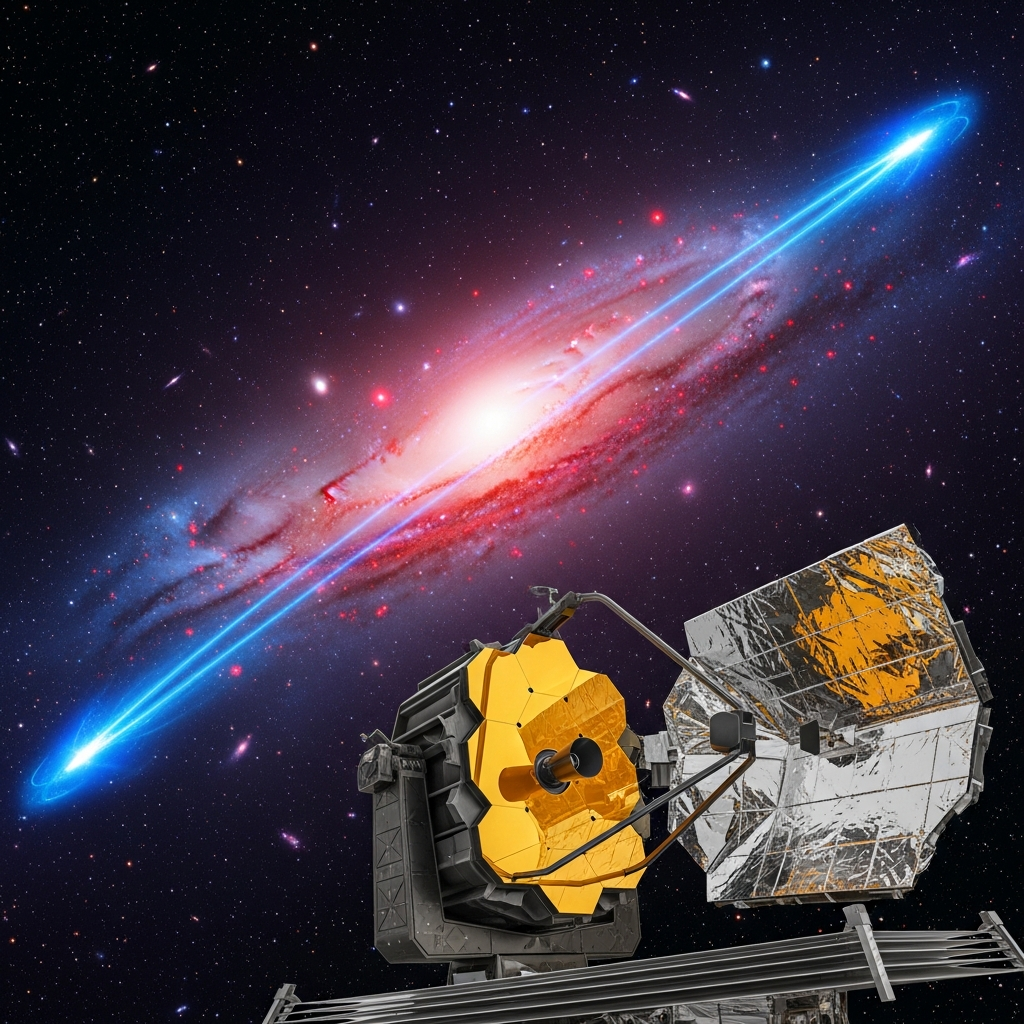
The James Webb Space Telescope (JWST) has made an astonishing discovery: a supermassive black hole growing at an unprecedented rate just 570 million years after the Big Bang. This ancient cosmic behemoth, residing in a “Little Red Dot” galaxy named CANUCS-LRD-z8.6, fundamentally challenges our understanding of how these gargantuan objects and their host galaxies formed and co-evolved in the early Universe. This groundbreaking observation provides crucial new data for astrophysical models, hinting at a much faster, more extreme path for black hole growth than previously imagined.
Unraveling the Mystery of Little Red Dots
For years, astrophysicists have been puzzled by “Little Red Dots” (LRDs). These incredibly distant, small, and distinctively red galaxies appear in increasing numbers during the early Universe, their light stretched by billions of years of cosmic expansion. Their precise nature remained elusive, even at the edge of JWST’s observational capabilities. Scientists theorized that LRDs could be primordial galaxies hosting actively feeding supermassive black holes (SMBHs). However, finding such massive black holes so soon after the Big Bang — within the first 500-600 million years — presented a significant challenge to conventional theories of black hole formation and galaxy evolution. Compounding the mystery, many LRDs surprisingly don’t exhibit strong X-ray emissions, a common characteristic of active galactic nuclei (AGNs).
JWST’s Unprecedented Glimpse into the Cosmic Dawn
The recent breakthrough, led by Roberta Tripodi and her team, focused on CANUCS-LRD-z8.6, observed at a spectroscopic redshift of z=8.6319. This translates to roughly 570 million years after the Big Bang. Using JWST’s powerful Near-Infrared Spectrograph (NIRSpec), researchers could capture the faint light from this distant galaxy, revealing spectral features previously undetectable. These instruments are vital for peering through cosmic dust and vast distances to analyze the spectral fingerprints of light emitted billions of years ago. Dr. Nicholas Martis from the University of Ljubljana highlighted that these specific spectral features, definitive signs of an accreting black hole, were entirely beyond the reach of older technology.
The Spectral Signatures of an Ancient Giant
The NIRSpec analysis provided compelling evidence of an active galactic nucleus. Key observations included:
Broad Hβλ4863 Å emission: This spectral line, with a Full Width at Half Maximum (FWHM) of approximately 4200 km/s, signifies material rapidly orbiting very close to the black hole. The absence of broad [O III]λ5008 emission ruled out alternative explanations like vigorous outflows.
High-ionization lines: The detection of C iv and N iv] emission, which cannot be attributed to star formation, strongly confirmed the presence of an AGN. These lines indicate atoms stripped of electrons by intense radiation from the accreting black hole.
High electron temperature: Measurements revealed an electron temperature (Te) of around 40,000 K, 2-4 times higher than typical star-forming galaxies, yet consistent with other AGNs.
Together, these features paint a clear picture of a vigorously active black hole.
Unmasking an Over-Massive Black Hole
From these spectral measurements, the team inferred the black hole’s mass to be a colossal (1.0 times 10^8 M_odot). This makes CANUCS-LRD-z8.6’s black hole at least ten times more massive than most spectroscopically confirmed AGN LRDs found at redshifts z ~5-7. Astonishingly, it hosts an SMBH approximately 100 times more massive than that of GN-z11 (at z=10.6), despite being only about 150 million years younger. The black hole is also accreting material at a significant fraction of its Eddington limit (λEdd = 0.1), showcasing its rapid growth.
A Galaxy of Extremes
The host galaxy of CANUCS-LRD-z8.6 is equally remarkable. It exhibits an exceptionally high [O III]λ4364/[O III]λ5008 ratio, suggesting very high gas densities in the narrow line region, characteristic of Type I AGNs. Spectral Energy Distribution (SED) fitting, which included an AGN component, revealed a stellar mass of approximately (4.5 times 10^9 M_odot). This makes CANUCS-LRD-z8.6 the most massive AGN host identified at z > 7 in terms of stellar mass. Furthermore, this galaxy is extremely compact, with a half-light radius estimated to be less than 70 parsecs.
Paradoxically, despite clear signs of nitrogen and carbon enrichment, the galaxy’s overall gas-phase metallicity is surprisingly low, with an upper limit of Z ≲ 0.2Z⊙. This positions CANUCS-LRD-z8.6 among the most metal-poor galaxies for its stellar mass at high redshifts. Researchers explain this contradiction through a model of metallicity stratification. In this scenario, the enriched nitrogen and carbon originate from the compact broad line region (BLR) immediately surrounding the black hole, where chemical evolution can be highly accelerated. Meanwhile, the larger host galaxy maintains a low metallicity due to ongoing accretion of pristine, metal-poor gas that also fuels its high star formation rate.
Redefining Cosmic Co-evolution
One of the most profound implications of this discovery is that CANUCS-LRD-z8.6’s black hole is significantly over-massive relative to its host galaxy’s stellar mass, especially when compared to the well-established black hole-galaxy mass relations observed in the local Universe. This suggests an early, rapid growth phase for the black hole that outpaced the growth of its stellar host.
The research team proposes a physical model for this unique system. They believe the AGN’s powerful UV continuum is visible due to a relatively cleared line of sight, while the majority of the galaxy’s stellar light is obscured by dense gas clouds where stars are forming. This means we are witnessing a highly compact system undergoing intense star formation, where a very energetic AGN has created an observable “window.” This dynamic interplay suggests that CANUCS-LRD-z8.6 might represent a crucial evolutionary link, a precursor to the luminous quasars observed at z ~6, rather than simply a lower-luminosity AGN. Such massive and active SMBHs could profoundly influence star formation, potentially even initiating quenching processes in galaxies at these very early epochs.
Challenging Black Hole Formation Theories
The existence of a (10^8 M_odot) supermassive black hole just 570 million years after the Big Bang presents a formidable challenge to current black hole formation models and simulations. Standard accretion models, often assuming steady Eddington-limited growth from “light seeds” (e.g., Pop III stellar remnants of 10-100 (M_odot)), struggle to explain how such a massive black hole could assemble within the limited cosmic time available. The data instead points towards two primary scenarios:
Very massive seeds: The black hole might have originated from “heavy seeds” (e.g., (>3 times 10^7 M_odot)) that formed much earlier (z > 25) and then accreted material near the Eddington limit.
- Super-Eddington accretion: Alternatively, lighter seeds could have grown at exceptionally rapid rates, significantly exceeding the Eddington limit for prolonged periods.
- www.nature.com
- www.universetoday.com
- earthsky.org
- petapixel.com
- www.nature.com
Semi-analytical models (SAMs) that assume Eddington-limited accretion fail to reproduce such extreme high-redshift black holes. However, SAMs incorporating super-Eddington accretion, such as the Cosmic Archaeology Tool (CAT) model, successfully predict the assembly of a (10^8 M_odot) black hole by z=8.6, often showing black holes that are “over-massive” compared to their hosts.
Similarly, most standard hydrodynamical simulations struggle to reproduce these early, massive black holes. However, modified simulations that promote earlier black hole seeding and allow for mild super-Eddington accretion (e.g., factors of two) can successfully explain the observed mass of CANUCS-LRD-z8.6. These refined models often show that reducing AGN feedback or lowering radiative efficiency can accelerate black hole growth. The findings from CANUCS-LRD-z8.6, along with observations of another LRD at z=7.3, J1007_AGN, which shows similar characteristics and is embedded in a dense galaxy overdensity, suggest that LRDs could reside in massive dark matter halos. This implies a surprisingly high duty cycle for LRDs compared to UV-luminous quasars, allowing more time for black holes to accumulate mass.
Frequently Asked Questions
What makes CANUCS-LRD-z8.6’s black hole so unusual?
CANUCS-LRD-z8.6 harbors a supermassive black hole with a mass of approximately (1.0 times 10^8 M_odot), observed just 570 million years after the Big Bang (at redshift z=8.6319). This is exceptionally massive for such an early epoch, being at least ten times larger than most other active black holes found in “Little Red Dots” at similar distances and 100 times more massive than the black hole in GN-z11 (z=10.6), despite a relatively small age difference. Crucially, it’s also “over-massive” compared to its host galaxy’s stellar content, challenging typical co-evolution theories.
How did the James Webb Space Telescope identify this distant black hole?
The James Webb Space Telescope (JWST) utilized its Near-Infrared Spectrograph (NIRSpec) instrument to analyze the faint light from CANUCS-LRD-z8.6. NIRSpec allowed scientists to detect specific spectral features indicative of an actively growing black hole, such as broad Hβ emission (showing rapid gas movement) and high-ionization lines like C iv and N iv] (produced by intense radiation from the black hole). These detailed spectroscopic observations were essential, as previous technology lacked the sensitivity to detect these clear “smoking guns” of an accreting black hole at such extreme distances and ages.
Why does the discovery of CANUCS-LRD-z8.6 challenge current black hole formation theories?
The rapid assembly of a (10^8 M_odot) black hole so early in the Universe’s history (within 570 million years) presents a major puzzle. Existing theories often rely on Eddington-limited accretion from “light seeds,” which would not allow enough time for such immense growth. This discovery suggests that either black holes must have formed from very massive “heavy seeds” much earlier in the Universe, or they underwent prolonged periods of “super-Eddington accretion,” consuming matter at rates far exceeding theoretical limits. It also indicates that early black hole growth might have significantly outpaced the growth of their host galaxies, necessitating refinements in models of black hole seeding, accretion physics, and the complex feedback between black holes and galaxies.
Future Horizons
CANUCS-LRD-z8.6 provides invaluable observational constraints, emphasizing the critical need for refining theoretical models and simulations. These models must now coherently explain black hole seeding, accretion physics, star formation, and AGN feedback to account for the observed population of high-redshift AGNs and the rapid co-evolution of massive black holes and their host galaxies. Researchers plan further observations with JWST and the Atacama Large Millimeter/submillimeter Array (ALMA) to study cold gas in the system, aiming to deepen our understanding of this extraordinary object and potentially uncover more like it, further unraveling the fundamental origins of our Universe.