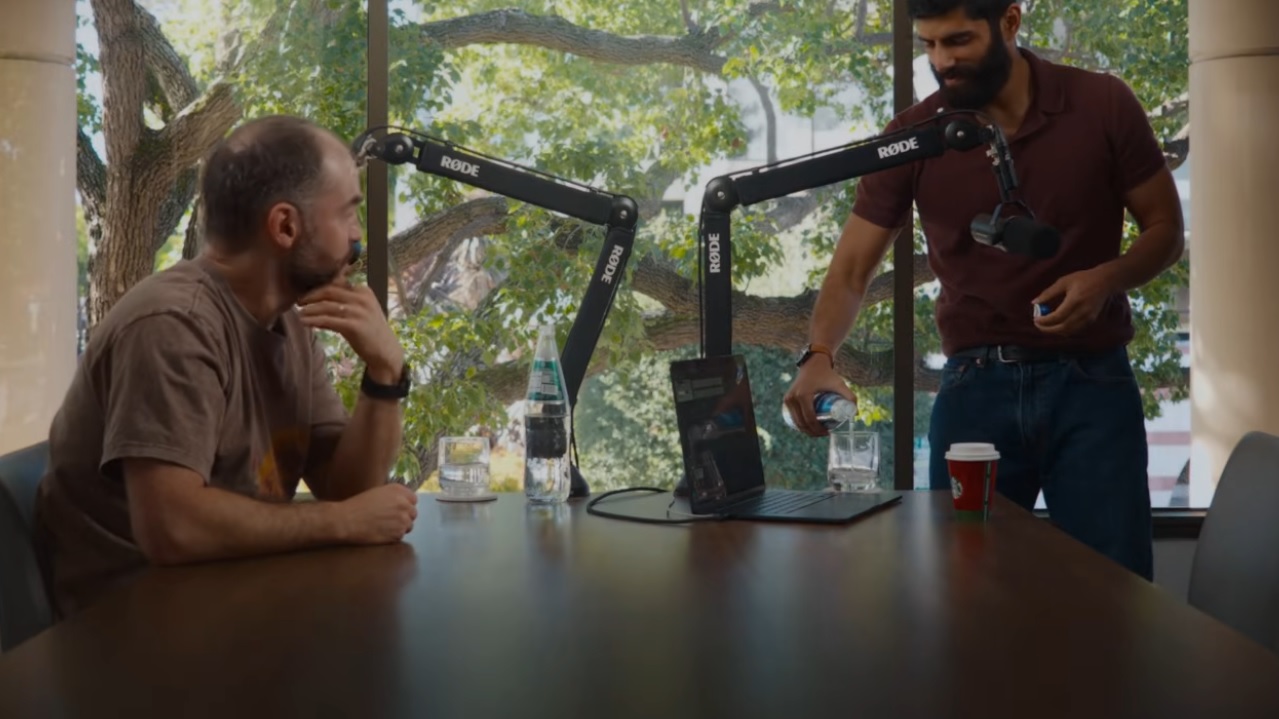
The future of artificial intelligence is at a pivotal crossroads. In a compelling discussion, OpenAI co-founder Ilya Sutskever sat down with influential podcaster Dwarkesh Patel to dissect the evolution of AI, its current limitations, and the revolutionary path ahead. This insightful conversation, capturing the minds of tech leaders and enthusiasts alike, reveals that the AI industry is moving beyond mere “scaling” to a new “Age of Research” driven by fundamental breakthroughs. Understanding these shifts is crucial for anyone navigating the rapidly evolving landscape of AI.
The Unlikely Rise of Silicon Valley’s Premier AI Interviewer
Dwarkesh Patel, a 23-year-old visionary behind “The Lunar Society” podcast, has swiftly become one of Silicon Valley’s most respected interviewers. Just three years ago, while a computer science student at the University of Texas at Austin, Patel launched his podcast from a dorm room. Lacking initial connections or institutional backing, his journey began with a bold cold email to economist Bryan Caplan during the 2021 COVID lockdowns. This singular act sparked a word-of-mouth phenomenon within intellectual circles, catapulting him into the global spotlight.
From Dorm Room to Global Influence
Patel’s influence is now undeniable. His guest list reads like a who’s who of global thought leaders, featuring titans such as Jeff Bezos, Marc Andreessen, Mark Zuckerberg, Satya Nadella, and even former UK Prime Minister Tony Blair. Noteworthy AI pioneers like OpenAI’s Ilya Sutskever and DeepMind’s Demis Hassabis have also graced his platform. Bezos has publicly praised Patel’s essays as “thoughtful and thought-provoking,” while his interview with Anthropic CEO Dario Amodei was even entered into the congressional record. This rapid ascent underscores his unique ability to engage with and extract profound insights from the world’s most innovative minds.
The Secret to Dwarkesh Patel’s Deep Dive
What sets Patel apart is his unparalleled dedication to preparation. Unlike many podcasters who spend a day on research, he commits a week or more to each guest. For an AI expert like Demis Hassabis, this might involve reading most of DeepMind’s recent papers and consulting a dozen other AI researchers. He sometimes even implements technical concepts from academic papers himself before an interview. This rigorous, intellectual approach allows him to steer conversations beyond superficial talking points, earning him the moniker “Lex Fridman but better” among tech insiders. Operating from a “perfect intermediate zone,” Patel is knowledgeable enough to challenge experts while also translating complex ideas for a broader audience, making him an indispensable part of AI’s intellectual infrastructure.
Ilya Sutskever’s Radical Vision: Beyond Scaling
At the heart of Ilya Sutskever’s critique lies a provocative argument: the primary bottleneck in AI development has fundamentally shifted. The industry’s pervasive reliance on “scaling” – creating bigger models, using more data, and allocating massive computational budgets – is reaching its limits. Sutskever contends this focus is now hindering genuine progress towards artificial general intelligence (AGI).
The “Jaggedness” Problem in AI
Sutskever highlights a critical inconsistency in current AI systems, particularly large language models (LLMs). While they often excel on standardized tests, their real-world economic impact and robustness are dramatically lacking. He terms this “jaggedness,” where highly competent models can inexplicably fall into basic error loops. For instance, an AI might introduce a new bug, then endlessly cycle between reintroducing the first and second bugs. This fragility points to a fundamental flaw in how these models generalize, suggesting they’re not truly “learning” in a human sense.
Why Current AI Falls Short: RL Tunnel Vision & Evaluation Traps
This fragility, according to Sutskever, stems from two interconnected issues. First, reinforcement learning (RL), a common training method, can make models overly single-minded and narrowly focused, preventing broader awareness. Second, as high-quality pre-training data becomes scarce, companies meticulously define RL training environments. This risks models becoming optimized to ace specific tests rather than developing true general skills. It’s like a student who practices for 10,000 hours for a competitive programming contest but struggles with broader problem-solving scenarios, lacking genuine versatility.
The Human “Value Function” as the Key to Generalization
Sutskever argues that human beings exhibit “better machine learning, period.” Humans demonstrate superior generalization and sample efficiency, even in domains like coding or mathematics. The crucial difference, he posits, lies in the human “value function” – an integrated system that instinctively evaluates whether an intermediate step in a process is good or bad, guiding efficient learning. In humans, this value function is inextricably linked to emotions, which evolution has hardcoded to provide critical guidance. AI systems, currently lacking such an integrated, emotion-modulated value function, struggle to self-correct and learn efficiently from limited samples, leading to their “jaggedness.”
The Age of Research: A New AI Paradigm Dawns
Sutskever declares that the “age of scaling,” roughly from 2020 to 2025, is concluding. This period, where increased data and compute almost guaranteed progress, is now giving way to the “age of research.” Here, the discovery of new fundamental ideas is paramount. He asserts that simply increasing scale by 100x will not fundamentally transform AI. The dominance of scaling has “sucked out all the air in the room,” leading to a homogeneity of research efforts, which now must diversify.
AGI: Gradual Ascent or Rapid Acceleration?
The path to AGI remains a subject of intense debate among experts. While Sutskever envisions a transitional “AI-as-airplanes” stage that is economically valuable for “a good multiyear chunk of time,” others offer varied timelines. Microsoft CEO Satya Nadella, a guest on Dwarkesh Patel’s podcast, predicts a “slow takeoff” for AGI, foreseeing significant legal and societal challenges before full integration. Conversely, insiders like former OpenAI researcher Leopold Aschenbrenner warn of an “intelligence-feedback loop” where AIs make AIs smarter, leading to extremely rapid advancement and even predicting AGI by 2030 or sooner. The consensus among many insiders from Patel’s “The Scaling Era” interviews points to AI improving with “surprising speed,” leading to widespread automation of cognitive labor.
The Geopolitical Stakes of AI’s Future
The implications of this shift are profound, extending beyond technical advancements to geopolitical competition and societal readiness. Experts like Aschenbrenner envision scenarios where a country gaining an AI lead could be militarily decisive, potentially leading to threats of nuclear retaliation to protect or target data centers on the verge of creating “superintelligence.” These are not merely scientific concerns but urgent “political matters” concerning the “degrees of technological acceleration” we are willing to accept.
Defining Our AI Future: A Call to Collective Action
The rapid progression of AI demands a societal reckoning. The New Yorker article, “Are We Taking A.I. Seriously Enough?”, underscores a prevalent struggle to grasp AI’s profound implications beyond the technical community. The author describes a personal “Aha!” and “uh-oh” moment, witnessing ChatGPT’s “street smarts” in a complex real-estate negotiation, highlighting AI’s immediate, tangible real-world impact. While anti-hype suggests AI will plateau, experts like Sutskever and those interviewed by Patel present a different picture: a future defined by decisive AI systems that will reshape our world.
Beyond the Algorithm: The Human Imperative
The debate surrounding AI’s future is currently dominated by technical experts. However, their values and worldviews, while brilliant, are not necessarily universal. Sutskever’s belief that AI could help humans find meaning and become “more enlightened” or “better on the inside” prompts a crucial question: should this particular worldview define humanity’s “North Star” for AI? The time for broader, humanistic intellectual work across disciplines—politics, economics, psychology, art, religion—is rapidly diminishing. It is imperative for civil society to engage actively, defining what we want and don’t want from AI. Otherwise, the future will be shaped solely by those focused on the technology’s functionality and speed, potentially at the cost of collective human values.
Frequently Asked Questions
What is Ilya Sutskever’s main critique of current AI development?
Ilya Sutskever, co-founder of OpenAI, argues that the AI industry’s overreliance on “scaling”—developing larger models with more data and compute—has reached its limits. He contends that this approach is no longer leading to genuine breakthroughs towards general intelligence. Instead, he highlights issues like “jaggedness” in AI performance, where models are robust in tests but fragile in real-world applications. Sutskever believes the core bottleneck has shifted to the generation of new, fundamental machine learning ideas rather than just increasing scale.
How did Dwarkesh Patel become a prominent AI interviewer in Silicon Valley?
Dwarkesh Patel, a 23-year-old podcast host, rose to prominence through his rigorous preparation, intellectual curiosity, and bold networking. He began “The Lunar Society” podcast from his dorm room with no connections, sending a cold email to economist Bryan Caplan. His in-depth research, often spending a week or more preparing for each interview, impressed top minds. This led to word-of-mouth recommendations, attracting influential guests like Jeff Bezos, Satya Nadella, and Ilya Sutskever. He’s known for driving conversations beyond superficial talking points, acting as a crucial interlocutor between experts and the public.
What are the key implications of the shift from the “Age of Scaling” to the “Age of Research” for AI’s future?
The shift from the “Age of Scaling” to the “Age of Research,” as described by Ilya Sutskever, means that future AI progress will depend more on discovering new, fundamental machine learning principles rather than simply increasing computational power or data. This implies a potential diversification of research efforts beyond a singular focus on scaling. It also suggests that the path to Artificial General Intelligence (AGI) will require breakthroughs in generalization and a deeper understanding of human-like “value functions.” For industry, this may mean a focus on foundational innovation over pure compute investment, potentially ushering in a period of rapid technological acceleration with significant economic and geopolitical consequences, as AIs become more adept at creating even smarter AIs.
The Unfolding Narrative of AI
The conversation between Dwarkesh Patel and Ilya Sutskever offers a crucial roadmap for understanding AI’s next chapter. It’s a shift from the predictable gains of brute-force scaling to the exciting, yet uncertain, quest for entirely new principles. This “Age of Research” demands not only technological brilliance but also a proactive, collective human effort to define our values and shape the trajectory of a technology poised to redefine our existence. The insights shared by these two influential figures underscore the urgency of engaging with these complex questions, ensuring that AI’s next frontier serves humanity’s best interests.