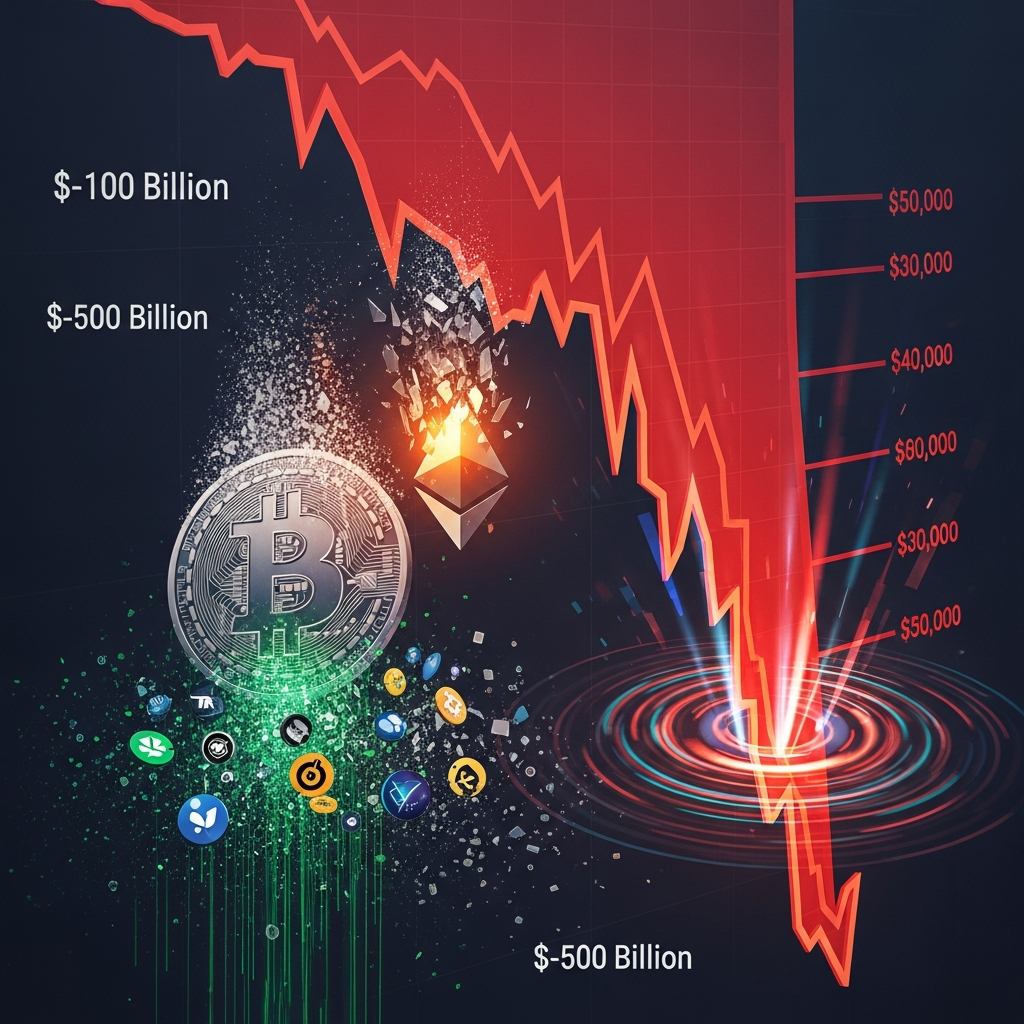
The cryptocurrency market recently endured a devastating downturn, seeing billions of dollars vanish within days. This significant crypto plunge sent shockwaves across the digital asset ecosystem, leading to sharp price corrections for major cryptocurrencies like Bitcoin and Ethereum. The widespread sell-off has intensified debates about crypto’s role as a long-term asset and the inherent volatility of the market. Investors are now questioning the future trajectory of digital assets amidst an environment of global economic uncertainty and geopolitical shifts.
A Massive Crypto Plunge: Billions Erased Overnight
The crypto market experienced an accelerating nosedive, with global market capitalization shedding an estimated $1.2 trillion in just over five weeks. This significant crypto plunge was abrupt and far-reaching. Bitcoin, the leading cryptocurrency, alone saw nearly $800 billion in value evaporate from its peak. This single asset lost over a third of its value since reaching an all-time high in October. The drastic losses affected virtually every corner of the market, including major altcoins. This event ranks as one of the sharpest single-day drops in recent history for digital assets.
Bitcoin’s price dipped as low as $81,919, per CoinGecko data, marking its lowest level since April. This decline put Bitcoin on track for its worst monthly performance since 2022. During that earlier period, the crypto sector faced widespread corporate collapses. Ethereum, not immune to the market turmoil, crashed below the critical $4,000 mark. It saw a drop of over 10% in 24 hours. The downturn also hit other leading altcoins severely, with BNB, XRP, Solana, and even memecoins like Dogecoin recording double-digit losses.
Decoding the Triggers: Why the Market Crashed
Several converging factors fueled this dramatic crypto plunge, painting a complex picture for investors. Understanding these catalysts is crucial for comprehending the market’s fragility. The sudden collapse wasn’t a singular event but a confluence of economic, political, and technical pressures.
Geopolitical Tensions Spark Panic
A significant trigger for the widespread panic came from an unexpected source: international trade policy. President Trump’s announcement of a 100% tariff on all Chinese imports, slated for November 1st, immediately rattled global risk assets. This news sent shockwaves through traditional stock markets and, in turn, the highly interconnected cryptocurrency market. Investors quickly moved to liquidate positions, fearing a renewed U.S.-China trade war. Such a conflict could lead to higher inflation and reduced global liquidity, making speculative assets like cryptocurrencies less attractive. Joshua Duckett, director of investigations at a crypto forensic firm, specifically highlighted these tariffs as a primary instigator of the sell-off.
Macroeconomic Headwinds and Wall Street Unease
Beyond tariffs, broader macroeconomic concerns added to investor apprehension. Wall Street showed growing unease over a potential bubble in artificial intelligence and tech stocks. This concern prompted investors to shift away from assets perceived as carrying higher risk. Cryptocurrencies, often viewed as risk-on assets, naturally fell victim to this cautious sentiment. Experts like Nic Puckrin, co-founder of The Coin Bureau, noted the strong correlation between tech stocks and Bitcoin. He stated, “When tech sneezes, it’s natural to expect Bitcoin to catch a cold.”
Further complicating the outlook was uncertainty surrounding the Federal Reserve’s interest rate decisions. Signs of weakness in the labor market led more economists to anticipate the Fed holding off on rate cuts. This added to general market apprehension, contributing to the flight from riskier investments. Gerry O’Shea of Hashdex Asset Management cited these uncertainties as key selling pressures.
The Avalanche Effect: How Leveraged Trading Exacerbated Losses
While tariffs and macroeconomic concerns provided the initial spark, the crypto market’s inherent structure amplified the losses. The pervasive use of leveraged trading within the industry played a critical role in turning a sharp decline into a full-blown liquidation cascade.
Understanding Margin Calls and Forced Liquidations
Leveraged trading allows investors to magnify their exposure to assets using borrowed funds. Platforms often offer significant leverage, sometimes as high as 10-to-1 or even 100-to-1 in the crypto space. While this can amplify gains, it equally exacerbates losses. Even a modest price drop in the underlying asset can trigger an outsized loss. When an investor’s position falls below a certain threshold, the trading platform issues a “margin call.” If the investor cannot meet these additional margin requirements, the platform automatically liquidates their position to cover the borrowed funds.
Nigel Green, CEO of deVere Group, explained this mechanism: “When traders borrow heavily to magnify positions, any reversal triggers liquidations that accelerate the move.” This creates a “spiral of cascading liquidations,” as Duckett described. As more positions are forcibly closed, it adds immense selling pressure to the market. This pushes prices even lower, triggering further liquidations in a rapid, self-reinforcing downward cycle.
Billions in Liquidations: A Snapshot
The scale of these liquidations during the recent crypto plunge was staggering. According to CoinGlass data, over $1.1 billion worth of leveraged trading positions were wiped out in a short period. Ether long positions were particularly hard hit, accounting for over $400 million in liquidations. Bitcoin positions also saw substantial closures, totaling $265 million. This “leverage flush” highlights the extreme volatility inherent in highly leveraged markets.
Bitcoin’s Tumultuous Journey and Altcoin Contagion
The crypto market operates 24/7, unlike traditional stock exchanges. This continuous operation allows for immediate and extreme reactions to adverse news. The recent downturn saw Bitcoin’s price tumble significantly. It breached critical support levels and fell below $90,000 for the first time in seven months. This erased a substantial portion of its year’s gains.
Ethereum and Other Major Altcoins Follow Suit
The contagion quickly spread to the altcoin market. Ethereum’s fall below its 50-day Simple Moving Average (SMA) and a critical support level at $4,356 confirmed a strong bearish reversal. It briefly touched a low near $3,436. Solana also experienced a sharp decline, falling below $200. BNB, XRP, and TRON all recorded significant double-digit losses. Even top memecoins like Dogecoin saw plunges exceeding 25%, underscoring the widespread nature of the crash. Publicly traded companies with significant crypto exposure, such as MicroStrategy, also saw their stock sink, hitting five-month lows.
Expert Perspectives: Correction or Prolonged Bear Market?
The intense crypto plunge has naturally sparked a heated debate among analysts: is this merely a temporary market correction, or the beginning of a prolonged bear market cycle? Both optimistic and cautious viewpoints offer insights into the potential future of digital assets.
The Optimistic Outlook: Temporary Headwinds and Buying Opportunities
Some experts view the current downturn as a normal, albeit sharp, correction within a broader bullish trend. Brian Vieten, a research analyst at Siebert Financial, points out that Bitcoin has historically experienced approximately five corrections of 20-30% or more during bull markets. He suggests these issues might be “temporary headwinds.” Many investors may even view lower crypto prices as an attractive buying opportunity.
Bernstein analysts offer a more optimistic outlook, suggesting this situation might be a short-term consolidation. They anticipate a ‘new local bottom’ rather than the severe 60-70% drawdowns seen in previous cycles. They cite increased ETF adoption by institutional investors as a sign of ‘higher quality and consistent ownership’ of Bitcoin. Furthermore, supportive political signals, like the Trump administration’s favorable stance on cryptocurrencies and the progress of the Clarity Act legislation, are seen as positive long-term drivers. Michael Saylor, CEO of MicroStrategy, reinforced this confidence by purchasing an additional 8,178 BTC tokens for $835 million during the dip.
The Cautious View: Maximum Caution and Macro Risks
Conversely, other experts advocate for “maximum caution.” 10X Research attributes the market’s fragility to weakened buyer appetite since early October and the Federal Reserve’s hawkish monetary policy. They align with independent indicators suggesting this is a moment for significant prudence. 10X Research also warned of a potential “liquidation cascade” if Bitcoin fell below $93,000, a scenario that played out in parts of the market.
Peter Chung, head of Presto Research, highlights that Bitcoin’s price pressure aligns with that of other risk assets. He also suggests that its downside could be exacerbated by “thinner” order books, impacting numerous market makers. Thomas Chen, CEO of Function, encapsulates the prevailing uncertainty by remarking, “The future is uncertain. It almost feels like it’s moving back to the question: do I even want to hold [bitcoin] in this environment?”
Navigating Crypto Volatility: Essential Advice for Investors
The recent crypto plunge serves as a stark reminder of the inherent volatility and risks associated with digital asset investments. While the market remains unpredictable, several fundamental principles can help investors navigate these turbulent waters.
First, never invest more than you can afford to lose. This timeless advice is particularly critical in the highly speculative crypto market. Price swings can be dramatic, and rapid losses are a genuine possibility.
Second, thoroughly research what you are investing in. Understanding the technology, use case, and market dynamics of any cryptocurrency is paramount. Don’t rely solely on hype or social media trends.
Third, consider the long-term perspective. While short-term fluctuations can be alarming, historically, Bitcoin has rebounded from significant corrections. Long-term investors often adopt a “hodl” strategy, holding assets through market cycles.
Finally, exercise caution with leveraged trading. While it offers the potential for magnified gains, the risks of forced liquidations and accelerated losses are substantial. Most experts advise against high leverage, especially for novice investors.
Frequently Asked Questions
What caused the recent massive crypto market crash?
The recent crypto market crash, or crypto plunge, was triggered by a combination of factors. Key drivers included President Trump’s announcement of new tariffs on Chinese imports, sparking fears of a trade war and reduced global liquidity. Wall Street’s growing unease over a potential AI and tech stock bubble led investors to shift away from risky assets. Furthermore, uncertainty around Federal Reserve interest rate decisions and weaknesses in the labor market contributed to broader market apprehension. The severity of the crash was significantly exacerbated by cascading liquidations from highly leveraged trading positions.
Where did Bitcoin and Ethereum prices fall during the market downturn?
During the recent crypto plunge, Bitcoin’s price plummeted as low as $81,919, reaching its lowest level since April and wiping out nearly $800 billion from its peak value. Ethereum experienced a significant crash, falling below the $4,000 mark for the first time in weeks, settling around $3,900 after briefly hitting a low near $3,436. Other major altcoins like Solana, BNB, XRP, and Dogecoin also saw substantial double-digit losses, with Solana falling below $200 and BNB dropping over 13%.
Should investors consider buying during a crypto market plunge?
Whether to buy during a crypto market plunge is a complex decision with divided expert opinions. Some analysts view significant corrections as “temporary headwinds” and potential “buying opportunities,” citing Bitcoin’s historical ability to rebound from sharp downturns. They suggest the current weakness could be an attractive entry point for new investors. However, other experts advocate for “maximum caution,” highlighting weakened buyer appetite, hawkish macroeconomic policies, and the potential for further liquidation cascades. Investors are advised to never invest more than they can afford to lose and to conduct thorough research, weighing the long-term potential against short-term volatility and macroeconomic risks.
The Road Ahead: Navigating an Unpredictable Landscape
The recent crypto plunge underscores the dynamic and often unpredictable nature of the digital asset market. While the immediate future remains uncertain, the long-term outlook continues to be a subject of intense debate among experts. The interplay of global politics, macroeconomic trends, and technological adoption will undoubtedly shape the trajectory of Bitcoin, Ethereum, and the broader altcoin ecosystem. For investors, vigilance, informed decision-making, and a clear understanding of risk tolerance are more crucial than ever in this evolving financial frontier.