A groundbreaking discovery has sent ripples through the astrophysics community. Scientists have detected an unprecedented “chirp” in the light of an exploding star. This signal offers profound new insights. It may finally unlock the immense power source behind the Universe’s most brilliant cosmic explosions. This finding provides the clearest evidence yet for a long-debated theory involving magnetars. These mysterious objects are now believed to fuel superluminous supernovae (SLSNe). This landmark observation also offers a rare opportunity. It allows us to test Albert Einstein’s General Relativity in extreme cosmic environments.
Unraveling the Mystery of Superluminous Supernovae
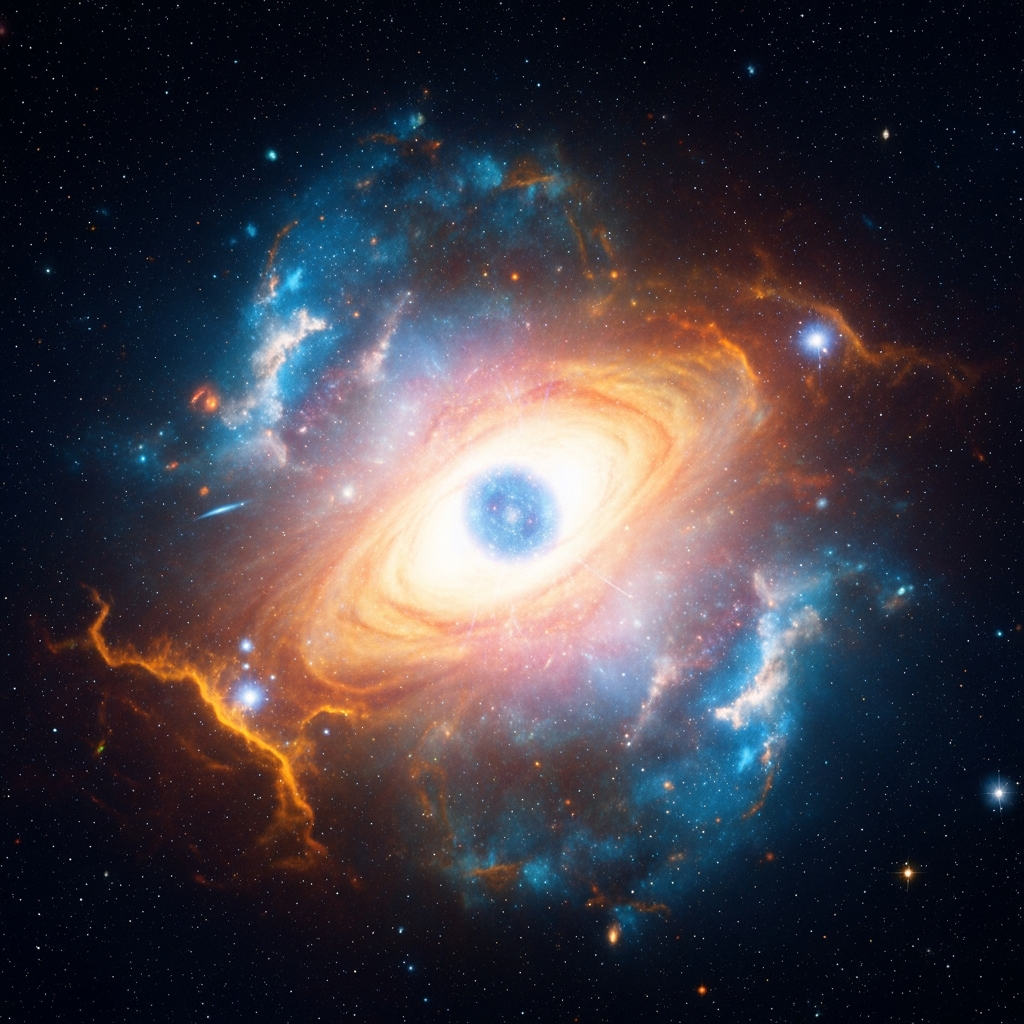
Superluminous supernovae are true titans of the cosmos. These stellar explosions are astonishingly powerful. They shine up to 100 times brighter than a typical supernova. Their extreme luminosity has long puzzled astronomers. Unlike standard supernovae, which follow a predictable pattern of brightening and fading, SLSNe exhibit an unusual light curve. This curve features a series of distinctive “bumps” or undulations. Scientists theorized that newly formed, rapidly spinning magnetars might power these events. Magnetars are incredibly dense neutron stars with extraordinarily powerful magnetic fields. As a newborn magnetar’s spin decreases, it transfers vast energy to the expanding supernova ejecta. This energy is then re-emitted as light. While this model explained the extreme brightness, it failed to account for the perplexing “bumps” in the light curve. The exact mechanism behind these fluctuations remained a major cosmic mystery.
A ‘Chirp’ Heard Across Billions of Light-Years: SN 2024afav
The turning point came with the observation of SN 2024afav. This particular superluminous supernova was located over a billion light-years from Earth. Astronomers meticulously monitored its changing brightness for months in 2024. A global network of telescopes facilitated this sustained observation. The ATLAS survey initially detected the supernova’s flash. Later, the Las Cumbres Observatory (LCO) network provided over 200 days of continuous data. Joseph Farah, an astrophysicist at Las Cumbres Observatory in the US, led the research team.
Farah and his colleagues noticed the characteristic brightness “bumps” of an SLSN. However, something else stood out. These variations were not random. They followed a highly structured, wave-like rhythm. Crucially, the interval between each bump progressively shrank. This meant the signal’s frequency was rapidly increasing over time. This unique pattern is what astronomers call a “chirp.” It’s a signal whose frequency intensifies as time progresses. This “chirp” was reminiscent of gravitational wave signals from colliding black holes. No existing supernova model could explain such an accelerating, quasi-periodic signal. Farah describes the signal as too structured to be due to random interactions.
Unpacking the “Chirp”: Lense-Thirring Precession
Farah drew inspiration from a General Relativity course to propose a novel explanation. He theorized that the supernova’s explosion left behind a rapidly spinning magnetar. This magnetar was the core engine. Some of the exploded stellar material didn’t escape. Instead, it fell back towards the nascent magnetar. This material formed a tilted accretion disk orbiting the powerful neutron star. This disk slowly spiraled inward.
The key to the “chirp” lies in a mind-bending effect predicted by Einstein’s theory. Due to the magnetar’s extreme density and incredibly rapid rotation, it warps the very fabric of spacetime around itself. This phenomenon is known as Lense-Thirring precession, or frame dragging. Imagine spinning a bowling ball rapidly in a vat of thick honey. The honey around the ball would be dragged along with its rotation. Similarly, the magnetar’s spin “drags” spacetime. This warped spacetime causes the tilted accretion disk to wobble. It behaves much like a spinning top that’s slightly off-axis.
Einstein’s Theory in Action: Frame-Dragging at the Extreme
As the tilted disk wobbles, it periodically obstructs or redirects some of the intense energy streaming from the magnetar. This energy would otherwise blast into the expanding supernova debris. This periodic blockage acts like a cosmic lighthouse. It creates the observed “bumps” in the light curve. What explains the “chirp”—the increasing frequency of these bumps? As the disk gradually falls inward, it gets closer to the magnetar. The frame-dragging effect becomes progressively stronger at these closer distances. Consequently, the disk wobbles faster. This accelerated wobble causes the brightness bumps to occur closer together over time. The result is the distinctive “chirp” signal that Farah’s team observed.
To validate this audacious hypothesis, Farah and theorist Logan Prust rigorously tested several alternative mechanisms. They considered purely Newtonian effects. They also explored precession driven by the magnetar’s powerful magnetic fields. Their meticulous analysis yielded a clear result: only Lense-Thirring precession could perfectly match the precise timing of the signal. It also matched the rate at which its period changed. “It is the first time general relativity has been needed to describe the mechanics of a supernova,” Farah explains. This marks an extraordinary application of Einstein’s century-old theory to a contemporary cosmic phenomenon.
Beyond Brightness: Unifying the Superluminous Supernova Model
This discovery is more than just an explanation for a strange signal. It provides strong, compelling evidence. It confirms that magnetar spin-down truly powers superluminous supernovae. Moreover, it finally resolves the long-standing mystery of the “bumps” in their light curves. Astrophysicists now have a much stronger framework. They can use it to analyze and understand these extreme cosmic explosions.
Andy Howell, Farah’s advisor, described the finding as the “smoking gun.” It elegantly unifies the puzzling brightness fluctuations with the magnetar model. This unification is entirely explained by General Relativity. This means that observations of these distant, violent stellar deaths can now serve a dual purpose. They help us understand stellar evolution. They also become laboratories for testing the fundamental laws of physics.
Far-Reaching Implications for Astrophysics and General Relativity
The implications of this “chirp” discovery extend far beyond merely understanding supernovae. It suggests that violent cosmic events like these offer a brand new regime. They allow scientists to test General Relativity at the very limits of physics. Magnetars represent some of the densest and most rapidly spinning objects in the universe. Their extreme environments provide unparalleled conditions to observe Einstein’s theories in action. This research opens up entirely new avenues for fundamental physics.
Farah expressed profound personal excitement about the discovery. “This is the most exciting thing I have ever had the privilege to be a part of. This is the science I dreamed of as a kid,” he said. He views it as the Universe’s direct challenge to our current scientific understanding. “It’s the Universe telling us out loud and in our face that we don’t fully understand it yet, and challenging us to explain it.” This groundbreaking research was published in the prestigious scientific journal Nature. Future observatories, such as the Vera C. Rubin Observatory, are anticipated to detect many more “chirping” supernovae. This will further unveil the complex and fascinating mechanisms of our universe.
Frequently Asked Questions
How does a “chirp” in a supernova’s light reveal its power source?
A “chirp” in a supernova’s light refers to a signal where periodic brightness fluctuations occur closer together over time, meaning their frequency increases. In the case of SN 2024afav, this chirp indicated the violent birth of a rapidly spinning magnetar. As material falls back towards this magnetar, it forms a tilted accretion disk. The magnetar’s intense spin warps spacetime around it, an effect called Lense-Thirring precession. This causes the disk to wobble like a spinning top. This wobble periodically blocks the magnetar’s energy, creating brightness “bumps.” As the disk spirals inward, the frame-dragging effect strengthens, making it wobble faster and producing the observed “chirp.”
Why are superluminous supernovae (SLSNe) so much brighter and puzzling than regular supernovae?
Superluminous supernovae (SLSNe) are exceptionally powerful stellar explosions, shining 10 to 100 times brighter than typical supernovae. Their immense brightness is theorized to come from a newly formed, rapidly spinning magnetar. This magnetar injects vast amounts of energy into the surrounding supernova ejecta as its spin slows down. What made them puzzling were the mysterious, undulating “bumps” in their light curves, which existing magnetar models couldn’t explain. The recent discovery of the “chirp” and its link to Lense-Thirring precession in SN 2024afav finally provides a comprehensive explanation for both their extreme brightness and these characteristic fluctuations.
What are the broader implications of this “chirp” discovery for physics and future astronomical research?
This “chirp” discovery has profound implications. Firstly, it provides robust observational evidence confirming that magnetar spin-down powers superluminous supernovae, unifying a long-debated model. Secondly, it marks the first time General Relativity’s Lense-Thirring precession has been directly observed in the extreme environment of a magnetar during a supernova. This positions violent cosmic events as new laboratories for testing Einstein’s theory at the limits of physics. For future astronomical research, it identifies a novel type of observable behavior in stellar explosions, paving the way for further discoveries as observatories like the Vera C. Rubin Observatory begin to detect more “chirping” supernovae, expanding our understanding of the universe’s most energetic phenomena.
Conclusion
The detection of a distinctive “chirp” from superluminous supernova SN 2024afav represents a monumental leap forward in astrophysics. It provides direct, observational evidence linking these powerful cosmic explosions to the violent birth of magnetars. Moreover, it beautifully demonstrates Einstein’s General Relativity in action, specifically the Lense-Thirring precession. This finding not only solves a long-standing cosmic mystery regarding the perplexing brightness “bumps” in SLSNe but also opens exciting new avenues. It allows scientists to explore the fundamental laws of physics in the most extreme environments the Universe has to offer. Joseph Farah and his team have not just observed a distant explosion; they have listened to the Universe’s challenge, and in doing so, brought us closer to understanding its deepest secrets.