Humanity’s understanding of the cosmos just took two monumental leaps forward. In groundbreaking observations, astronomers have peeled back billions of years of mystery to witness the precise “time zero” of planet formation around a distant star. Simultaneously, another team has captured the unprecedented quiet collapse of a massive star directly into a black hole, without the spectacular flash of a supernova. These dual discoveries, powered by advanced telescopes like the James Webb Space Telescope (JWST), ALMA, and NEOWISE, are profoundly reshaping our models of how planetary systems begin and how giant stars end their lives. They offer a rare glimpse into the universe’s most dramatic acts of creation and ultimate demise.
The Cosmic Nursery: Witnessing Planet Formation’s “Time Zero”
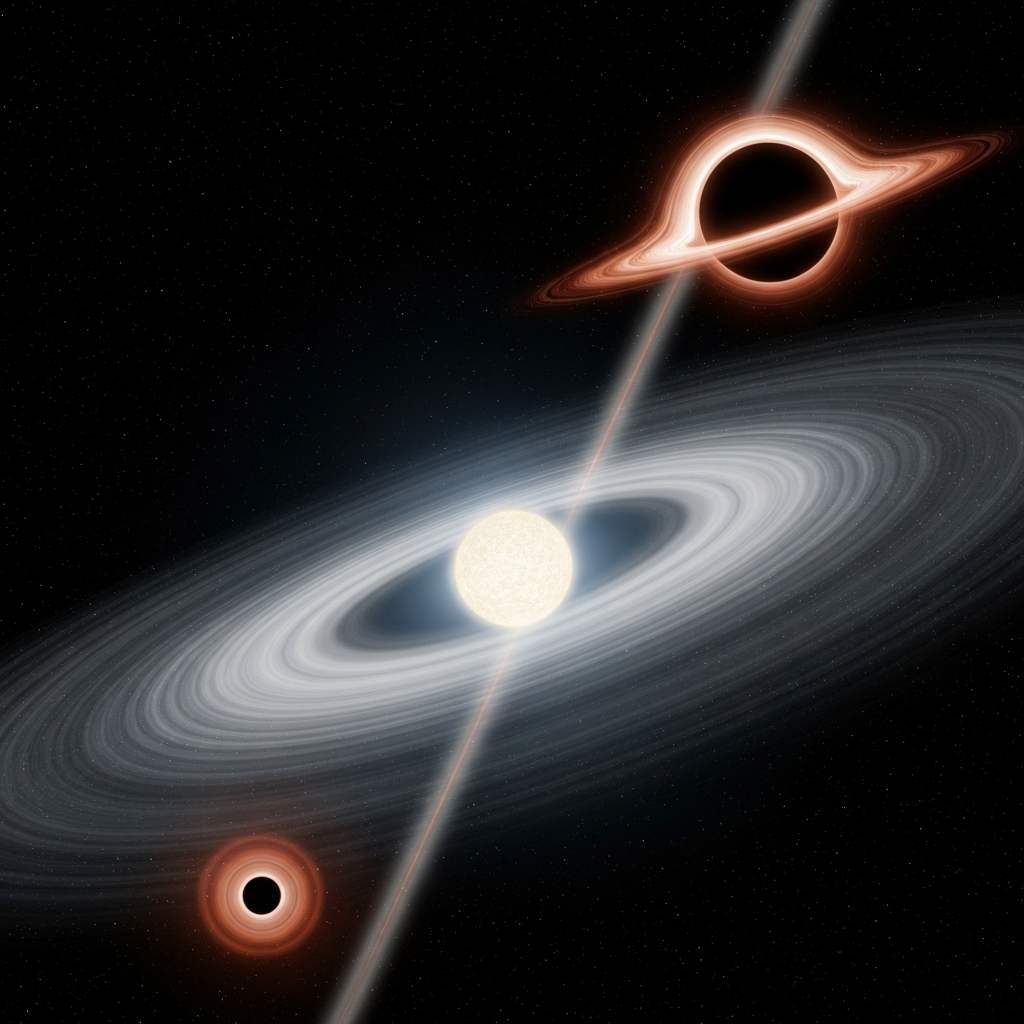
For generations, the birth of planets remained largely theoretical, pieced together from ancient meteorites and indirect observations. Now, an international research team, led by Melissa McClure of Leiden Observatory, has achieved a critical breakthrough: they’ve directly observed the earliest moments of planet formation around a young star named HOPS-315. Located approximately 1,300 to 1,400 light-years away in the constellation Orion, this protostar, with about 0.6 solar masses, offers a unique analogue for studying the nascent stages of our own solar system.
This isn’t just seeing a dusty disk; it’s witnessing the fundamental first steps. Astronomers detected hot, gaseous silicon monoxide (SiO) actively condensing into solid, crystalline silicate minerals. These aren’t just any minerals; they’re identical to the calcium-aluminum-rich inclusions (CAIs) found in 4.567-billion-year-old primitive meteorites on Earth. CAIs are considered the oldest solid objects in our solar system, marking “time zero” for our planets’ genesis. Observing this process in action around HOPS-315 confirms long-held hypotheses about how the building blocks of planets first solidify from a swirling cloud of hot gas.
HOPS-315: A “Unicorn” Star Reveals Planetary Secrets
Why was HOPS-315 the lucky star to unveil this process? It’s a true astronomical “unicorn” target. Not only is it exceptionally young, estimated at only 100,000 to 200,000 years old, but its specific tilt relative to Earth offers a rare, direct view into its inner structures. This unique orientation allowed astronomers to bypass the thick, obscuring material that typically surrounds protostars and hides these crucial processes. Early observations by NASA’s Spitzer Space Telescope had flagged HOPS-315 as promising, but it lacked the resolution for detailed follow-up.
The game-changer came with the combined power of JWST and the Atacama Large Millimeter/submillimeter Array (ALMA). JWST, with its superior sensitivity and spectral resolution, provided the molecular “fingerprints” of gaseous silicon monoxide and crystalline silicates. These signals confirmed solid mineral grains condensing from hot gas as the protoplanetary disk cools. Subsequent ALMA observations in November 2023 were vital. They confirmed the mineral grains were indeed located within a specific region of the star’s disk, spanning twice the Earth-sun distance, an area comparable to our solar system’s main asteroid belt. This precise location strongly aligns with theoretical models predicting where CAIs would emerge at “time zero.”
The research also unearthed a curious anomaly: the outflowing jet from HOPS-315 is significantly depleted in silicon. Approximately 98% of the expected silicon, relative to carbon, is missing. Since silicon is a primary element for silicates – essential planet formation building blocks – lead author Melissa McClure speculates this silicon is being locked away. It could be forming vast reservoirs of dust or even larger rocky objects coalescing deeper within the disk. This observation hints that planetesimals, the precursors to planets, might already be forming around HOPS-315, much like they did in our own nascent solar system. The sheer quantity of crystalline silicates detected, roughly a tenth of the Moon’s mass, is sufficient to seed multiple rocky planets.
Beyond Birth: Unmasking the Quiet Death of Massive Stars
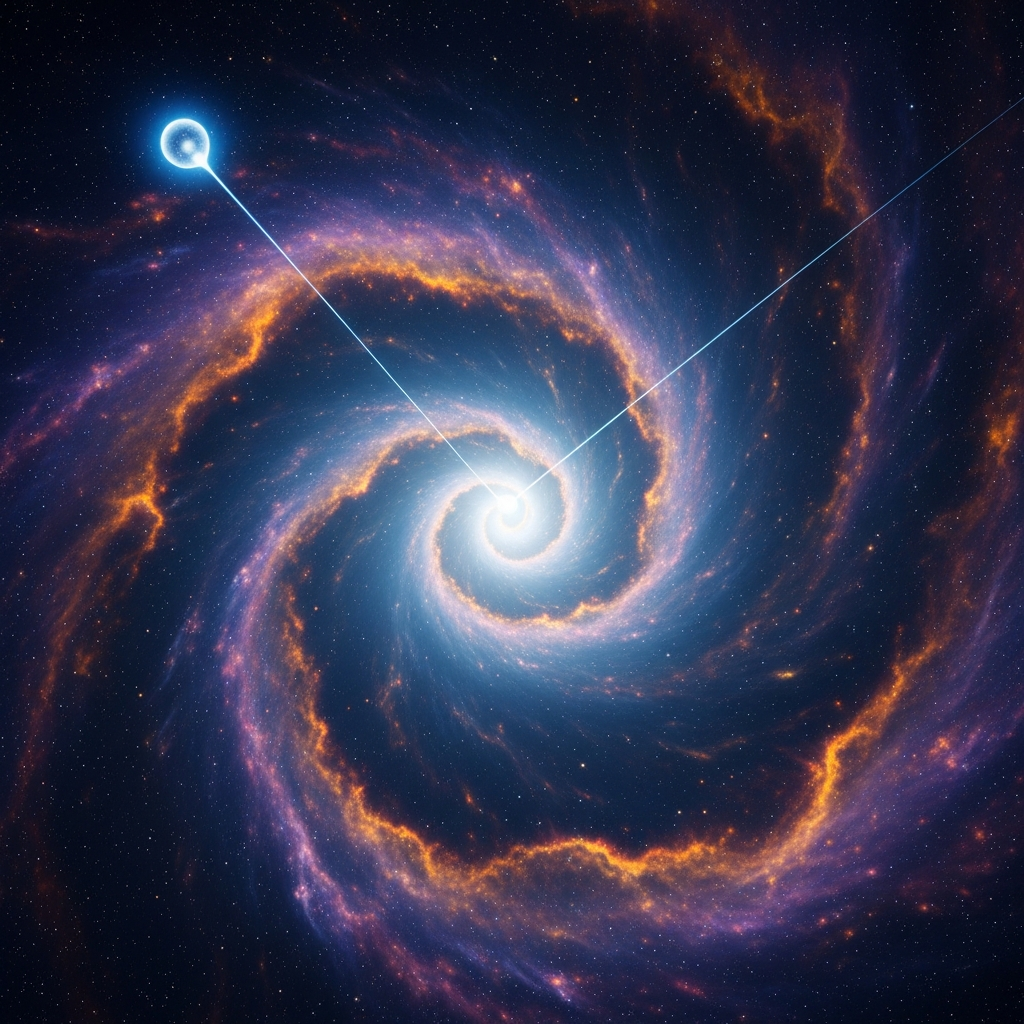
While one team peered into the cradle of creation, another unveiled a different cosmic drama: the silent demise of a giant star. Astronomers have for the first time directly observed a massive dying star collapse into a black hole without undergoing a supernova explosion. This remarkable event, involving a star named M31-2014-DS1, is located 2.5 million light-years away in the Andromeda Galaxy. Published in Science, these findings profoundly refine our understanding of how some of the universe’s most massive stars meet their end. They suggest this “failed supernova” mechanism might be a more common pathway to black hole formation than previously believed.
M31-2014-DS1 was meticulously monitored using data from NASA’s NEOWISE mission and other telescopes between 2005 and 2023. The observations revealed a peculiar sequence: the star brightened in infrared light in 2014, then dramatically dimmed by 2016. By 2022-2023, M31-2014-DS1 had virtually vanished in visible and near-infrared wavelengths, fading to a mere one ten-thousandth of its former luminosity. What remains is a persistent, reddish infrared glow, about one-tenth of its original intensity. This sustained, dramatic dimming, akin to a star like Betelgeuse suddenly disappearing, strongly indicated a core collapse directly leading to black hole formation. Lead author Kishalay De and his team at the Simons Foundation’s Flatiron Institute concluded this was a failed supernova.
Unpacking the “Failed Supernova” Mystery
Stars maintain their stability through a delicate balance between outward pressure from nuclear fusion and inward gravitational pull. When massive stars exhaust their nuclear fuel, gravity wins, causing the core to collapse. This collapse typically releases a flood of neutrinos, creating a powerful shock wave that tears the star apart in a supernova. However, theoretical models have long posited that if this shock wave is too weak, much of the star’s material falls back inward, transforming the nascent neutron star into a black hole. This observation of M31-2014-DS1 provides the most detailed evidence yet for this theoretical pathway.
A critical new insight from this research highlights the role of convection in dictating the fate of the star’s outer layers during such an event. Convection, driven by large temperature differences, causes gas to circulate within the star. Models developed at the Flatiron Institute suggest that when the core collapses, ongoing convective motion prevents most of the outer material from directly plunging into the new black hole. Instead, inner layers orbit the black hole, while outermost layers are gradually pushed outward. As this expelled material cools, it forms dust that blocks visible light from the hotter gas. This dust absorbs energy and re-emits it in infrared wavelengths, explaining the long-lasting reddish infrared glow now observable for decades by telescopes like the JWST.
Co-author Andrea Antoni elaborated that the angular momentum of this convective material forces it to circularize around the black hole. This leads to a much slower accretion rate, taking decades instead of months for material to fall in. This delayed infall means the entire star doesn’t collapse at once, creating a brighter and more prolonged dimming signal than a direct implosion. Researchers estimate that only about one percent of the star’s original outer envelope ultimately feeds the black hole, accounting for the faint light still observed today. The detailed study of M31-2014-DS1 also prompted a re-examination of a similar object, NGC 6946-BH1, bolstering confidence in this “failed supernova” category.
Rewriting the Cosmic Story: What These Discoveries Mean
These two unprecedented astronomical observations – the “time zero” of planet formation and the quiet black hole formation from a failed supernova – are fundamentally rewriting our understanding of the universe’s most dramatic processes. They highlight the incredible power of next-generation telescopes like JWST and ALMA to penetrate cosmic veils and reveal phenomena previously confined to theory. Edwin Bergin, an astronomer at the University of Michigan, called the planet formation discovery “unprecedented,” while Fred Ciesla from the University of Chicago described it as “one of the things we’ve been waiting for.”
The HOPS-315 observations confirm that the initial steps of planet building, the condensation of hot minerals into solid building blocks, are actively occurring in young stellar systems, likely a common process throughout the cosmos. This significantly boosts confidence in the prevalence of rocky planets, potentially including Earth-like worlds. The M31-2014-DS1 discovery, on the other hand, refines our models for stellar evolution and death, revealing a more diverse set of pathways to black hole formation. Both findings provide crucial benchmarks for future theoretical models and observational campaigns, opening new windows into the life and death cycles of stars and the birth of worlds.
Frequently Asked Questions
What does “time zero” of planet formation mean, and why is the HOPS-315 discovery significant?
“Time zero” refers to the absolute earliest stage of planet formation, specifically the moment when the first solid materials, like crystalline minerals, condense from a hot gaseous disk around a nascent star. The HOPS-315 discovery is significant because it’s the first time astronomers have directly observed this process outside our own solar system. Using the James Webb Space Telescope and ALMA, scientists saw hot gas (silicon monoxide) actively solidifying into planet-forming minerals (silicates) in a region equivalent to our solar system’s asteroid belt, confirming long-held theories based on meteorites from our own system.
How does the M31-2014-DS1 discovery change our understanding of black hole formation?
The M31-2014-DS1 discovery provides the most detailed evidence yet of a “failed supernova.” This is when a massive star collapses directly into a black hole without the explosive light show of a typical supernova. Previously, this was a theoretical concept. The star’s dramatic, sustained dimming in visible light, coupled with a lingering infrared glow, indicated that its core collapsed and much of its material fell inward to form a black hole, rather than being expelled in an explosion. This pathway suggests some black holes form more quietly than previously assumed, influenced by internal processes like convection.
What role did the James Webb Space Telescope (JWST) and ALMA play in these discoveries?
The JWST and ALMA were crucial to both discoveries. For HOPS-315, JWST’s high sensitivity and spectral resolution allowed it to penetrate the dusty cocoon around the protostar and identify the specific molecular fingerprints of hot gaseous silicon monoxide and crystalline silicates. ALMA then pinpointed the exact location of these condensing materials within the protoplanetary disk. For the black hole discovery, JWST is expected to monitor the long-lasting infrared glow from M31-2014-DS1, providing further data on the material slowly accreting onto the newly formed black hole, building on initial observations from missions like NEOWISE and other ground/space telescopes.
The universe continues to unveil its secrets, one groundbreaking observation at a time. As astronomers continue to probe these complex objects, the insights gained from HOPS-315 and M31-2014-DS1 will undoubtedly inspire further research. Future studies will likely revisit other promising protostars and dying giants, using the unparalleled capabilities of current and future telescopes to deepen our cosmic narrative. The journey to understand where we come from, and how the universe ultimately works, is only just beginning.